Last updated on September 30th, 2026.
If you are going to keep a fish, the humane and culinary goal is the same goal: instant brain death. The two methods that achieve it reliably are a sharp percussive blow to the brain with a priest or stunner, and ikejime, the Japanese technique of spiking the brain and then pithing the spinal column with a wire. Both are over in seconds. Both produce a better fillet than what you get from any other approach.
The default failure mode is putting a fish in a bucket, on a stringer, or in the bottom of a boat and letting it suffocate. That is neither humane nor good for the meat. A suffocating fish thrashes, dumps adrenaline and cortisol into its bloodstream, and burns through muscle glycogen on the way out. The flesh goes into rigor faster, holds more lactic acid, and loses both texture and flavor compared to a fish killed instantly. The ethical case and the meat-quality case point at the same technique.
This page covers the mechanism (why instant brain death matters), the two methods that deliver it, the post-kill bleed and chill, and the decision logic around when to keep a fish at all.
The mechanism: brain, spine, and stress chemistry
A fish’s brain sits in a small, well-defined location at the top of the skull, roughly above and slightly behind a line drawn between the eyes. In a trout or salmon-shaped fish, you can find it by tracing the lateral line forward and finding the soft spot just behind the eyes on top of the head. The brain itself is small relative to the body, but the target zone for a percussive blow or a spike is forgiving: a strike anywhere in the top-of-skull region with enough force will produce immediate concussive death. The spinal cord runs from the back of the brain down the length of the fish along the top of the vertebral column, just below the dorsal musculature.
Two things happen when you destroy the brain quickly. First, sensation stops. Whatever capacity for nociception the fish has, the receiving end of that signal is no longer functional. Second, the central nervous system stops issuing the stress cascade that begins the moment a fish is hooked and accelerates the moment it leaves the water. Cortisol and adrenaline production halts. The cardiovascular system slows. The fish goes from a metabolically active, stressed animal to a neutral biological system within seconds rather than minutes.
That window matters for the fillet. A stressed fish accumulates lactic acid in its white muscle as it fights and as it asphyxiates. Lactic acid drops the pH of the flesh. Lower-pH flesh enters rigor mortis faster, holds tighter rigor, and produces a firmer, drier, less flavorful piece of meat once rigor resolves. A fish that is killed instantly at the moment of landing enters rigor more slowly, holds it more softly, and resolves it into flesh that is closer to what a chef paying for boat-side ikejime tuna is paying for. The difference is not subtle. Anyone who has eaten a trout killed properly on a stream versus one that suffocated in a creel has tasted it.
One thing to know about fish nervous systems: a “dead” fish can still twitch, flex, and gill for minutes after the brain is destroyed. Those are spinal reflexes, not sensation. A fish doing a slow tail-flap on the rock after a clean priest strike is not partially conscious. It is a body running on stored spinal signal. Ikejime addresses this directly by adding a second step, pithing the spinal cord with a wire, which stops the reflex activity and slows the onset of rigor further still.
Percussive stunning with a priest
Percussive stunning is the field-practical method for most river and lake anglers. The tool is a priest, also called a stunner or a knocker, a short blunt instrument weighted at one end. Wooden priests with a brass-loaded head are the traditional design, often turned to fit the hand with a wrist lanyard. A heavy multitool, a section of hardwood from the bank, or a smooth river rock will do the same job in a pinch. What matters is enough mass behind the swing to deliver a single decisive blow.
The strike point is the top of the skull, between the eyes or just behind them. One firm swing, not a hesitant tap. A fish stunned correctly goes completely limp on the first blow. If the fish is still twitching with intention, swing again. A second strike is not a sign of failure, it is the correct response to insufficient force on the first. Aim slightly forward of where you would intuitively place the blow, since the brain sits further toward the eyes than most people guess.
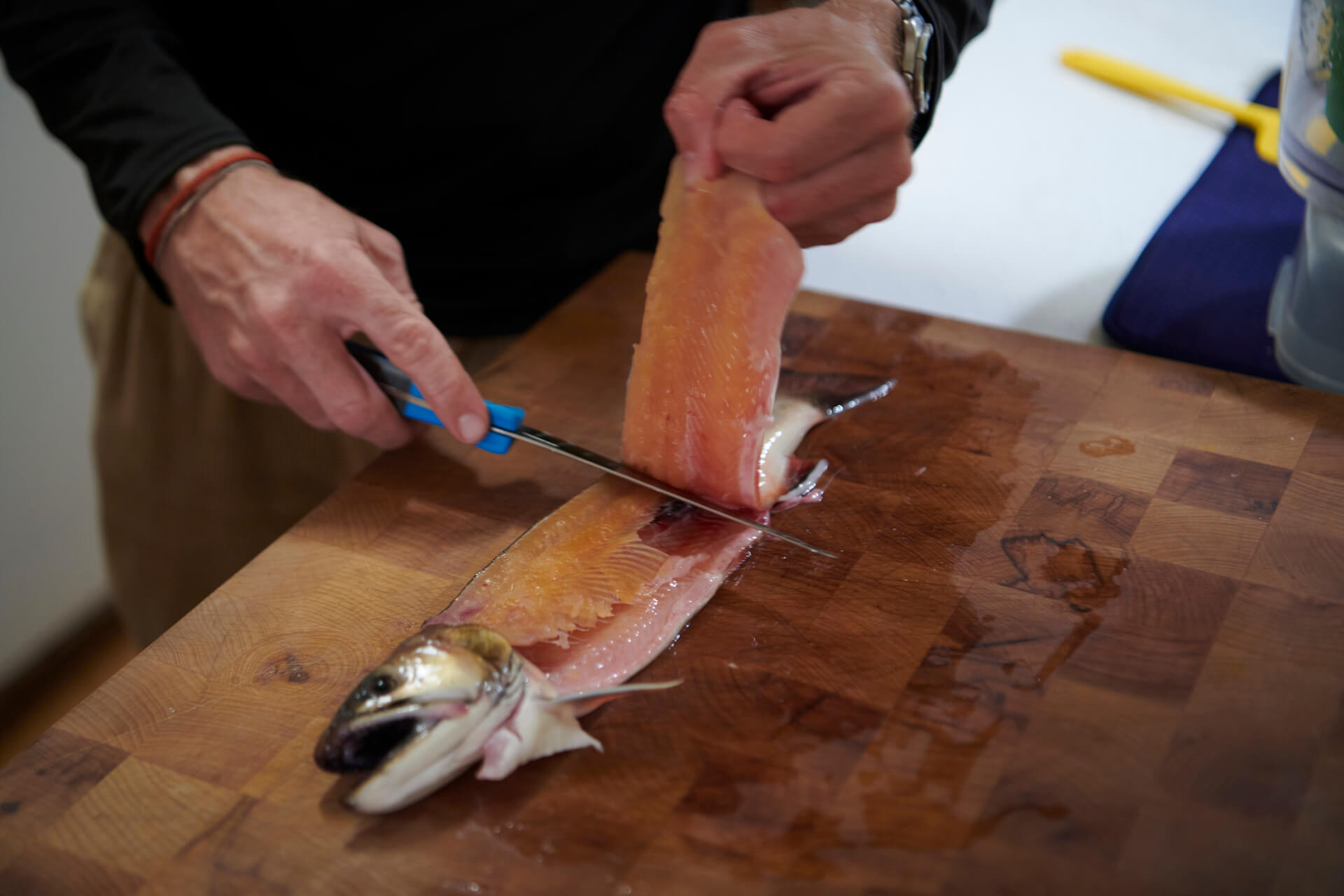
Follow the stun with a bleed cut. With the fish on its side, lift a gill cover and slice through the gill arches with the tip of a sharp knife. A blade in the best fillet knife category, kept stream-sharp, makes this a single clean cut. Cut all the way through the gill rakers on one side, deep enough to sever the ventral aorta where it runs along the floor of the throat. Blood will pump out cleanly if the heart is still functioning, which is the point: a beating heart that no longer has a brain attached will purge the circulatory system through the cut gills in under a minute. A fish bled this way produces noticeably whiter flesh and a longer shelf life on ice.
Percussive stunning is the right call when you are on the water with limited tools, when the fish is a reasonable size for handheld dispatch (trout, panfish, bass, smaller salmon, mackerel), and when speed matters more than maximum culinary refinement. It is the universal default for keepers in stream and lake fishing. Carry a priest. Use it.
Ikejime: the spike-and-pith method
Ikejime is the Japanese technique developed by commercial fishermen and refined by chefs. It produces the highest-quality fillet of any field-practical dispatch method, which is why high-end sushi sourcing pays a premium for ikejime-handled fish at the dock. The technique is two steps: spike the brain, then pith the spinal cord with a length of stiff wire.
Step one is the spike. The tool is a sharpened metal pick, usually a dedicated ikejime spike with a handle, though a sharp awl or a stout knife tip works. Locate the brain at the soft spot on top of the skull, just behind and between the eyes, and drive the spike through the bone in a single firm push. A successful spike produces an immediate full-body flex (the “ikejime flash”) followed by complete relaxation. The mouth opens, the fins drop, the color often shifts. That flash is the visual confirmation that the brain has been destroyed. If the fish does not flash and relax, the spike missed; reseat it slightly forward or back and push again.
Step two is the pith. A length of stainless steel wire, usually 50 to 80 cm depending on fish size, is fed into the channel above the spinal column. Entry is through the spike hole or through a fresh cut at the base of the skull. The wire goes in along the top of the spinal column, working it down the length of the fish toward the tail. The wire destroys the spinal cord as it goes, which stops the reflex twitching, prevents the spinal signaling that drives early rigor, and noticeably extends the time the flesh stays in its pre-rigor texture window. Some practitioners then make a small cut at the base of the tail and at the gills to allow the body fluids to drain, and chill the fish immediately in an ice slurry.
Ikejime is appropriate any time you have the tools and want the best possible fillet: trout for the table, kept salmon, larger bass, anything sized large enough to justify the technique. A pocket-sized ikejime kit (spike plus a coiled wire) fits in any vest. For someone working through fish on a boat dock, the technique is fast once practiced. For the rare keeper from a quality stream, it is the gesture of respect that matches the catch.
When to keep a fish, and which method applies
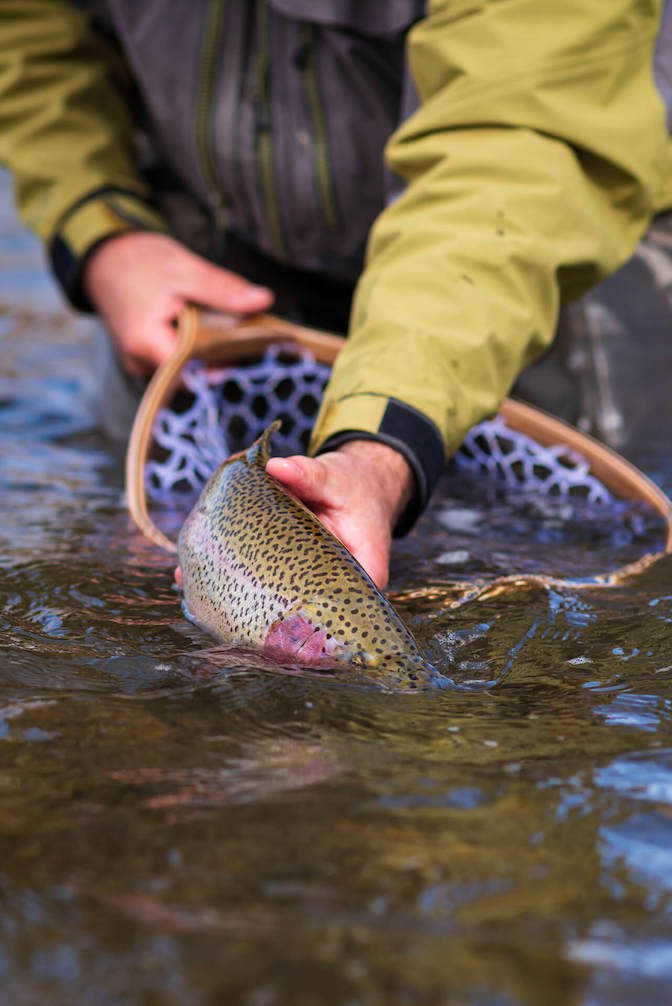
The first question on humane dispatch is whether to keep the fish at all. Catch and release is the default for most river fishing in trout and bass waters, especially on wild populations and in any fishery where regulations specify it. A fish you intend to release should never be lifted out of the water for long, should not be squeezed or handled with dry hands, and should be revived facing the current until it kicks off on its own. The kill question only arises if you have decided, before the fish is landed, that this is a fish you intend to eat.
The decision to keep should account for legality, size, species, water type, and intent. Check the regulations for the water you are fishing, including any slot limits or special restrictions. Native and wild populations in marginal habitat are usually the wrong fish to keep even when legal; stocked fish in put-and-take waters are usually the right fish to keep if you want one. A fish that has fought to exhaustion and cannot be revived is a fish you should consider keeping (where legal) rather than releasing to die anyway. A bleeding fish hooked deep is the same call. Guided trips often build the keep-or-release question into the day, and the guide’s read on the fishery is worth deferring to (see how much to tip a fishing guide for the broader frame on guided-trip etiquette).
Once the decision to keep is made, the method follows the situation. Percussive stunning with a priest is the right tool for most stream and small-lake fish at the moment of landing. Ikejime is the right tool when you have the equipment ready, the fish is large enough to justify the extra step, and the meat quality matters. Both should be followed by a bleed cut at the gills and immediate transfer to an ice slurry, ideally a saltwater or salinated freshwater slurry that chills faster than ice alone and produces firmer flesh.
The processing chain downstream of the kill matters as much as the kill itself. A bled, chilled fish at home on a clean board with a sharp filleting tool yields the cleanest result; a fish scaler speeds the prep on species that require scaling. For larger harvests where you are working through multiple fish, an electric fillet knife saves the wrist on a long session. New anglers working through the basics of how to catch fish for the table can build the kill-and-process habit in from the first keeper rather than learning it the wrong way first.
What is not appropriate, in any situation, is letting a fish suffocate on a stringer, in a bucket, on a boat deck, or in a creel. That is the practice this page exists to replace. If you are going to take the life of a fish, take it cleanly and use it well.

Leonard Schoenberger is a fly fishing professional and gear specialist with over 20 years of experience on the water. As the manager of Heidarvatn, a world-class sea trout lodge in Iceland, his product recommendations and tactical advice are tested in some of the most demanding conditions on earth. His expertise has been mentioned in The New York Times, the Financial Times, and at the Outdoor Media Summit.