Last updated on May 29th, 2026.
The technique is called fly fishing because the lure tied to the end of the line is an artificial fly, a hook dressed with feathers, fur, thread, and synthetic material to imitate an insect at one of its life stages. The name comes from the bait, not the rod and not the line. Every other piece of the system, the long flexible rod, the thick weighted line, the tapered leader, the abrupt stop at the end of the cast, exists in service of that one object on the end.
That makes the name oddly literal. “Fly fishing” is fishing with a fly. “Spin fishing” describes the reel mechanism. “Bait fishing” describes what is on the hook. Fly fishing belongs to the second category, and the artificial fly is the central thing the whole sport organises itself around. Most of what feels mysterious about fly fishing to an outsider, the casting motion, the special line, the long rod, the obsession with bug hatches, traces back to the consequences of using a near-weightless imitation of an insect as the lure.
What an artificial fly actually is
A fly is a hook with materials wrapped onto its shank to imitate something a fish might eat. The classical target is an aquatic insect, and the four functional categories of modern artificial flies divide along where in the water column the imitation fishes and what stage of insect life it represents.
Dry flies float on the surface and imitate adult insects sitting on or struggling in the surface film. The hackle (a wrapped feather around the hook shank) and stiff tail fibres hold the fly on top of the meniscus, and the silhouette mimics the adult mayfly, caddisfly, midge, or stonefly that just emerged from the water. Nymphs sink, often with a tungsten or brass bead at the head for weight, and imitate the underwater larval stages of those same insects tumbling along the riverbed. Streamers are larger and imitate baitfish, leeches, sculpins, or anything else that swims, fished on an active retrieve rather than a drift. Wet flies sit between dry and nymph, swung across the current on a tight line to imitate an insect rising toward the surface to emerge into its winged adult form.
The four major insect orders that drive this whole vocabulary are mayflies (Ephemeroptera), caddisflies (Trichoptera), midges (Diptera), and stoneflies (Plecoptera). A trout in a feeding lane is paying attention to whichever one is hatching at that moment and whichever life stage of it is most abundant and most vulnerable. The angler’s job is to identify that and put an imitation of it on the water at the right depth, in the right size, with the right drift. The hatch chart for a given river is what tells you what to tie on at what time of year, and it is the most foundational piece of paper in the sport. The fly is the conceptual centre of fly fishing because the fly is the question the sport keeps asking: what is the fish eating right now, and can I make a convincing imitation of it land naturally in front of him.
Why the fly drives the entire mechanical system
A real fly is too light to cast. A size 16 dry fly tied on a standard hook weighs a small fraction of a gram. Air resistance stops it the moment it leaves the rod tip. This is the central engineering problem of fly fishing, and the entire equipment system is the answer.
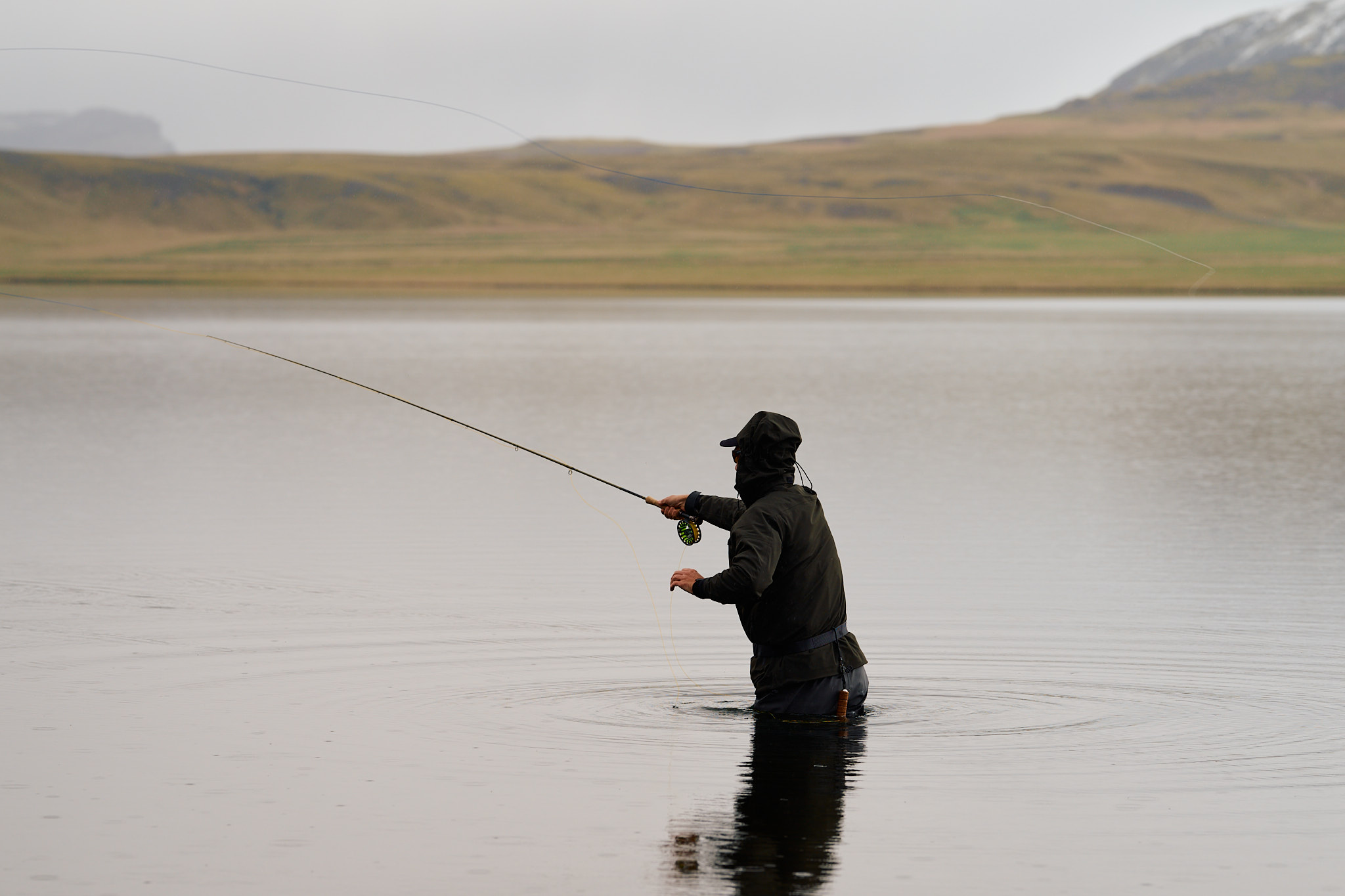
In conventional spin or bait fishing, the lure is dense. The angler whips the rod, the lure’s mass pulls a thin monofilament line off the spool, and the line follows the lure through the air. The casting energy lives in the lure. Fly fishing inverts that. The fly is left weightless and the line itself is built heavy. A modern fly line is a braided nylon or monofilament core coated in PVC or polyurethane, with the front 30 to 40 feet engineered to a specific grain weight (a 5-weight line, the trout standard, weighs 140 grains in that head section). The casting energy lives in the line. The rod is a calibrated spring that loads against the mass of the moving line and releases that stored energy into a forward stroke. The fly rides at the end of a thin tapered leader, going wherever the line puts it.
This is the difference conventional and fly tackle cannot share a category for. A bass rod flexes when you set the hook, but it does not load against the line during the cast. The cast on a spinning rod is a release of lure momentum. The cast on a fly rod is a release of stored rod energy, with the line as the medium. Most of what makes fly fishing distinct, the long flexible rod, the thick line on a large-arbor reel, the false casting, the long leaders, the tapered tippet, the obsession with grain weights, comes back to the same root: the fly is too light to carry line, so the line carries the fly. Everything else is a consequence of that one inverted relationship.
The history of the name
The earliest written reference is the Roman author Aelian in his De Natura Animalium, written around 200 A.D., describing Macedonian anglers on the Astraeus River catching speckled fish on hooks wrapped in red wool and two wax-coloured rooster feathers. The fish would not take a real insect mounted on a hook because the casting motion shredded the bug, so they invented the imitation. The principle has not changed in eighteen hundred years.
The next major milestone is Dame Juliana Berners’ Treatyse of Fysshynge with an Angle, published in 1496, the first instructional fly fishing text in English. Berners catalogued a year’s worth of artificial fly patterns matched to the months they should be used in, which is essentially the first hatch chart. A century and a half later, Izaak Walton and Charles Cotton published The Compleat Angler (1653, with Cotton’s fly fishing chapters added in 1676), the book that codified fly fishing as a literary and contemplative pursuit and gave the sport its philosophical voice for the next three centuries.
The 19th century split the sport into two distinct traditions. The English chalkstream school, formalised by F.M. Halford on the southern English rivers (the Test, the Itchen) in the late 1800s, insisted on upstream presentations of dry flies to visibly rising trout. G.E.M. Skues argued back from the same waters in the early 1900s that submerged nymphs were equally legitimate, and the dry-vs-nymph debate is still mostly Halford and Skues. Meanwhile, American anglers on the rougher freestone rivers of the Catskills and the Rockies developed their own patterns (the Adams, the Royal Wulff, the various Catskill dries) suited to faster broken water. Bamboo rod craft, the introduction of synthetic floating lines in the 1950s, graphite blanks in the 1970s, and the global expansion into saltwater fly fishing in the late 20th century are all built on top of the same idea Aelian described around 200 A.D.: tie feathers to a hook, cast it without breaking it, fish that cannot tell the difference.
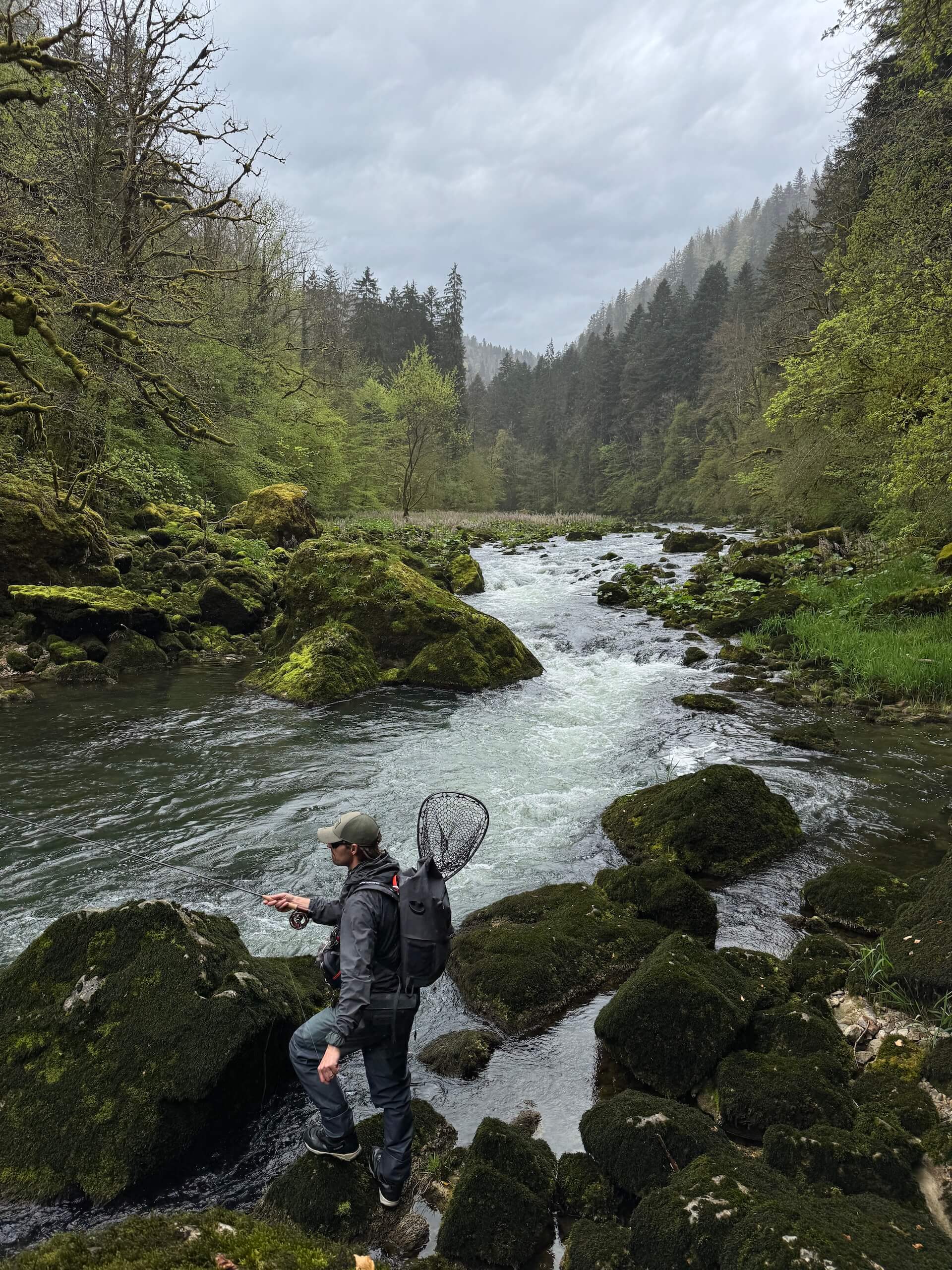
What the name does not mean
The name “fly fishing” is literal, but it is also narrower than the sport itself, and a few misconceptions are worth clearing.
First, fly fishing is not only insects. The artificial-fly category has expanded over the last century to include baitfish patterns (Clouser Minnows, Deceivers, articulated streamers), crustaceans (crab and shrimp patterns for saltwater flats), terrestrials (foam grasshoppers, beetles, ants), mice, frogs, eggs, and pure attractors that imitate nothing in particular. They are all still called flies because they are tied on hooks with traditional fly tying tools and fished on fly tackle, even when the prey they imitate is a five-inch baitfish or a swimming mouse.
Second, fly fishing is not only floating flies. The “fly” most outsiders picture, a delicate dry fly drifting on the surface, is one category among four. Nymph fishing (underwater) accounts for the majority of trout taken on most rivers, because trout spend the majority of their feeding time eating subsurface insects. The image of fly fishing in popular culture skews heavily toward the dry fly because it is the most visible and photogenic part of the sport, not because it is the dominant technique.
Third, fly fishing is not only trout. The 5- to 6-weight trout rig is the default starter setup and the most-bought rod weight in the sport, and the introductory walkthrough for trout on a trout-specific 5-weight is the standard on-ramp for most beginners. But the same casting principle scales: 1- to 3-weights for panfish and small streams, 7- to 9-weights for bass and bonefish, 10- to 12-weights for permit and tarpon, 14- to 16-weights for billfish and tuna. The fly changes, the rod weight scales, the casting mechanic stays the same.
Fourth, fly fishing is not only freshwater. Saltwater flats fishing for bonefish, permit, tarpon, redfish, and striped bass is a fully developed branch of the sport with its own gear, its own fly patterns, and its own casting demands. The Spey casting tradition for Atlantic salmon (using two-handed rods up to fifteen feet long) is another major branch, and tenkara, the Japanese fixed-line tradition that uses no reel at all, is a third.
What unites all of it is the fly on the end of the line. That is why the sport is called what it is called.

Leonard Schoenberger is a fly fishing professional and gear specialist with over 20 years of experience on the water. As the manager of Heidarvatn, a world-class sea trout lodge in Iceland, his product recommendations and tactical advice are tested in some of the most demanding conditions on earth. His expertise has been mentioned in The New York Times, the Financial Times, and at the Outdoor Media Summit.