Last updated on September 30th, 2026.
A hatch chart is a calendar of which aquatic insects emerge in which months on which water types, what life stage matters at each window, and what fly patterns and sizes match. It is the bridge between entomology and pattern selection: instead of guessing which fly to tie on, the angler checks the chart, looks at what is actually on the water, and converges on a working pattern in minutes rather than hours.
Hatch charts are river-specific in the small details. A Pale Morning Dun hatch peaks mid-July on the Bighorn but late June on the Madison; a Trico spinner fall starts in early July on Pennsylvania spring creeks and runs through October on western tailwaters. The general framework, though, is portable across most trout water in the northern hemisphere. Once you know what to look for and when to look for it, a generic chart gets you close, and a few hours on local water sharpens it to the specific watershed.
The four major insect orders
Most trout calories from aquatic insects come from four orders: mayflies, caddisflies, midges, and stoneflies. A trout that is rising to the surface is almost always rising to one of these four, plus the occasional terrestrial (hopper, ant, beetle) that fell off the bank.
Mayflies (Ephemeroptera) are the order most hatch charts organize around. The aquatic nymph lives on the riverbed for months or years, breathing through abdominal gills, before swimming or crawling to the surface and emerging through the film as a dull-winged subimago (the dun). Within twenty-four hours, sometimes much less, the dun moults again into the sexually mature imago (the spinner) with clear glassy wings. Adult mayflies have vestigial mouthparts and cannot feed; the entire adult stage is reproduction. After mating, females drop eggs onto the water and die, falling to the surface with wings splayed flat in the surface film. This is the spent spinner. Mayfly hatches are the visual sport of fly fishing because the dun stage rests on the surface drying its wings (often for several seconds) before lifting off, giving trout an easy and predictable target.
Caddisflies (Trichoptera) take a different route. Larvae either build portable cases out of silk and gravel or spin filter-feeding nets in the current. They pupate underwater inside silken cocoons, cut their way out with specialized mandibles, and swim hard for the surface. The emergence is fast and frantic; the adult often skitters across the surface for a few feet before lifting off. This is why caddis takes are often splashy and aggressive: the fly is moving fast, the trout has to commit, and a slow take loses the bug. Caddisfly hatches dominate the late spring through early summer window on most freestone streams.
Midges (Chironomidae) are small non-biting flies whose larvae tolerate extremely low oxygen and high pollution. The bright red “bloodworm” larva is a midge using a hemoglobin analog to survive in oxygen-poor mud. Pupae ascend slowly to the surface to eclose. Midges hatch year-round, including in the dead of winter, which makes them the critical food source on tailwaters and spring creeks from December through March when no other insects are emerging.
Stoneflies (Plecoptera) are the outlier. Nymphs are strictly aquatic, crawl rather than swim, and live one to four years on the bottom of well-oxygenated streams. When ready to emerge, they crawl out of the water onto rocks or vegetation rather than breaking the surface. This is why stonefly nymphs are constantly available to trout (they migrate along the bottom and edges all year), but adult stoneflies appear on the water only when females return to lay eggs, which is concentrated in specific seasonal windows.
A generic hatch chart for northern hemisphere trout water
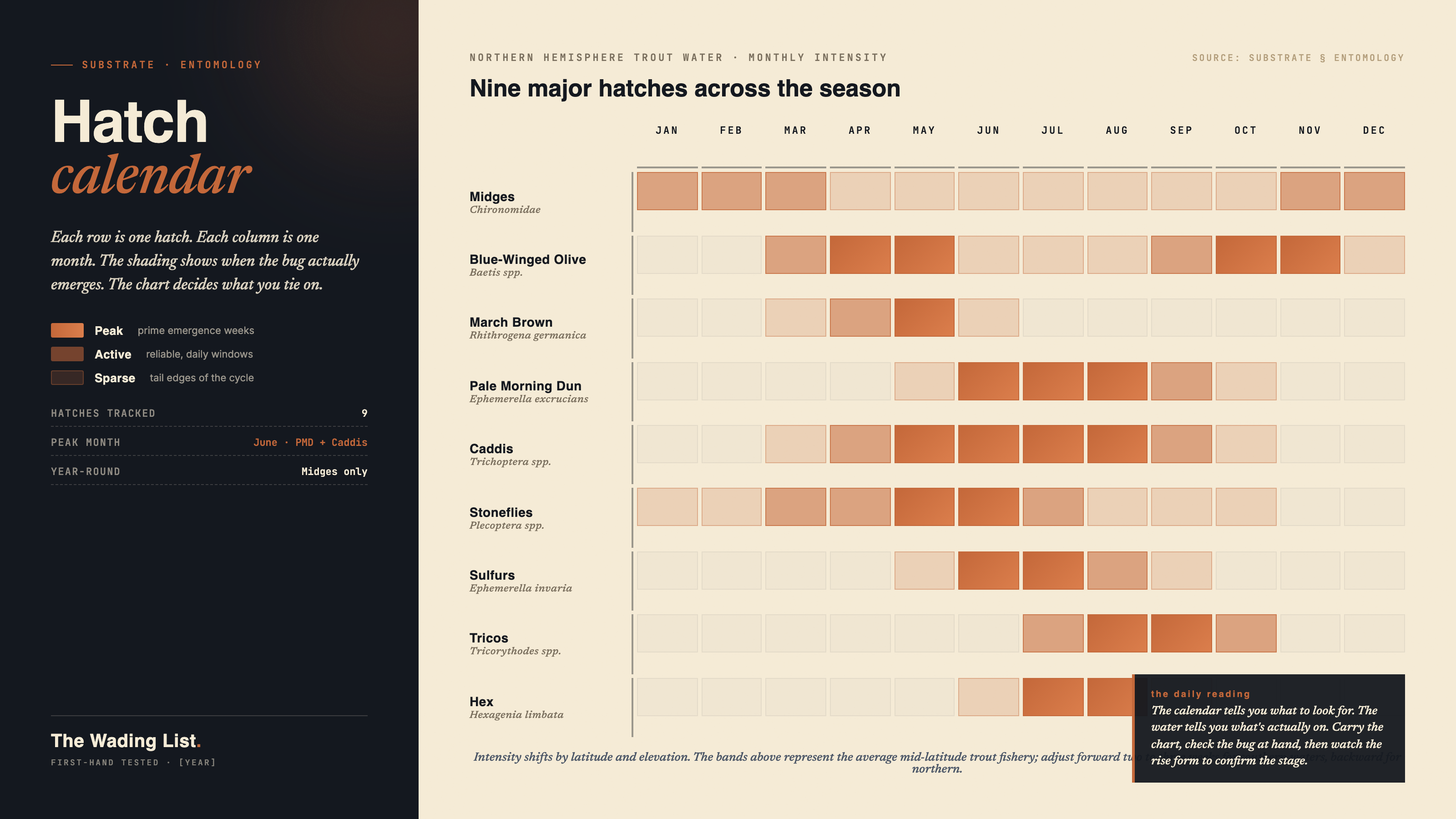
The chart below is a starting reference. Adjust earlier for southern latitudes and later for northern; adjust earlier for tailwaters (which stay warmer in spring) and later for high-altitude freestone (which stays colder).
January through February: midges. Sizes 20 to 26. Black, grey, and red are the colors. Midge clusters can show on warm afternoons. Tailwaters and spring creeks fish best.
March: Blue-Winged Olives (BWOs, Baetis) begin. Sizes 16 to 22. The early-season mayfly. Cool overcast drizzly afternoons produce the best hatches. Midges continue.
April: BWOs peak in many waters. Quill Gordons (Epeorus) on Eastern freestones. Skwala stoneflies on Pacific Northwest rivers in mid-March through April; sizes 8 to 12. Early-season caddis (the Mother’s Day caddis on Western rivers) begin.
May: caddis dominates most freestone water. Brachycentrus, Hydropsyche, and Rhyacophila in sizes 14 to 18. Mother’s Day caddis (Western rivers) and Hendricksons (Eastern). The Hendrickson hatch on Pennsylvania and Catskill water is one of the classic early-season mayfly events. March Browns (Maccaffertium) start mid-May on Eastern water.
June: the heart of the dry fly season on most water. Pale Morning Duns (PMDs, Ephemerella) on Western tailwaters in sizes 14 to 18, hatching mid-morning to early afternoon. Green Drakes (Drunella) in sizes 8 to 12 are the giant of the spring hatch. Sulphurs (a yellow mayfly, sizes 14 to 18) on Eastern water. Caddis continues. Stoneflies of various species (Yellow Sallies, Golden Stones) on freestone rivers; Salmonflies (Pteronarcys californica) on Western rivers in late May through early July in sizes 4 to 8, the largest stonefly hatch in North America.
July: PMDs continue. Tricos (Tricorythodes) start mid-month on tailwaters and spring creeks; tiny (sizes 22 to 26) mayflies that emerge in dense clouds in the cool of mid-morning and produce a spectacular spinner fall an hour or two later. Hopper season begins on rivers with grassy banks. Hexagenia limbata (the Hex) on slow rivers and lakes in the upper Midwest from late June through July; size 6 to 10 mayflies that hatch at dusk and into full darkness, producing the largest dry-fly rises of the year.
August: Tricos peak. PMDs may continue at higher elevation. Hopper fishing is at its best. Terrestrials (ants, beetles, hoppers) dominate the daytime surface bite. Caddis evening hatches in many waters.
September: Tricos continue. Mahogany Duns (Paraleptophlebia) replace PMDs on many Western tailwaters. BWOs return as fall hatches in cooler weather. October Caddis (Dicosmoecus) on Western rivers in sizes 6 to 10, a large orange caddis that fishes well in the late afternoon.
October: BWOs peak. October Caddis continues. Mahogany Duns. Brown trout become aggressive on streamers as the spawn approaches. The midge-only winter window is approaching.
November through December: midges dominate. Tailwaters and spring creeks. Sizes 20 to 26. Fewer surface eats; nymphing under indicators dominates.
Reading rise forms to identify the active stage
The hatch chart tells you what is hatching. The rise form tells you what stage the trout is eating. These are not always the same; trout often key on the emerger or the spinner rather than the dun, even during a visible dun hatch.
A porpoising rise (dorsal fin and back showing, mouth never breaking above the film) means the fish is taking emergers just below the surface. Switch to a CDC emerger pattern or a soft-hackle wet fly.
A splashy aggressive take that throws water means caddis adults skittering on the surface, or in some cases stonefly adults skating. The Elk Hair Caddis and X-Caddis are the classic patterns.
A gentle barely-visible sip in flat water (sometimes called a kiss rise) means the fish is eating spent spinners trapped in the film. Tie on a flat-wing spinner pattern in the matching size. This is the late-evening spinner-fall fishing scenario, often the technical capstone of a day.
A head-and-tail rise where the dorsal fin shows briefly behind the head means the fish is feeding on nymphs higher in the column, often well below the surface. Not a dry fly situation; switch to nymphs or wet flies.
A subsurface boil with no actual break of the surface means the fish is taking emergers or fleeing minnows just under the film. Streamer or soft-hackle.
The “what is hatching right now” problem
The chart is a starting point. The real answer comes from looking at the water in front of you.
Turn over rocks in the riffle. Nymphs of the current dominant species will be on the underside. A heavy population of size 16 PMD nymphs on the rocks tells you a PMD emergence is likely within the next few weeks if not days, and a size 16 PMD nymph drifted dead through the run is the right working fly.
Watch the surface. Floating duns, drifting spinners, fluttering caddis, all show what is on. A few minutes of patient observation often beats consulting any chart.
Check the air. Sweep the rod tip through the air over the river or watch the streamside grass. Adult insects that lifted off the water will be in the air or in the bushes. A swarm of size 14 mayflies in the sun above the bank means a spinner fall is coming as soon as the sun drops.
Local fly shops know what is on. A 20-minute conversation in a fly shop near the water you are fishing is the highest-leverage entomology consult available. They have current intel; the chart has averages.
Online hatch trackers and local-river forums can fill gaps when no shop is available. Treat them as recent intel, not as live data; the bug on the water in front of you right now is the source of truth.
How weather shifts the hatch window
Stream temperature drives insect metabolism, and the calendar dates above are correlations to typical temperature schedules, not to dates per se. A cold spring delays everything by two to three weeks; a warm spring accelerates everything similarly. Tailwaters lag less than freestone rivers because the dam-released bottom water is more thermally stable.
Cloud cover and barometric pressure shift hatch timing within a day. Cool overcast drizzly afternoons extend BWO and emerger windows beyond what bright sun would allow. Bright high-pressure days compress hatches into shorter windows or move them to lower-light hours (early morning, late evening).
Recent precipitation matters. A rain that bumps the river up and dirty kills surface activity for a day, then often triggers a strong hatch when the water clears the next day. Snowmelt in the West cools the water and can shut down a hatch that was due that week, pushing it later by weeks.
Related gear
Matching the hatch needs the right line at the terminal end. Floating lines for dry fly hatches, sinking tip or weighted-leader rigs for nymphing through the same hatch when the fish are not on top. Our guide to the best fly lines for trout covers floating lines for the dry fly and euro nymph lines for fishing under the hatch.
Tying your own hatch-matching flies eventually becomes the cheaper and more interesting path. A rotary vise opens up the entire pattern world above, from size 22 spinners to size 6 stonefly nymphs. The best fly tying vise page walks through the rotary versus stationary distinction and the difference between an entry-level vise and the lifetime tools from Renzetti, HMH, and Regal.
The hatch is one variable; the river-reading skill that finds the holding water where the hatch-feeding trout sit is the other half. Our guide to how to mend fly line covers the mechanics of drag-free drift through the kind of varied currents where trout feed on emerging insects.
Specific pattern families get their own coverage. Our guide to dry fly patterns covers Catskill, parachute, comparadun, CDC emerger, and foam terrestrial construction, with the cases where each is the right answer. Our guide to emerger flies for trout drills into the in-between stage where most of the trickiest selective dry fly fishing actually happens.

Leonard Schoenberger is a fly fishing professional and gear specialist with over 20 years of experience on the water. As the manager of Heidarvatn, a world-class sea trout lodge in Iceland, his product recommendations and tactical advice are tested in some of the most demanding conditions on earth. His expertise has been mentioned in The New York Times, the Financial Times, and at the Outdoor Media Summit.