Last updated on September 30th, 2026.
The casting-vs-spinning question is really a question about reel placement and the line path that follows from it. A spinning reel hangs below the rod and the line spools off perpendicular to the blank in open coils. A baitcasting reel sits on top and the line peels off a rotating spool in a straight path parallel to the blank. Everything else, the guide sizing, the trigger grip, the lure weight range, the learning curve, falls out of that single mechanical difference.
There is a third rod system that almost never shows up in this comparison and should: the fly rod. A fly rod is not a heavier or lighter version of either spinning or casting gear. It runs on inverted mechanics. The fly is too light to carry line, so the line itself becomes the projectile, and the rod is a calibrated spring that loads against the mass of the line moving through the air. That distinction is worth understanding even if you fish a spinning combo for bass on the weekends, because once you see how fly casting works you stop thinking of “fishing rod” as one tool category.
This page covers what each of the three systems actually does, when to use which, and why fly tackle sits in its own physical regime that the standard spin-vs-cast comparison cannot describe.
How the spinning reel and the casting reel actually differ
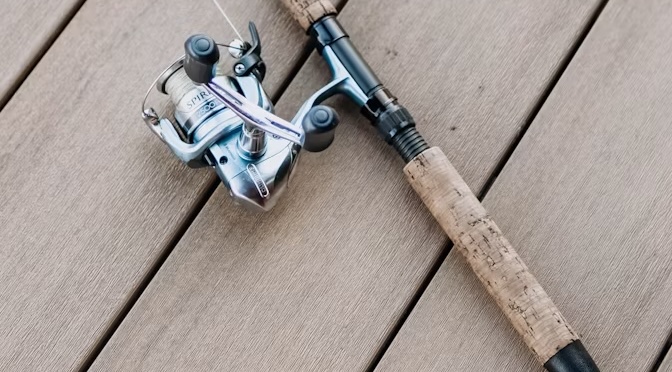
A spinning reel’s spool is fixed. It does not rotate when you cast. The bail arm flips open, the line releases, and the lure’s momentum pulls coils of line off the front of the spool in a widening helix. Because the line leaves the spool sideways rather than straight, the rod needs large-diameter stripper guides near the reel to gather and tame those coils before funneling them down toward the tip. Look at any spinning rod and you will see the first guide above the reel is significantly larger than the rest, often two to three inches in diameter on a longer rod, then tapering quickly to a small tip-top.
A baitcasting reel works the opposite way. The spool rotates as the lure pulls line off it. The line peels off straight in line with the blank, so the guides can be much smaller and sit closer to the rod itself. Casting rods also carry a trigger grip beneath the reel seat, a small hook that anchors the index finger and gives the angler a stable platform to thumb the spool during the cast. That thumb control is the whole game on a baitcaster. If the lure decelerates faster than the spool, the spool keeps spinning, line piles up under it, and the result is the line nest the bass-fishing world calls a backlash.
The mechanical tradeoff is straightforward. The spinning reel cannot backlash because the spool does not rotate, which makes the system tolerant of casting errors and ideal for learning. The cost is that line management through the guides is less efficient, and the system struggles to deliver heavy lures with precision because the energy of the cast has to fight the helical line release. The baitcaster trades the tolerance for direct line flow and direct thumb-on-spool control, which is what gives casting setups their reputation for precision with heavy lures. Pinpoint a jig into a six-inch gap between lily pads at thirty feet, and the baitcaster’s straight-line release plus thumb braking is doing the work.
Line capacity follows the same logic. Spinning reels are typically spooled with light to medium monofilament or thin braid, two to ten pound test for most freshwater applications, because the open-coil release does not tolerate thick, stiff line well. Baitcasters are spooled with heavier line, ten to thirty pound test or up to fifty-pound braid for heavy cover, because the parallel release path handles thick line without resistance. The lure range follows the line range: spinning excels under a quarter ounce, baitcasting excels above three eighths of an ounce, and the overlap in the middle is where personal preference takes over.
Why a fly rod is not a third kind of casting rod
A spinning rod and a baitcasting rod look different but they belong to the same physical category. The lure is dense, the line is thin and nearly weightless, and the lure’s mass pulls the line out behind it. A two-ounce crankbait flying through the air drags two hundred feet of six-pound monofilament because the lure has the kinetic energy and the line has almost none.
A fly rod inverts that relationship. A typical trout fly weighs a fraction of a gram. Cast it on its own and air resistance stops it the moment it leaves the rod tip. So fly fishing solves the problem by weighting the line and leaving the fly nearly massless. The fly line is a thick, coated, weight-calibrated rope, typically eighty to one hundred feet of braided nylon or monofilament core wrapped in polyvinyl chloride or polyurethane. The angler casts that line. The fly rides at the end of a thin leader, going wherever the line decides to put it.
The industry has standardized this relationship through the American Fly Fishing Trade Association. AFFTA assigns a grain weight to the first thirty feet of each fly line, the section closest to the angler where the cast is loaded. A 5-weight line weighs 140 grains in that thirty-foot head, plus or minus six grains. A 7-weight weighs 185. A 10-weight, used for big saltwater fish, weighs 270. The full breakdown across the 1-to-16 range sits in the fly rod weight chart. Rod manufacturers then design a 5-weight rod blank to flex optimally when carrying that 140-grain head in the air. Use a heavier line and the rod overloads. Use a lighter one and the rod will not flex at all.
This is why a fly rod is described as “loading” during the cast. The rod is a spring. The line in the air is the mass that bends it. When the angler accelerates the rod forward and then stops it abruptly, the stored energy in the bent rod releases into the line, and the line unfurls in a loop that carries the fly to the target. There is no equivalent to this in spinning or casting tackle. A bass rod flexes when you set the hook, but it does not “load against the line” during the cast. The cast in conventional tackle is a release of lure momentum. The cast in fly fishing is a release of stored rod energy.
A few practical consequences fall out of this. Fly rods are designated by line weight rather than lure weight (a 5-weight rod casts a 5-weight line, not a 5-ounce lure). Action describes where in the blank the rod flexes, fast-action rods bend near the tip for high line speed, slow-action rods bend down to the cork for delicate short-range presentations. And fly casters routinely add line speed through a technique called hauling, where the non-rod hand pulls sharply on the line during the rod’s acceleration phase, increasing the bend in the rod and the resulting velocity of the unfurling loop.
What each system is actually built to catch
The spinning rod’s strengths line up with finesse presentations and lighter species. Trout on small spinners, panfish on tiny jigs, walleye on slip-bobber rigs, light saltwater work for schoolie striped bass or speckled trout on the flats. The system also dominates in wind, because a light lure on light line can be sliced out of a sidearm cast with a spinning setup more cleanly than a baitcaster will manage. Skipping a soft plastic under a dock overhang, the low-loop sidearm release of a spinning combo is the standard answer.
The baitcasting rod’s strengths line up with power techniques and structure-heavy water. Largemouth bass in pad fields, flipping heavy jigs into matted vegetation, pitching plastics to laydowns and dock pilings, throwing deep-diving crankbaits or large spinnerbaits for suspended fish. The accuracy under thumb control is what gives casting tackle its dominance in bass tournaments. The system also handles pike, musky, peacock bass, and most of the heavy freshwater predators that need to be pulled out of cover rather than played in open water.
The fly rod’s strengths sit somewhere else entirely. The fly rod exists because some prey items are too small and too delicate to imitate on conventional tackle. A size 18 Blue-Winged Olive dry fly weighs nothing. A size 22 Trico spinner weighs less than nothing. Spinning gear cannot deliver them, and even an ultralight setup will land that fly with a splash that puts every wild trout in the pool down. The fly system exists to present small, light, lifelike imitations onto trout-feeding currents with no leader splash and a drift that matches the speed of the water exactly.
Fly tackle also scales up. A 1-weight fishes panfish and small stream brook trout. A 5 weight fly rod is the trout standard worldwide. An 8-weight handles bonefish on tropical flats. A 10-weight handles permit. A 12-weight handles tarpon, with shock tippets to survive the abrasive mouth and three-foot leaps. A 16-weight is built for blue water, billfish and tuna. The same casting principle, line as projectile, rod as spring, scales across the whole range. The mechanics that put a size 20 midge onto a Yellowstone cutthroat put a six-inch baitfish pattern in front of a hundred-pound tarpon. Different rod, different line weight, same physics.
When to use which, in plain terms
If you are starting from zero and fishing freshwater for whatever bites, a spinning rod and reel is the right first purchase. The system is forgiving, light, intuitive within an afternoon, and covers everything from panfish to small bass to trout on lures. The cast tolerates mistakes, the line will not nest, and the gear is inexpensive enough at the entry tier that you can replace components as you learn what you actually like.
If you are fishing bass seriously, particularly in cover, the spinning rod gives way to a baitcasting setup once your weekly hours start adding up. The precision under thumb control, the heavier line and lure capacity, and the direct leverage when hauling fish out of vegetation are not luxuries at that level. Most bass anglers carry a quiver of three to five casting rods for different techniques plus one or two spinning rods for finesse situations like drop-shotting or shaky-head work in clear water.
If you want to catch trout on rising-fish water, or sight-cast to a bonefish on a sand flat, or swing a wet fly through a steelhead run, none of the conventional answers work. The fly system is what catches those fish, and the mechanics described above are why. The investment to start fly fishing is higher than starting spinning, because the rod, line, reel, and leader system have to be calibrated together rather than picked off a peg at random. But the access it grants to water and fish that conventional tackle simply cannot reach is the whole reason fly fishing exists as a separate discipline rather than a stylistic variant of spin fishing.
Many serious anglers carry both. A spinning combo for the lake trip with the kids, a baitcaster for the bass tournament, a fly rod for the morning hatch on the river. The systems do not compete. They cover different water.

Leonard Schoenberger is a fly fishing professional and gear specialist with over 20 years of experience on the water. As the manager of Heidarvatn, a world-class sea trout lodge in Iceland, his product recommendations and tactical advice are tested in some of the most demanding conditions on earth. His expertise has been mentioned in The New York Times, the Financial Times, and at the Outdoor Media Summit.