Last updated on September 30th, 2026.
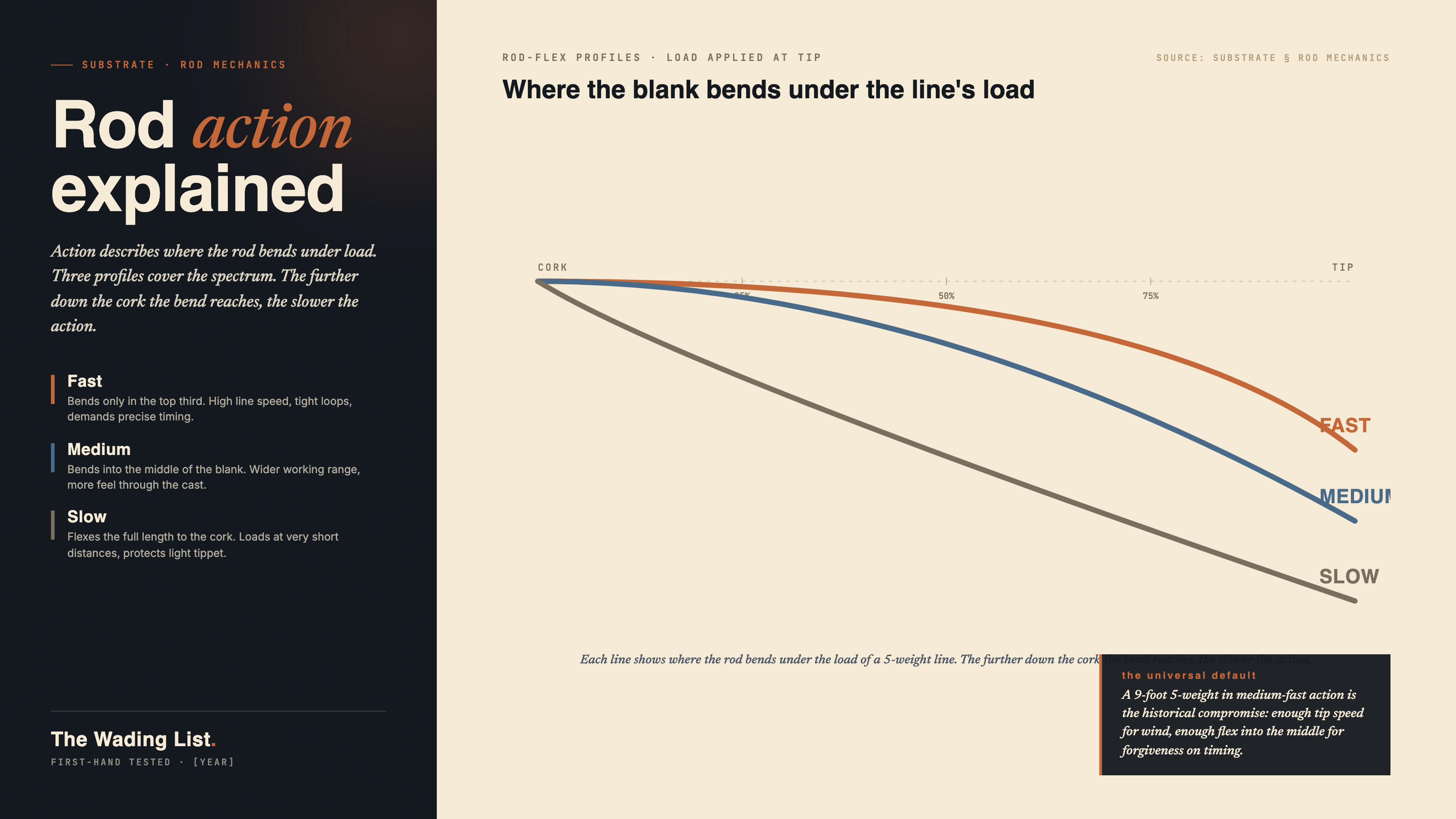
Rod action describes where a fly rod flexes when it loads under casting motion. A fast-action rod flexes primarily near the tip. A medium-action rod flexes down through the middle of the blank. A slow-action (or full-flex) rod bends all the way to the cork grip. That single difference, where along the blank the rod stores energy, dictates almost everything about how the rod casts: line speed, loop size, presentation feel, the wind window the rod can punch through, and the tippet strength it protects on a hookset.
Action is not the same as power or stiffness. A 5-weight rod and a 9-weight rod can both have fast action; they just store and release energy at very different magnitudes. Action is the geometry of the flex; power is the magnitude of the force. Both matter, and they are designed independently.
The physics of rod flex
A fly rod acts as a class-three lever with one critical extra property: it is a flexible spring. The casting motion accelerates the rod through an arc; the line, with its grain weight, lags behind and bends the rod tip rearward, storing elastic energy in the bent blank. When the rod is stopped abruptly at the end of the casting stroke, the stored energy releases back into the line, generating the forward loop.
The deeper the flex extends down the blank, the more rod mass is involved in the storage and release. A full-flex rod with the bend reaching the cork engages the whole blank as a long, slow spring. A tip-flex rod with bend confined to the top third engages only that short section as a short, fast spring. The amount of stored energy is roughly proportional to how much blank is involved and how far it deflects, but the speed at which that energy releases depends on how concentrated the flex is.
Concentrated flex (fast action) means fast release, which generates high line speed. A tight, fast loop with a small loop face cuts through wind, holds shape over long distance, and turns over heavy flies. The trade-off is that fast action requires a longer head of line to load the rod properly; the bend will not happen until enough line weight is in the air to overcome the stiff tip. A fast-action 5-weight needs roughly 30 to 40 feet of line outside the rod tip before it loads correctly. Inside that distance, the rod feels dead and the cast collapses.
Distributed flex (slow action) means slower release, which generates lower line speed but a softer presentation. The rod bends with very little line out, which is why slow-action and medium-action rods load on short casts under 20 feet, where fast-action rods cannot. The trade-off is wind. A slow-action loop is larger and lower in line speed; in 15 mph or higher wind, the loop drops and the cast falls short.
The line itself participates in the equation. AFFTA standards assign grain weights to the first 30 feet of fly line: a 5-weight line weighs 140 grains, a 6-weight 160 grains, an 8-weight 210 grains. The rod is designed to flex optimally when that specific grain weight is carried in the air. Overlining a fast-action rod (putting a 6-weight line on a 5-weight rod) forces the rod to load with less line out, effectively making a fast-action rod feel like a medium-action rod for short casts. This is a common small-stream move where the angler wants the wind-cutting backbone of the fast 5-weight but only ever casts to 20 feet. Underlining (a 4-weight line on a 5-weight rod) rarely works because the rod simply will not load.
Reading the action descriptions on a rod
Manufacturers describe action with words: slow, medium, medium-fast, fast, extra-fast. There is no industry standard for these labels, and one company’s fast is another company’s medium-fast. The actual descriptor that does have a standard is the flex distribution, sometimes printed on rod specs as “tip flex,” “mid flex,” or “full flex,” and sometimes given numerically (e.g., 9.5 on a stiffness index).
A few practical translations across the modern market. Sage rods historically run fast to extra-fast across their performance lineup (the Sage R8, Sage X, Sage Igniter sit at the stiff end). G. Loomis (now Shimano) similar. Hardy generally medium-fast. Orvis Helios runs fast across most weights but with notably easier loading than the Sage equivalents. Scott runs medium-fast to fast with a reputation for “feel” through the blank. Echo and Redington at the more accessible price tier typically run medium-fast, which is the right action profile for most anglers most of the time.
Glass and bamboo are their own category. Modern fiberglass rods (built by Epic, Echo, Orvis, Scott, Steffen) deflect deep and slow, with action profiles equivalent to what graphite called slow or full-flex twenty years ago. Bamboo (split cane) is always slow action by physics; it cannot help but flex through the whole blank because of the material’s high density and low modulus.
Graphite (carbon fiber) modulus rating is the underlying spec that drives action. Modulus measures stiffness-to-weight ratio. High-modulus graphite (40 to 60 Msi) builds light, stiff, fast-action rods. Lower-modulus graphite builds heavier, softer, slower-flexing rods. The modern premium market is high-modulus high-resin-content composites; the entry-level market is lower-modulus blanks. This is part of why a $1200 rod feels different in the hand than a $250 rod even when both are rated 9-foot 5-weight.
Matching action to use case
Fast action is the right call for distance casting, heavy flies, windy conditions, and saltwater. The fast 8-weight that handles bonefish wind, the fast 6-weight that drives a hopper-dropper rig across a wide river, the fast 10-weight that turns over a tarpon fly all need the line speed and the recovery (the speed at which the rod returns to straight after stop) that fast action delivers.
Medium-fast action is the all-around standard for trout fishing on moderate-to-large rivers. A 9-foot 5-weight in medium-fast handles dry flies at moderate distances, nymph rigs with split shot and indicators, and small streamers, all within the same setup. Most anglers who own one fly rod own a medium-fast 5-weight.
Medium action favors presentation over distance. Spring creek anglers, dry fly purists, and small-stream anglers gravitate toward medium-action rods because the softer tip protects fine tippets (4X to 7X), the slower loop lays down delicately, and short-cast loading happens with less line out. The medium-action 4-weight or 5-weight is the dry fly tool in slow water.
Slow action and full-flex glass cover small streams and intimate fishing. Brook trout creeks where the cast is rarely more than 20 feet, fiberglass 3-weights and 4-weights with full-flex profiles let the angler load the rod with almost no line out, present softly, and protect tippets that would snap on the hookset of a stiff rod. The glass rod’s deep flex absorbs the strike energy in a way no fast graphite rod can match.
Specific casts that demand specific actions
Distance casts beyond 60 feet need fast action and high line speed. The loop must hold its shape over the full distance, and the rod tip must recover fast enough between false casts to keep line speed building.
Roll casts (and Spey-derived casts) load the rod off water tension, not off backcast line motion. They favor medium to medium-fast action because the load builds more gradually than in an aerialized cast.
Reach mends, parachute casts, pile casts, and other slack-line presentations work better with medium or medium-fast rods. The angler is deliberately introducing controlled slack at the end of the cast, and a slower loop with more drift in the line gives more time to shape the slack pattern.
High-stick nymphing (short-line nymph rigs at close range, including Euro nymphing) uses 10-foot or 11-foot rods in 3-weight or 4-weight, with medium to medium-fast action. The rod is held high to keep line off the water; the deep flex absorbs hard takes from large trout on fine tippet without breaking off.
Streamer fishing for big trout favors medium-fast 6-weight to 8-weight rods with enough backbone to throw weighted flies and enough tip flex to protect leaders on aggressive strikes.
Common confusions
Faster is not better. The market trend toward stiffer rods over the last two decades has produced a generation of rods that load only at distance and feel dead at close range. For anglers who fish small to medium water within 40 feet most of the time, a medium-fast or medium rod outfishes a fast-action rod by feel and by accuracy, even though it is “less rod” by spec.
Action and weight scale independently. A fast-action 4-weight and a fast-action 9-weight both flex predominantly at the tip, but they are designed to flex at very different deflection magnitudes (the 4-weight bends with 140 grains in the air, the 9-weight needs 240 grains). Do not assume a fast-action 4-weight feels stiff in absolute terms; it feels stiff for a 4-weight.
The cast itself, not the rod, generates line speed. A fast-action rod responds well to a crisp casting stroke with a sharp stop. The same fast rod in the hands of an angler with a long, swimming stroke feels heavy and unresponsive. Action makes some casting habits work; it does not generate good casts on its own.
Length interacts with action. A 9-foot rod and a 10-foot rod of the same weight and stated action do not feel the same. The longer rod has more leverage at the tip, which extends the apparent flex even at the same action grading. Longer rods feel softer than their printed action suggests; shorter rods feel stiffer.
Related gear
Rod action is one of three variables that define a fly rod choice; the other two are weight and length. Our guide to the best fly rods for trout covers weight and length for trout fishing, with picks from budget to premium.
For trout-specific rods, the dominant action choices are medium and medium-fast in 3-weight through 6-weight. The 9-foot 5-weight is the rod size that defines trout fishing, and the one most of those picks are built around.
Rod weight and action together drive line choice. A fast 5-weight wants a 5-weight line with a short, heavy head; a medium 5-weight wants a presentation taper with a longer front section. Our guide to fly fishing line setup covers the line-rod pairing and the cases where overlining or underlining makes sense.
The rod weight chart is the universal reference for matching rod weight to species and fly size. The fly rod weight chart page walks through 1-weight through 16-weight applications, with the action profiles that pair best with each weight range.

Leonard Schoenberger is a fly fishing professional and gear specialist with over 20 years of experience on the water. As the manager of Heidarvatn, a world-class sea trout lodge in Iceland, his product recommendations and tactical advice are tested in some of the most demanding conditions on earth. His expertise has been mentioned in The New York Times, the Financial Times, and at the Outdoor Media Summit.