Last updated on September 5th, 2026.
Tarpon fishing means pursuing Megalops atlanticus, the so-called Silver King, on shallow saltwater flats and along passes, beaches, and channels of Florida, the Caribbean, the Gulf Coast, and West Africa. Adult fish run 70 to 200 pounds and are taken on heavy 10- to 12-weight fly tackle (or 6000- to 8000-class spinning gear), short shock-tippet leaders, and shrimp or baitfish patterns sight-cast from a poled flats skiff. The fish is prized not for the table, which is bony and inedible, but for what happens after the eat: repeated head-shaking jumps that can throw a hook in a single shake of a mouth the texture of cinder block.
This page is the orientation hub for the fly-fishing approach to tarpon. The biology, the season windows, the gear class, the strip-set, and the bow-and-arrow rod position during the fight all flow from one mechanical fact about the species: tarpon are obligate air breathers, and the way they expose themselves to atmospheric oxygen is the same behavior that makes them targetable from a boat in the first place.
The fish: Megalops atlanticus
Tarpon are the only living members of the family Megalopidae, a prehistoric lineage that has changed little in tens of millions of years. The genus name Megalops comes from the Greek for “large eye,” referring to the species’ oversized eye relative to body length. The Atlantic tarpon ranges across the western Atlantic from Virginia south through the Caribbean and Gulf of Mexico, and across the Atlantic to the coastal waters of West Africa. A separate sister species, Megalops cyprinoides, occupies the Indo-Pacific.
The biological adaptation that defines the fishery is the species’ modified swim bladder. In Megalops atlanticus, the swim bladder is lined with alveolar tissue and is connected to the esophagus, allowing it to function as a pseudo-lung. Tarpon are not merely capable of breathing air, they are obligate air breathers. They must periodically surface to gulp atmospheric oxygen, and they will drown if denied access to the surface. This adaptation evolved in response to the species’ preferred juvenile habitat: stagnant, low-oxygen mangrove backwaters and brackish lagoons where predators like sharks and barracuda cannot follow.
For the angler, the air-breathing behavior is everything. Tarpon “roll” at the surface, breaking through with a glint of silver flank and a quick gulp of air, and this is how schools are located from a poled skiff. A guide standing on the platform reads the water for rolling fish, and the angler on the bow casts to the visible target. The fishery is fundamentally a visual one. Take away the rolling behavior and tarpon would be effectively invisible on the flats, the way bonefish are invisible at distance until they cross a sand patch.
Adult tarpon are strictly carnivorous and feed on midwater prey: mullet, pinfish, threadfin herring, pass crabs, shrimp. They are not table fare. The flesh is dense with intramuscular bones and the species is almost universally released. In Florida and most Caribbean fisheries, regulations require release of fish above a minimum size, and catch-and-keep is restricted to a single fish for IGFA record purposes. The conservation ethic in the modern fishery is total release.
Where and when
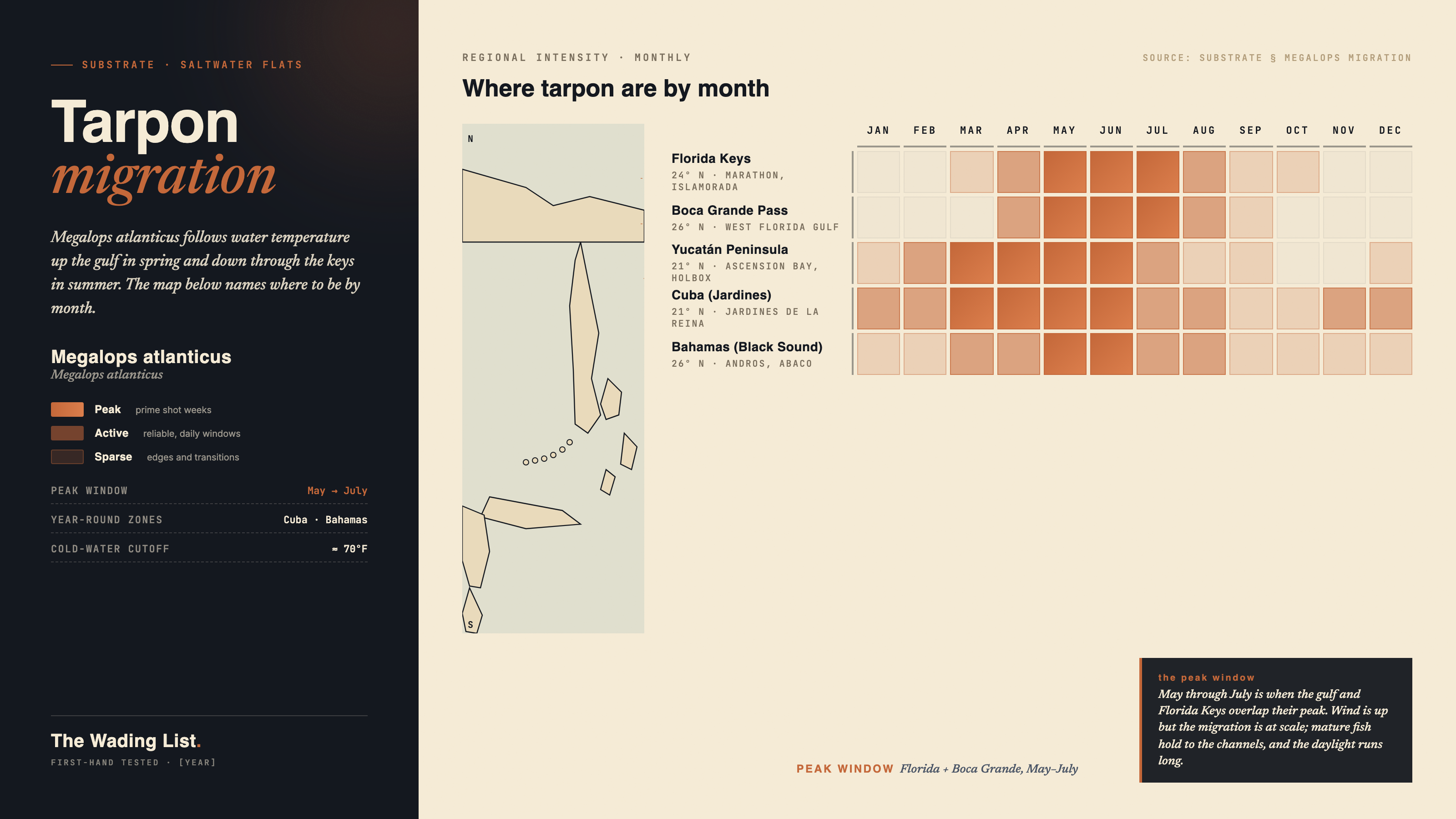
The classic American tarpon fishery is the migration that funnels fish along the Gulf Coast and through the Florida Keys from late spring into midsummer. Adult tarpon overwinter in deeper offshore water and in the warmer southern reaches of their range, then move shoreward as Gulf water temperatures climb past the high 70s F. The Florida Keys peak runs late April through early July, with Boca Grande Pass on the Gulf Coast peaking in the same window. The Florida Panhandle and the upper Gulf push later, into July and August. The Big Bend and Tampa Bay are bridges between the early Keys run and the late Panhandle run.
Caribbean fisheries do not migrate in the same pulsed way. Belize, the Yucatan, the Bahamas, and Cuba hold resident populations year-round on flats and in lagoon systems, with peaks driven by local water temperature and bait availability rather than long-distance movement. West African tarpon, primarily off Gabon and Angola, are targeted on a different annual calendar with different bait dynamics.
Within the season, tide and moon matter more than calendar date. Tarpon move with current. The strongest tides of each lunar cycle, around new and full moons, concentrate fish in passes and inlets where bait is being flushed by water movement. Boca Grande Pass is the textbook example: tarpon stack in the deep cut at moving tide, feeding on bait being pulled through the pass by current. Beach fishing along the Gulf works on the same principle at a smaller scale, with fish following bait along the trough just outside the first sandbar.
The visual fishery operates best in calm conditions with good light. Sight-casting from a flats skiff requires the angler to see the fish before casting, which means a stable boat, low wind, and sun high enough to penetrate the water column. The classic tarpon morning is glass-flat, bluebird sky, sun above 30 degrees of elevation. Wind and chop turn a sight fishery into a blind one.
Gear required
The gear class is set by the fish, not by preference. Adult tarpon routinely run 80 to 150 pounds, with trophy fish past 200, and the lifting power required to turn a fish away from coral, mangrove roots, or boat bottom is what dictates the 10- to 12-weight rod range. A 10-weight handles juvenile tarpon (5 to 50 pounds) in backwater and laid-up shallow situations. An 11-weight is the standard travel rod for most adult fishing. A 12-weight is the right tool for the largest fish in the deep cuts at Boca Grande or the bridges of the Florida Keys.
The line is a tropical-coated weight-forward floater for almost all flats work, often with a short clear intermediate tip for laid-up fish. Tropical coatings stay slick at high air and water temperatures where temperate-water lines turn tacky. The leader is short by trout standards: six to nine feet total, built from heavy 40- to 60-pound butt to drive a weighted fly into wind, stepping down through a class tippet, and terminating in a short shock tippet of 60- to 100-pound fluorocarbon or hard mono. The shock is non-negotiable. A tarpon’s mouth is a layer of bone and abrasive plates over the upper and lower jaw, and a fish that gets a wrap of class tippet around any of it will saw through 16-pound class material in seconds. The shock absorbs that abrasion.
The reel is a sealed-drag saltwater design with at least 250 yards of 30-pound gel-spun backing. Sealed drag is mandatory: any sand or salt that reaches an exposed disc drag will destroy the braking surface during the first long run. The drag itself is set surprisingly light during the jumping phase of the fight, then progressively tightened as the fish settles into a sustained run. A hot drag at hook-set is one of the most common ways to lose a fish on the jump.
Flies fall into two broad families. Shrimp and crab patterns (toad flies, palmered shrimp, Black Death variants in dark olive and purple) sink quickly to laid-up or cruising fish. Baitfish patterns (Lefty’s Deceivers, EP Tarpon Streamers, mullet imitations in chartreuse and white) imitate the migratory bait the fish are tracking. Color choice tracks light and bottom: dark fly over dark bottom or cloudy day, light fly over white sand or bright sky. Hook quality matters more than for any other flats species. Tarpon hooks are heavy-wire, chemically sharpened, and frequently inspected and touched up with a file between fish.
Technique
The cast is made from the bow of a poled skiff to a visible, moving target. The guide on the platform calls the fish (“eleven o’clock, sixty feet, three fish coming left to right, lead the lead fish by ten feet”). The angler delivers the fly with at most one false cast, lands it ahead of and across the path of the fish, and begins a slow, even strip the moment the fly settles. Long casts to fish at the edge of vision are accuracy casts under wind; the AFFTA grain-weight loading of an 11-weight is exactly what’s needed to drive a weighted fly through a 15-knot side wind to a sixty-foot target.
The eat looks like nothing for a beat, then the fish opens its mouth and the fly disappears. The single most consequential mechanical choice in the entire fishery happens here: the strip-set, not the trout-style upward rod set. The angler keeps the rod tip pointed at the fly through the strip and, when the fish eats, hauls down hard with the line hand, sometimes two or three rapid strips, driving the hook point through the bony jaw with the direct pull of the line. Lifting the rod tip absorbs the energy in the rod blank rather than transferring it to the hook point, and a tarpon hook best fly rodsed with a trout-style set is a tarpon that will throw the hook on the first jump. After the first solid strip-set, many anglers add a low-rod sweep to the side, opposite the direction the fish is moving, to drive the hook a second time.
The first jump comes within seconds of the hook-set. This is where the rod position changes again. The angler “bows” to the fish: rod tip driven forward and down, sometimes all the way to the water, creating slack in the line for the instant the fish is airborne. A taut line on a jumping tarpon transfers the full weight of a 100-pound fish onto the leader at the apex of the jump, and either the leader breaks or the hook tears free from the bony jaw. The bow puts slack into the system at exactly the moment the fish has zero forward resistance, allowing the fish to land back in the water without snapping anything. After the jump, the rod comes back up and the fight resumes.
The sustained fight is a low-angle, lateral pull. The rod is held at roughly 30 degrees off horizontal, never straight up, with the angler walking the bow of the boat to keep the angle on the fish. A straight-up rod transfers all the leverage into the rod tip and exhausts the angler far faster than it tires the fish. The angle is kept just steep enough to use the butt section of the rod, where the actual lifting power lives, and pressure is sustained from the reel against the heel of the angler’s palm. Most fights run 20 to 45 minutes for an 80- to 120-pound fish. A green fish boated quickly is a fish that will survive release; a fully exhausted fish boated at the end of an hour-long battle is at high risk of post-release mortality from lactic acidosis, especially in warm water with depressed dissolved oxygen.
The release happens at the boat with the leader in hand, hook backed out with pliers, fish revived by holding it upright in the current until it kicks free under its own power. Tarpon are notoriously prone to delayed mortality if mishandled, and the boatside revival is part of the technique, not an optional courtesy.
Common confusions and adjacent species
Tarpon are sometimes confused at distance with Atlantic ladyfish (Elops saurus), a much smaller relative in the order Elopiformes that shares the silver flanks and forked tail. Ladyfish (“poor man’s tarpon”) rarely exceed three pounds and lack the dorsal-fin trailing filament that gives Megalops part of its name.
The two true flats fish often discussed alongside tarpon are bonefish and permit, and the gear class is what separates them. Bonefish are an 8-weight target, permit a 9-weight, tarpon a 10- to 12-weight. The flies are different (small shrimp and crabs for bonefish, weighted crab patterns for permit, large baitfish and shrimp for tarpon), the leaders are different (long delicate for bonefish, medium with no shock for permit, short with heavy shock for tarpon), and the casting demand scales with the fish. The “grand slam” in flats fishing is one of each species in a single day, which is harder than it sounds because the three species rarely overlap in the exact same water column on the same tide.
Goliath grouper (Epinephelus itajara), the resident giants of inshore Florida reefs and bridges, share habitat with adult tarpon and are sometimes encountered as an unwanted incidental on tarpon tackle, particularly around bridge pilings at night. They are not flats fish and are not the target of the sight fishery described here.
Related gear
If you are researching tarpon fishing, the guides that follow cover the gear this fishery demands.
The rod itself is covered at /best-saltwater-fly-rod/, which spans the 8- to 12-weight saltwater range. For tarpon specifically the 10-, 11-, and 12-weight sections are the relevant tier, and the buying decision splits on whether you are a one-fish-per-trip traveler (a single versatile 11-weight) or building a flats quiver (one 10-weight for juvenile and laid-up fish, one 12-weight for the largest adults).
The reel for any saltwater fly setup is a sealed-drag design with substantial backing capacity. Our reel coverage is at /best-fly-reels/; for tarpon use, the sealed-drag, large-arbor, 10- to 12-weight class is the relevant section. A reel that is fine for trout (a click-and-pawl or unsealed disc design) is the wrong tool for a tarpon flat.
Sight-fishing optics are not optional. Polarized lenses block the horizontal-axis light reflected off the water surface at Brewster’s angle, opening up the water column to the angler’s eye and turning a blind cast into a sight cast. Lens color shifts with light: copper or amber for the all-around flats day, gray for high-sun bluebird conditions over deep water. /best-fishing-sunglasses/ covers the glass-versus-polycarbonate tradeoff and the lens-color matrix in detail. For tarpon specifically, the high-contrast copper or amber lens over light bottom is the workhorse.
A flats day means a boat day, which means a different pack profile than a wading day. A waterproof or highly water-resistant pack that holds two boxes of tarpon flies, a tippet wallet, pliers, sunscreen, and water without taking up the deck of the skiff is the right tool. /best-fly-fishing-packs/ covers the boat-bag end of the spectrum alongside the wading-pack designs.
The two flats species adjacent to tarpon get their own hubs: /fly-fishing-bonefish/ for the 8-weight Bahamas and Belize fishery, and /fly-fishing-permit/ for the 9-weight Keys and Yucatan permit fishery. Most operators booking a flats trip will encounter all three over the course of a week, and the gear and technique distinctions across the three are worth working through before the trip rather than on the bow of the boat.

Leonard Schoenberger is a fly fishing professional and gear specialist with over 20 years of experience on the water. As the manager of Heidarvatn, a world-class sea trout lodge in Iceland, his product recommendations and tactical advice are tested in some of the most demanding conditions on earth. His expertise has been mentioned in The New York Times, the Financial Times, and at the Outdoor Media Summit.