Last updated on September 30th, 2026.
Bonefish (Albula vulpes) are amphidromous flats fish that move onto shallow tropical sand and mud flats with the incoming tide to root out benthic worms, crustaceans, and mollusks. Their silver sides and olive-green backs camouflage almost perfectly against sand, which is why guides call them grey ghosts. The sport is built around sight-casting weighted shrimp or crab patterns to fish that are often feeding in water less than a foot deep, with an 8-weight rod, a heavy-butt saltwater leader, and stealth as the absolute first requirement.
Bonefish fishing is not blind casting. Almost every fish you catch is one you saw first, identified the direction of, calculated the lead for, and presented to. That makes optics, casting accuracy, and a working knowledge of bonefish behavior far more important than the specific fly pattern.
The biology that dictates the fishery
Bonefish are wary by selection. They feed in water so shallow that any overhead predator (osprey, barracuda, shark) has a clean shot at them, and they survive by being one of the most jumpy fish in shallow water. A passing cloud shadow, a careless step in the water, a fly line slapping down within ten feet of them, any of those reads as predator and sends the school off the flat. Stealth is not a soft preference. It is the constraint that shapes every other choice about gear and presentation.
They feed by rooting. A bonefish nose-down on the bottom, tail tipping above the surface, is a fish that has committed to a food source and is digging it out of the marl or sand. This tailing posture is the highest-percentage shot in the sport because the fish has its head down, its peripheral vision compromised, and a known feeding zone within a foot of its nose. A fly that lands in front of and slightly to the side of a tailing fish, then gets stripped slowly along the bottom, gets eaten more often than any other presentation.
Schools move with the tide. Incoming water carries bonefish up onto the flats from deeper channels and basins; outgoing water drains them off. The first push of tide onto a flat is often the most productive window because the fish are hungry, the water is fresh, and they have not yet been pressured by other boats or wading anglers. Flats fishing schedules are organized around tides, not time of day.
The fight is one long, fast run. A hooked bonefish does not jump or shake its head; it bolts. Eight to ten pounds of fish on an 8-weight rod regularly takes 100 to 150 yards of backing off the reel on the first run, sometimes more on a bigger fish. The reel matters as much as the rod here. A bonefish reel needs a sealed drag (sand and salt destroy unsealed mechanisms quickly), a large arbor for fast line pickup, and at least 200 yards of 20-pound braided backing under the fly line.
The 8-weight setup
The standard bonefish rod is a 9-foot 8-weight, fast action. The fast action loads quickly off short backcasts (you often have less than 30 feet of line out when the fish appears at 50 feet, and the cast has to be in the air and on the water in two false casts at most) and drives heavy weighted flies into wind. Most flats see 15 to 25 mph trade winds as a daily baseline, and a 6- or 7-weight rod simply does not have the power to turn a heavy shrimp pattern over into that wind.
Line choice is a tropical-spec saltwater taper. Standard cold-water fly lines stiffen badly above 80 degrees Fahrenheit; tropical lines use harder coatings that stay supple in heat. Beyond temperature, the taper matters: bonefish lines have a short, heavy front taper (often 30 to 40 feet of weight concentrated in the head) so the line loads the rod fast and turns over a heavy fly with minimal false casting. Lines marketed as “bonefish taper” or “saltwater taper” from Scientific Anglers, Rio, or Cortland are all built to this profile.
Leaders run 9 to 12 feet, tapered, with a heavy butt section (around 30-pound monofilament) driving the cast and a 10- to 12-pound fluorocarbon tippet at the terminal end. The heavy butt is critical for turning the fly over in wind. Fluorocarbon at the tippet because it sinks (matching the weighted fly), resists abrasion against coral and shell, and refracts light closer to water (refractive index around 1.42 versus water’s 1.33) so it sits less visibly in front of a wary fish than nylon (refractive index around 1.49).
Flies cover three categories: shrimp patterns (Gotcha, Crazy Charlie, Bonefish Bitter, sized 4 to 8), crab patterns (smaller versions of permit crabs, in olive, tan, or pearl, sized 4 to 6), and the occasional baitfish or worm pattern when conditions call for it. Weight is matched to water depth: bead-chain eyes for skinny water (less than a foot), small lead dumbbells for one to two feet, larger dumbbells for deeper sand channels. The fly has to land softly enough not to spook the fish but hit the bottom fast enough to be in position when the bonefish reaches it.
Reading the flat and making the shot
The shot starts before you see the fish. Wading or poling slowly, scanning the water in concentric arcs from your position outward, you are looking for three things: shadow, push, and tail. Shadow is a fish-shaped dark spot moving against a lighter bottom. Push is the V-wake of water displaced by a swimming fish in skinny water. Tail is the splash of caudal fin breaking the surface when a fish is rooting nose-down.
Polarized lenses are not optional here. Without them, you see surface glare and miss the fish entirely. Lens color matters less in bright tropical light than people think; copper, amber, and brown all work well on flats, and glass lenses from Costa or Smith give the highest contrast for spotting fish against complex bottoms. Polycarbonate lenses from Bajio, Roka, or Vallon trade slightly less optical clarity for impact safety and lighter weight, which matters when you wear them all day in salt spray.
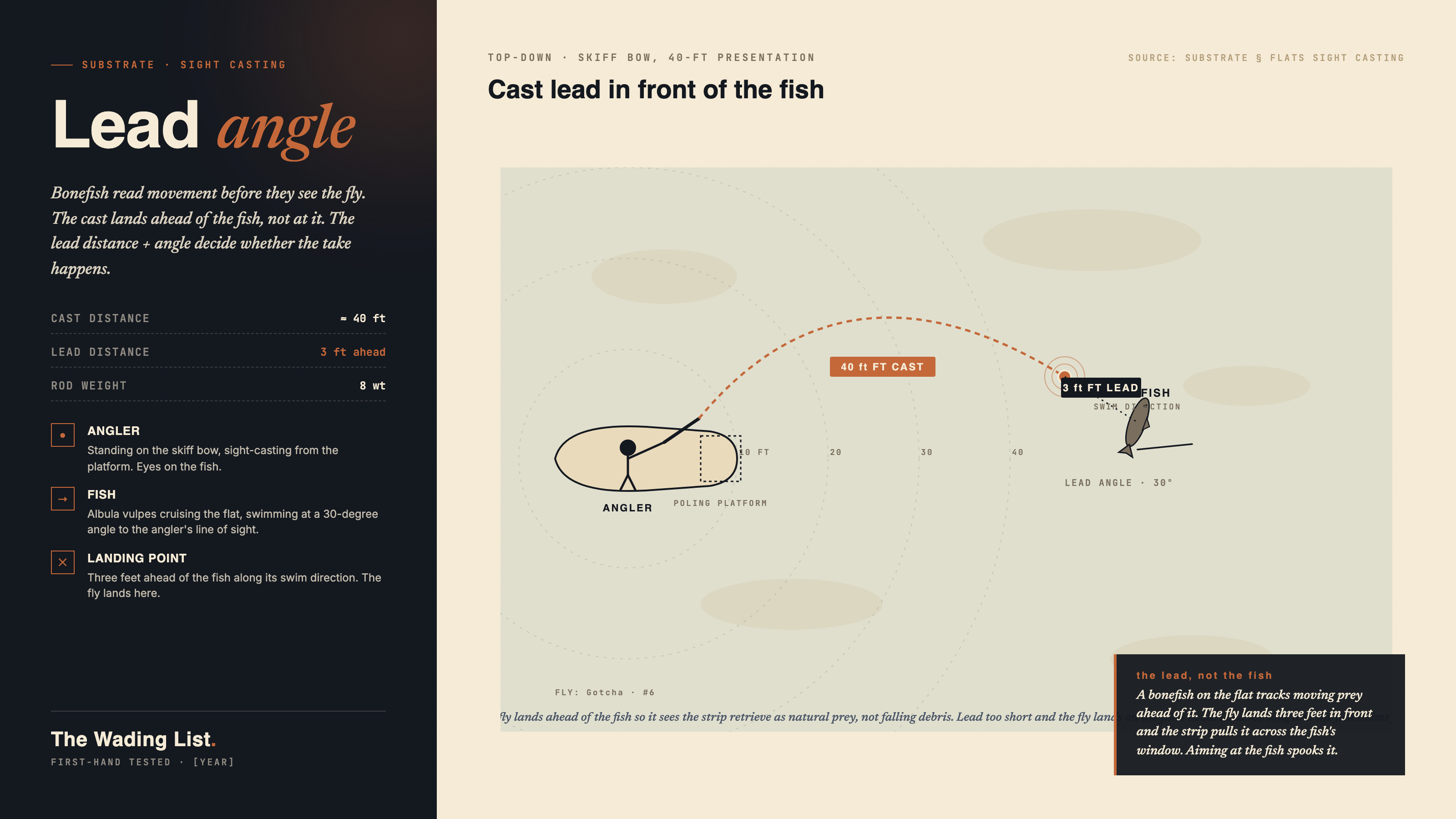
Once the fish is spotted, the lead is the next problem. A bonefish moving across your position at five feet per second is roughly five feet ahead of where you cast every second. Lead it. The fly should land in front of the fish, in its travel lane, not on its head and not behind it. A typical lead on a slow-feeding fish is two to four feet ahead; on a faster cruising fish, six to ten feet.
The strip is the third variable. A weighted shrimp on the bottom is presenting either a fleeing or a hidden prey item. Short, slow strips (an inch or two at a time, with pauses) mimic a shrimp burrowing or hopping. A long, hard strip drags the fly past the fish faster than a real shrimp would move and often spooks the school. When you see the bonefish turn toward the fly and then drop down on it, stop stripping. The take is often a subtle line tightening or a slight pause in the fish’s movement; you set the hook with a strip strike (a hard pull of the line with the rod still pointed at the fish), not a trout-style rod lift.
Where bonefish fishing happens
Bahamas (Andros, Acklins, Crooked Island, Long Island) is the historical heart of the fishery and still the densest mix of large fish and accessible flats. Belize offers smaller average fish but a permit and tarpon combination on the same flats that bonefish use. Mexico (Yucatan, particularly Ascension Bay and the Sian Ka’an biosphere) is similar to Belize. Hawaii (Oahu and Molokai) holds the largest bonefish in the world by average weight; a 10-pound fish in the Bahamas is exceptional, while a 10-pound fish in Hawaii is closer to the norm, and the Hawaiian fishery is mostly DIY wade-only and famously difficult.
Related gear
The 8-weight is the foundational tool. Action profile matters for wind and for loading off short backcasts; saltwater-specific blanks also use corrosion-resistant components and harder reel seats that survive salt exposure. The best saltwater fly rods page covers the 8- to 12-weight range, including the 8-weight builds purpose-designed for bonefish.
Optics are the difference between seeing fish and casting at empty water. Lens material (glass versus polycarbonate), tint (copper, amber, grey), and frame fit on a sweating face on a hot flat all matter more than brand marketing. The best fishing sunglasses page covers the technical differences and the trade-offs between weight, impact safety, and optical clarity.
A sealed drag fly reel is the saltwater-fishing requirement. Unsealed click-and-pawl or unsealed disc drags fail fast in salt and sand. Our guide to the best saltwater fly reels covers sealed-drag construction, arbor sizing for fast line pickup and the brands that dominate the saltwater market.
The bonefish line, leader, and tippet system is its own subset of fly line theory. Tropical-spec coatings, short heavy front tapers, and the fluorocarbon-versus-nylon decision at the terminal end all shape how the fly arrives and how the fish reads it. Our guide to fly fishing line setup covers the full system from backing to tippet.

Leonard Schoenberger is a fly fishing professional and gear specialist with over 20 years of experience on the water. As the manager of Heidarvatn, a world-class sea trout lodge in Iceland, his product recommendations and tactical advice are tested in some of the most demanding conditions on earth. His expertise has been mentioned in The New York Times, the Financial Times, and at the Outdoor Media Summit.