Last updated on September 30th, 2026.
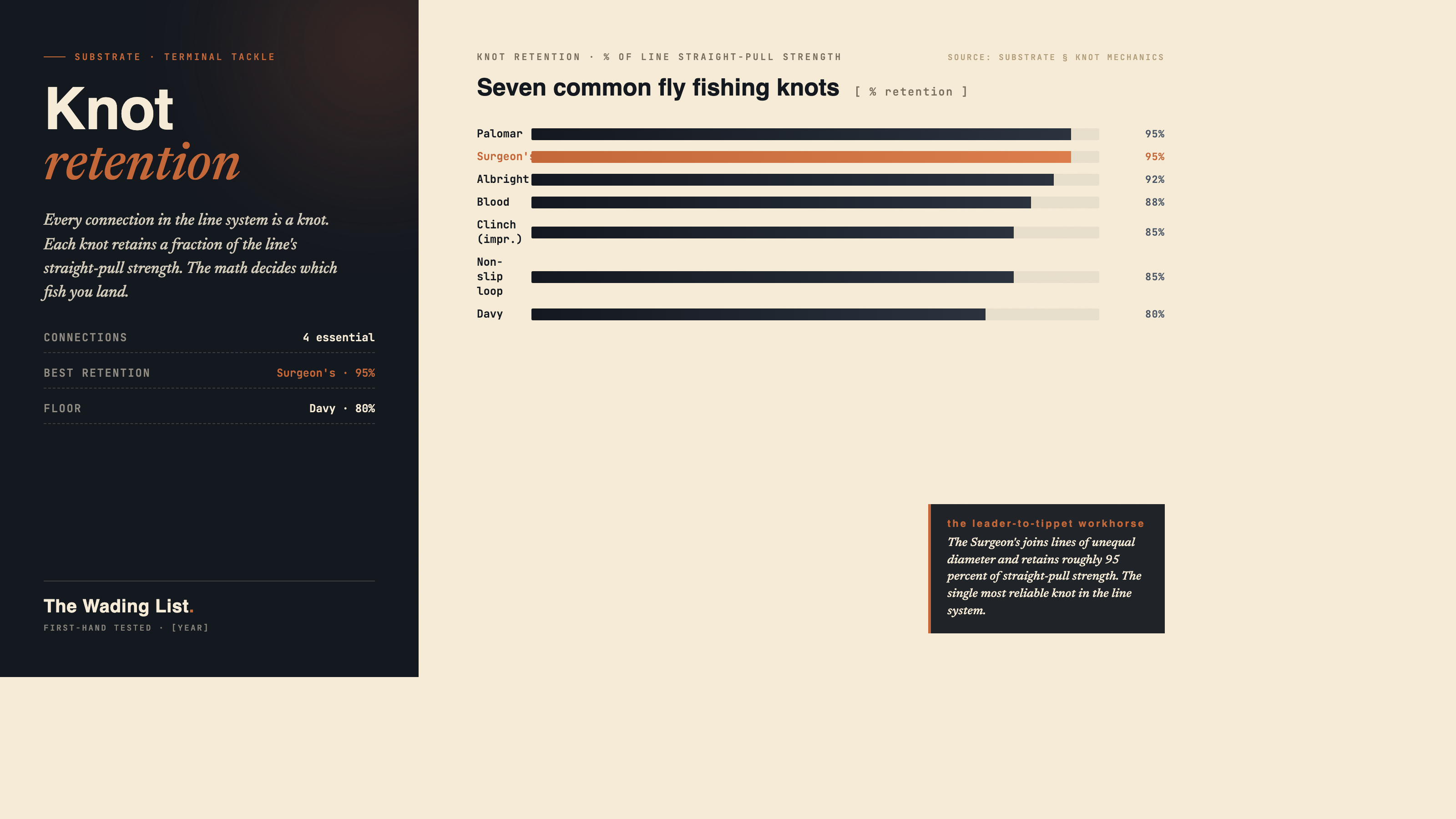
Knots are the breaking-strength gate of the entire fly fishing line system. The strongest tippet in the world is only as strong as the knot that connects it to the next component, and every connection in the rig is a knot. A rated 8-pound tippet does not break at 8 pounds; it breaks at whatever percentage of 8 pounds the knot retains. An improved clinch knot retains roughly 85 percent of the line’s straight-pull strength. A surgeon’s loop retains roughly 95 percent. A poorly seated or crossed knot can retain less than half. That is the math that decides whether you land a fish or watch it swim off with your fly.
Four knots cover the four connections in a standard fly fishing rig: backing to fly line, fly line to leader, leader to tippet, and tippet to fly. Learn those four (with one or two substitutes for specific situations) and you have the entire system covered.
Why knots matter mechanically
A fly fishing rig is four components in sequence: backing, fly line, leader, tippet, then the fly. Each transition between components is a knot. Five total knot points if you count the connection to the reel arbor: arbor knot, backing-to-fly-line, fly-line-to-leader, leader-to-tippet, tippet-to-fly. Every one of those is a potential failure point under load.
Breaking strength gets measured two ways. The first is straight-pull strength on the line itself, which is what the X-rating and the pound-test on the spool refer to. A 5X tippet is roughly 0.006 inches in diameter and rates around 4.75 pounds of straight-pull breaking strength. That is the number printed on the spool. The second is knot strength, which is the percentage of straight-pull strength the knot retains. A clinch knot on 5X does not break at 4.75 pounds. It breaks at about 85 percent of 4.75, which is roughly 4 pounds. A surgeon’s loop on the same 5X retains about 95 percent and breaks at roughly 4.5 pounds. The difference between the two numbers is the difference between a hot run that holds and a hot run that pops.
The mechanism behind knot failure is friction and seating. A knot works by bending the line around itself so that load on one end pulls the other end through wraps that compress under tension and grip themselves. If the wraps are crossed, the load concentrates on a single wrap instead of being distributed across all of them, and the knot fails at that single point. If the knot is not lubricated before being seated (a quick spit on it, or dunk in the river), the wraps tighten dry, generate heat-style abrasion, and weaken the line at the knot. If the tag end is trimmed too short, the wraps slip under load and the knot unravels. Every knot has a specific seating sequence that puts the wraps in the right geometry and a specific tag-end length that prevents slippage. Skipping any of that drops the retention percentage hard.
The takeaway is that no part of a fly fishing rig is stronger than the knot in front of it. The tippet rating is a ceiling, not a guarantee. Knot selection and tying technique are what determine whether you fish at 50 percent of that ceiling or 95 percent.
The four essential connections
The standard fly rig has four knot connections from reel to fly, plus the arbor knot that anchors the backing to the reel. Each connection has a specific knot (or short list of knot substitutes) that solves the specific mechanical problem at that connection.
Backing to fly line
Backing is 20- to 30-pound braided Dacron or gelspun. Fly line is a thick coated taper with a braided or monofilament core. Connecting them means joining a thin braid to a thick coated line, which is a different geometry from joining two pieces of monofilament.
The Albright knot is the traditional solution. The fly line forms a loop, the backing wraps around both legs of the loop and back through itself, the wraps are seated tight, and the connection becomes a small, smooth, low-profile bump that passes cleanly through the rod guides. The Albright works because the wraps of backing compress against the smooth coating of the fly line and grip without slipping.
Loop-to-loop is the modern alternative, and it has largely replaced the Albright on factory fly lines. Most current fly lines ship with a welded loop on the back end (a small permanent loop fused into the coating), and the backing is tied to a Bimini twist or simpler perfection loop, then the two loops handshake through each other. Loop-to-loop is faster to set up, easy to swap fly lines without re-rigging the whole reel, and it passes through the guides just as smoothly as a well-tied Albright. If the fly line has a welded loop, use it. If not, tie an Albright.
Fly line to leader
The fly line is thick and coated; the leader is tapered monofilament with a butt section roughly matched to the tip of the fly line. The connection has to be smooth enough to pass through the rod tip on a fish that runs hot.
The nail knot is the traditional solution. The leader butt wraps around the fly line, threads back through the wraps, and seats into a small bullet-shaped knot that lies flat against the fly line. The name comes from the fact that the wraps were originally formed around a nail (or a small tube) that was withdrawn before the wraps were seated. A well-tied nail knot is essentially invisible and lasts the life of the fly line.
Loop-to-loop is the modern alternative here too. Factory fly lines ship with a welded loop on the front end, the leader has a perfection loop tied into its butt section, and the two loops handshake. Same advantages as loop-to-loop on the backing side: fast, swappable, smooth through the guides. The trade-off is that the loop connection is slightly bulkier than a well-tied nail knot, which matters in spooky-fish situations where the connection lands in a fish’s window. For technical dry fly water, a nail knot is cleaner. For everything else, loop-to-loop is the practical choice.
Leader to tippet
This is the connection that gets retied most often. Every time the tippet wears down (after a few fly changes, or after a fish breaks you off), the worn tippet gets cut back to the leader and a fresh tippet section gets tied on. So the knot has to be quick, reliable, and tieable on the water with cold wet hands.
The double surgeon’s knot is the practical default. Two pieces of monofilament lie alongside each other, an overhand knot wraps around both at once and passes the tag ends through twice (the “double” part), and the whole thing seats into a small, strong, reliable joint. The surgeon’s knot retains roughly 95 percent of the line’s straight-pull strength when tied correctly. It is fast to tie, works between lines of similar or slightly different diameters, and forgives imperfect technique.
The blood knot is the traditional alternative. The two lines wrap around each other in opposite directions, the tag ends pass back through the center, and the knot seats into a slim, cylindrical profile that slides through rod guides more smoothly than the surgeon’s bulkier shape. The blood knot is slightly stronger than the surgeon’s when both are perfectly tied, and noticeably weaker when either is sloppy. It also requires both lines to be reasonably close in diameter (it does not handle a 3X-to-6X transition the way a surgeon’s does). For most anglers in most conditions, the surgeon’s wins on practicality. For careful trout work where the connection has to pass through guides on long casts, the blood knot earns the extra time it takes to tie.
A tippet ring is the modern third option. A tiny metal ring (1.5mm to 3mm, weighing fractions of a gram) gets tied to the end of the tapered leader once, with a clinch knot, and stays there permanently. Each new tippet section gets tied to the ring with another clinch knot. The advantage is that the tapered leader stops getting cut back every time the tippet is replaced, so a $5 leader lasts the full season instead of being whittled down in two weeks. The ring is small enough not to disturb the drift on most water.
Tippet to fly
This is the terminal connection, and the one most likely to fail because it is tied dozens of times a day in field conditions on the thinnest part of the rig.
The improved clinch knot is the default. The tippet passes through the hook eye, wraps five or six times around the main line, passes back through the small loop near the eye, then back through the larger loop just created (the “improved” step). Lubricate, seat slowly with steady pressure, trim the tag. Retention is around 85 percent. The improved clinch is fast, universally taught, and reliable on diameters from 0X down to about 5X. Below 5X, the wraps get fussy and the knot starts losing retention as the line gets thinner.
The Davy knot is a faster, lighter-profile alternative that has gained ground among guide-class anglers. The line passes through the eye, forms a small loop, wraps once or twice around the main line through the loop, and seats. The whole thing takes about five seconds and produces a very small knot that disturbs small dry flies less than a clinch. Retention is comparable to a well-tied improved clinch on monofilament; slightly lower on slick fluorocarbon. The trade-off is that the Davy is less forgiving of imperfect tying than the clinch, so the time savings only pay off after the technique is dialed in.
The non-slip mono loop is the third option, and it solves a different problem: instead of a snug knot that grips the hook eye, it creates an open loop that lets the fly swing freely on the tippet. The line forms an overhand knot above the hook eye, passes through the eye, comes back through the overhand, wraps three to five times around the main line, and seats with the overhand still open as a loop. The fly hangs on that loop and can move independently of the leader. This matters most for streamers, where the lateral wobble of a fly is what triggers strikes; for large dry flies on stiff tippet, where a snug knot can lock the fly’s posture into something unnatural; and for any fly where action is the trigger rather than imitation. For nymphs and most standard dry flies, a clinch knot is fine. For streamers and articulated patterns, the non-slip mono loop is the right tool.
The decision tree for the tippet-to-fly connection is short. Standard dry flies and nymphs: improved clinch (or Davy, if you have it dialed). Streamers and articulated patterns: non-slip mono loop. Anything below 5X with very small flies: Davy or a careful clinch with extra wraps.
Knots for fluorocarbon
Fluorocarbon and nylon monofilament look similar on the spool but behave differently under a knot. The reason traces back to the chemistry of the material. Fluorocarbon polymer is built around the carbon-fluorine bond, one of the strongest single bonds in organic chemistry. The high electronegativity of fluorine reduces the polarizability of the polymer chain, producing a dense, highly stable material with weak intermolecular attractive forces. That dense molecular structure is what gives fluorocarbon its near-water refractive index (around 1.42, much closer to water’s 1.33 than nylon’s 1.49) and its high abrasion resistance. It is also what causes knot problems.
A knot grips by friction between the wraps and the main line. Nylon monofilament is softer and more pliable, so when wraps seat under tension they deform slightly and lock against the main line, increasing the contact area and the friction. Fluorocarbon is harder and denser, and the wraps do not deform as easily. Under load, a fluorocarbon knot can slip incrementally instead of locking, especially in knots like the standard clinch where the wrap count is on the lower end of the range that gives reliable grip.
Two practical adjustments make standard knots work on fluorocarbon. The first is extra wraps. A standard improved clinch on nylon uses five wraps; on fluorocarbon, use six or seven. The extra wraps increase the contact area enough to compensate for the reduced deformation, and retention climbs back into the 80 to 85 percent range. The second is more careful lubrication and slower seating. Fluorocarbon is more sensitive to dry seating than nylon because the harder material is also more abrasion-prone to itself when heated by friction. Wet the knot well, seat it slowly with steady even pressure, and let it set before applying full load.
Alternative knots designed specifically for fluorocarbon include the double-slip knot and the Orvis knot, both of which seat with geometries that lock harder under load on dense polymers than a clinch does. The double-slip knot is essentially a clinch with an extra terminal loop that prevents slippage; the Orvis knot uses a figure-eight wrap that seats into a compact knot with higher retention on fluoro than a clinch. Either is worth learning if a lot of your fishing is on fluorocarbon tippets, particularly subsurface nymphing and saltwater flats where fluorocarbon is the default tippet material.
For the leader-to-tippet connection on fluorocarbon, the surgeon’s knot remains the most reliable choice. Its geometry is less sensitive to the harder material than a blood knot is, which is why most fluorocarbon-heavy anglers tie surgeon’s at the tippet junction even when they would tie blood knots on a nylon-only rig.
Loop knots versus solid knots
The choice between a snug knot at the hook eye and a loop knot at the hook eye is a presentation decision, not a strength decision.
A solid knot (clinch, Davy, Trilene, Palomar) seats tight against the hook eye and locks the fly’s posture relative to the tippet. The fly hangs at a fixed angle and moves with the tippet rather than independently of it. Solid knots are stronger than loop knots because the contact area between the wraps and the main line is larger and the load is concentrated on a single tight junction. For a dry fly that needs to sit flat on the surface, a solid knot is correct: the fly’s posture is what fish key on, and the knot’s job is to hold that posture without disturbing it.
A loop knot (non-slip mono loop, Rapala knot, Kreh loop) leaves an open loop between the main line and the hook eye. The fly hangs on the loop and can swing, dart, and wobble independently of the tippet. Loop knots are slightly weaker than solid knots because the load runs through the loop’s curvature rather than directly along the wraps, and the curvature adds a small stress point. The trade-off is that the fly’s action becomes free. For a streamer, where lateral wobble on the strip-and-pause retrieve is what triggers strikes, a loop knot is essential. A streamer tied on a clinch knot moves in a stiff, unnatural line. The same fly tied on a non-slip mono loop kicks side to side on every strip pause, mimicking an injured baitfish. The fish notice.
For dry flies, the calculus depends on the fly. Small standard dries (sizes 14 to 22) work fine on a clinch knot because their posture is the thing that matters. Larger dries (hoppers, big stoneflies, salmon dries) often benefit from a loop knot because the fly’s silhouette and slight movement become part of the trigger; a stiff snug knot can lock a hopper into an unnatural sit that real hoppers do not have. Anglers who fish big dries regularly carry both options and switch by fly type.
For nymphs, solid knots are the default. Nymph presentations rely on dead drift, not action, so a free-swinging fly is not the goal. A clinch knot keeps the nymph aligned with the tippet and the leader, which is what the indicator or sighter is reading the drift from.
For streamers and articulated patterns, loop knots are the default. Action is the entire point of the presentation, and a snug knot kills the action.
Common errors
Most failed knots fail for one of the same handful of reasons.
The first is not seating the knot wet. A dry knot generates friction heat as the wraps tighten against the main line, and the heat-style abrasion weakens the line at the knot before the knot has even taken its first load. A quick spit on the wraps, or a dunk in the river, drops the friction enough that the knot seats clean and the retention percentage stays at the rated value.
The second is a tag end trimmed too short. The tag is the small piece of line that sticks out past the seated wraps. Under load, the wraps compress and the tag can pull back through if it is shorter than about an eighth of an inch. The fly stays attached for the cast, and the first hard pull from a fish unravels the knot. Leave a sixteenth to an eighth of an inch of tag visible past the wraps.
The third is crossed wraps. When the wraps are formed, each one should sit cleanly next to the previous one, parallel and even. If a wrap crosses over another, the load under tension concentrates at the crossing point instead of being distributed across all the wraps, and the knot fails at that single weak spot. Crossed wraps are most common when tying in a hurry or in cold conditions. Slow down, watch the wraps form, and re-tie if you see a crossing.
The fourth is the wrong knot for the material. A clinch knot on fluorocarbon with only five wraps will slip under hard load. A blood knot connecting a 3X to a 6X will fail because the diameter mismatch is too great. A surgeon’s knot tied on slippery braided line will work loose. Match the knot to the line. The improved clinch is for monofilament and nylon tippets at moderate diameters; switch to a six-or-seven-wrap clinch or an Orvis knot on fluorocarbon. The blood knot is for similar-diameter monofilament; switch to a surgeon’s for larger diameter jumps. The Albright is for braided backing to coated fly line; not for monofilament-to-monofilament.
The fifth is knot creep. A knot that was seated properly at the start of the day can incrementally slip under hours of casting load, particularly on slick fluorocarbon. The fix is to check the tag end periodically. If it has grown noticeably longer (because the wraps have slipped and the tag has been pulled through), re-tie. Better to spend two minutes re-tying than to lose the fish of the day.
The sixth, less common but worth flagging, is mismatched knot purpose. A non-slip mono loop on a small dry fly leaves the fly hanging loose on the loop, which can drag the fly through the surface film on a sensitive drift. A clinch knot on a streamer locks out the action. The knot has a job; pick the knot that does the job, not the knot you know best.
Related gear
The knot system depends on the tools you use to tie it and the material you tie it on. A few cross-references on the site cover the adjacent pieces.
For trimming tag ends cleanly and consistently, sharp nippers are non-negotiable. Dull cutters mash the tag end into a flared mushroom that does not slip back through the wraps cleanly and can compromise the knot’s seating. Our best fly fishing nippers breakdown covers the cutting geometry, the spring-loaded versus simple-pivot designs, and which models hold an edge across a full season of saltwater and freshwater use.
For the step-by-step on the most-used tippet-to-fly knot, how to tie a clinch knot walks through the wrap count, the lubrication step, the seating motion, and the tag-end trim, with notes on the modifications that make the knot work on fluorocarbon.
For the leader-to-tippet connection that gets retied dozens of times a day, how to tie a surgeon’s knot covers the two-pass overhand sequence, the symmetric tightening that keeps both tags aligned, and the diameter range the knot handles cleanly.
For choosing the fly line that the knot system connects to, see our best fly lines for trout, from double-taper lines to shooting heads. The fly line is the largest single mass in the rig and the connection point where loop-to-loop versus nail-knot architecture starts to matter.
For the larger architecture that the knots tie together, fly fishing line setup covers the four-component sequence (backing, fly line, leader, tippet) end to end, the X-rating system that governs tippet diameter, and the fluorocarbon-versus-monofilament chemistry that determines which material belongs on which presentation. The knots covered above are the joints; the line setup guide is the skeleton they hold together.
Summary
Knots are the breaking-strength gate of the rig: a rated 5X tippet (around 4.75 lb) only holds at the knot’s retention percentage of that number. A standard fly rig has four knot connections, plus the arbor knot to the reel: backing to fly line (Albright or loop-to-loop), fly line to leader (nail knot or loop-to-loop), leader to tippet (surgeon’s or blood), tippet to fly (improved clinch, Davy, or non-slip mono loop). Retention percentages: improved clinch around 85 percent, surgeon’s loop around 95 percent, poorly seated knots under 50 percent. Fluorocarbon needs extra wraps and slower seating than nylon because its dense carbon-fluorine bond structure does not deform under the wraps the way softer nylon does. Most knot failures trace back to dry seating, short tag ends, crossed wraps, or the wrong knot for the material.

Leonard Schoenberger is a fly fishing professional and gear specialist with over 20 years of experience on the water. As the manager of Heidarvatn, a world-class sea trout lodge in Iceland, his product recommendations and tactical advice are tested in some of the most demanding conditions on earth. His expertise has been mentioned in The New York Times, the Financial Times, and at the Outdoor Media Summit.