The clinch knot is the terminal connection that ties the tippet to the fly. Two versions exist: the standard clinch, which retains roughly 75 to 80 percent of the tippet’s straight-pull breaking strength, and the improved clinch, which adds a final tuck through the loop and pushes retention closer to 85 percent. For everyday trout fishing on tippets in the 4X to 6X range, the improved clinch is the working standard, and the version this page walks through.
The knot only works if the wraps seat cleanly against each other under tension. Most clinch knot failures are not the knot itself but the moisture step and the seating step done sloppily. Get those two right and the knot fishes within its rated breaking strength every cast.
How the knot works
A clinch knot is a sliding-loop knot. Five wraps of the tag end spiral around the standing line, the tag is passed back through the small loop just above the fly’s eye, and on the improved version, tucked one more time through the larger loop that the tag’s first pass creates. When the angler pulls the standing line, the wraps slide down toward the eye, compressing against each other and against the eye of the hook. That compression is what grips the line. Under load, the friction between the wraps and against themselves resists the line’s tendency to pull straight through.
Knot strength is dictated by two things: how evenly the wraps lay against each other, and whether the line is lubricated before seating. Nylon and fluorocarbon both heat up when seated dry; the friction of the wraps tightening on each other generates enough heat to weaken the line at the knot. Spit, river water, or a wet finger across the tag end before pulling tight prevents that heat damage. This is the single biggest reason for unexplained break-offs on fish that should not have broken off.
The five-wrap count is calibrated for monofilament and fluorocarbon in the 0X to 6X range. On heavier saltwater tippet (20-pound and up), seven wraps work better because the line is stiffer and needs more wrap area to seat. On extremely fine tippet (7X and 8X for midge fishing), four wraps is enough and easier to seat without pinching the line.
Fluorocarbon’s chemistry matters here. The carbon-fluorine bond is exceptionally strong, but the material is harder, denser, and stiffer than nylon. Stiff line needs more attention to seating; dry-seated fluorocarbon clinch knots fail far more often than nylon ones because the wraps do not compress evenly without lubrication. If a fluorocarbon tippet feels like it is springing the knot loose as you tighten it, stop, wet it again, and pull more slowly.
The improved clinch step by step
The version below is the improved clinch, the trout-fishing standard.
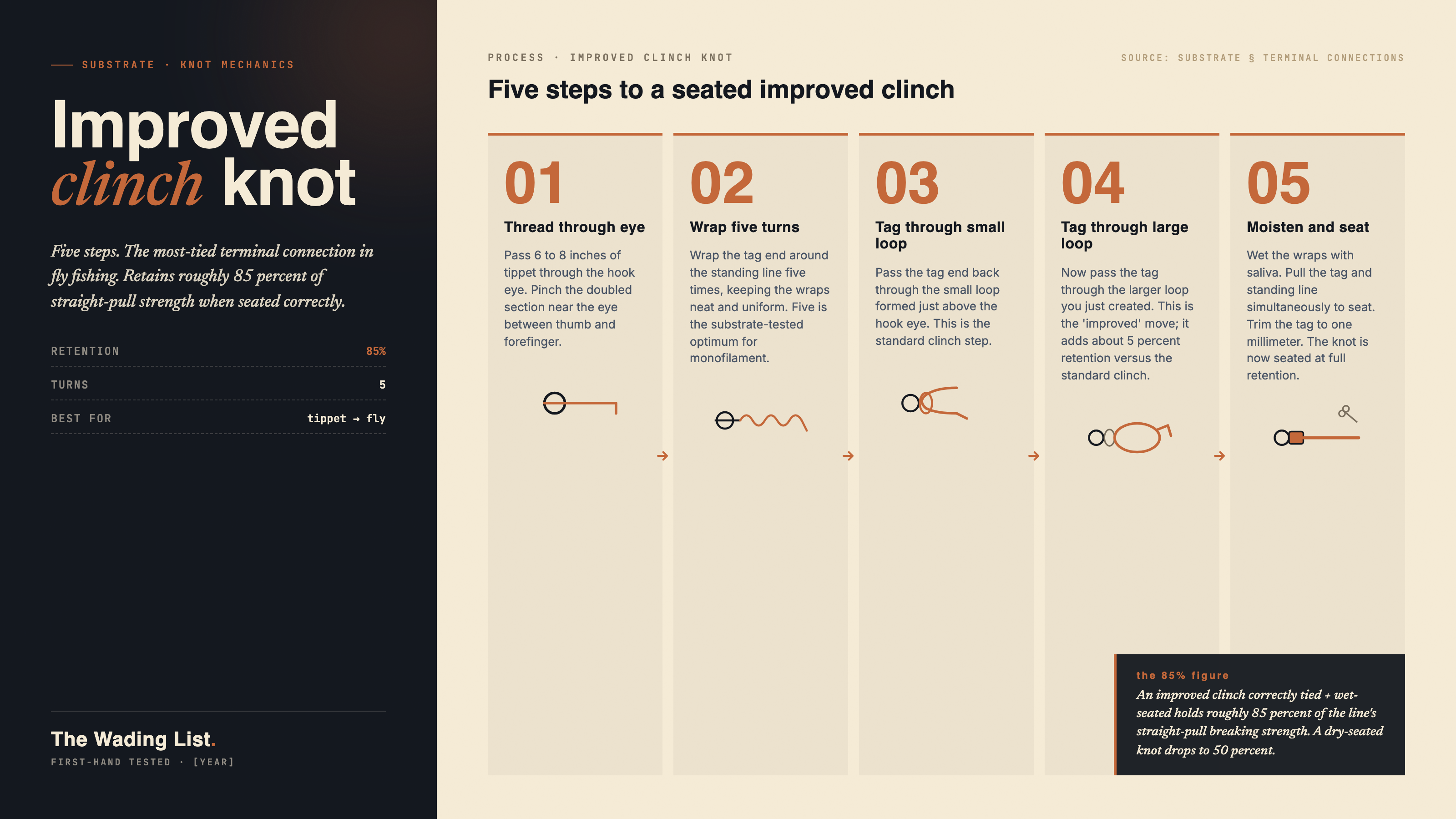
Pass the tag end of the tippet through the eye of the hook from front to back. Pull about six inches of tag through, enough to work with comfortably. Holding the tag and standing line parallel between thumb and forefinger of one hand, use the other hand to take the tag end and wrap it around the standing line five times, moving away from the eye. Keep the wraps spaced and lying parallel to each other; do not let them cross over.
After the fifth wrap, take the tag end and pass it through the small loop formed right above the eye of the hook, between the first wrap and the eye. The tag now sticks out perpendicular to the line, with a larger loop hanging behind it.
For the improved version, take the tag end one more time and tuck it back through that larger loop, the one made by the tag’s first pass through the small loop. This second tuck is what separates the improved clinch from the standard clinch.
Now lubricate. A short wet of saliva or river water across the wraps. Holding the fly steady (a hemostat or your fingers on the bend of the hook), pull the standing line slowly and steadily away from the eye. The wraps will spiral and seat. The tag end will be pulled inward as the knot tightens. Pull until the knot is firmly compressed against the eye of the hook; do not jerk.
Trim the tag close to the knot with sharp nippers. A clean, flush trim sits flat against the wraps; a ragged or long tag picks up debris and catches in the rod guides.
Common failures and how to read them
A clinch that breaks on the strike or on a hookset, with a curly pigtail at the broken end, was almost certainly seated dry. The heat damage weakens the line right at the knot, and the failure leaves the telltale curl. Lubricate next time.
A clinch that breaks during a fight, leaving a clean square cut, usually means the tippet itself was nicked or abraded somewhere along its length, not a knot failure. Run the tippet between thumb and forefinger after every fish or every snag; replace it if you feel any rough spot.
A clinch that pulls loose under tension, with the tag end longer than it should be, was either undertensioned (wraps not seated tight against each other) or had too few wraps for the line diameter. Tie again with more attention to seating, or add a wrap.
A clinch that fails repeatedly on heavy fluorocarbon is calling for a stronger knot. The non-slip mono loop and the Eugene bend hold heavier fluorocarbon more reliably than any clinch variant. Use the clinch for tippet to fly inside the trout range; switch to a stronger knot for saltwater and streamer rigs.
Clinch versus improved clinch
The standard clinch skips the final tuck through the larger loop. It is faster to tie, holds adequately on light tippets with a careful seat, and is the version most beginners learn first because it is simpler. The improved version adds the second tuck and gains roughly 5 to 10 percent in retained breaking strength. On 5X tippet rated at six pounds, that is the difference between a knot rated near five pounds and a knot rated near five and a half. On a strong fish on light tippet, the improved version is worth the extra two seconds.
The Trilene knot is a close cousin: same five wraps, but the tag passes through the eye of the hook twice before wrapping. This creates a small double loop at the eye that distributes wear and resists eye-cutting on hooks with rough or under-finished eyes. On hooks where you can feel a burr at the eye, the Trilene is a better choice than the improved clinch.
The Davy knot and the Orvis knot are recent alternatives that retain similar breaking strength with less line wasted in the knot itself (useful in competition contexts where tippet length is regulated). They are worth learning if you find yourself rebuilding leaders frequently, but the improved clinch remains the universal default.
Related gear
Tying knots well is half the connection; the other half is cutting them clean. A pair of sharp, well-machined nippers cuts the tag flush against the wraps without crushing the line or leaving a fuzzed end. The best fly fishing nippers page covers the differences between forged steel, carbide-insert, and titanium models, and why a dull pair of nail clippers (the default substitute) is actually one of the worst things you can put on the end of your tippet.
A pair of forceps or fishing pliers is the other piece. Forceps grip the bend of the hook while you tighten the knot, which keeps your fingers out of the way of the point and lets you seat the knot under cleaner tension. The best fishing pliers page covers the trade-offs between needle-nose, split-ring, and standard models, plus the corrosion-resistant builds that survive saltwater.
The knot is only as strong as the tippet it connects. The tippet itself is the thinnest section of a tapered leader, and matching its diameter to the fly size matters for both knot strength and presentation. Our guide to tippet covers the X-rating system, the rule of three for fly size matching, and the chemistry difference between nylon and fluorocarbon that changes how the knot seats.
When the clinch is not the right knot, the surgeon’s knot is usually next. The surgeon’s knot joins two pieces of line of unequal diameter, which is what you need when you rebuild a tapered leader by adding a fresh section of tippet to a worn one. Our surgeon’s knot guide walks the tie step by step and explains where it fits in a leader-building sequence.

Leonard Schoenberger is a fly fishing professional and gear specialist with over 20 years of experience on the water. As the manager of Heidarvatn, a world-class sea trout lodge in Iceland, his product recommendations and tactical advice are tested in some of the most demanding conditions on earth. His expertise has been mentioned in The New York Times, the Financial Times, and at the Outdoor Media Summit.