Last updated on September 30th, 2026.
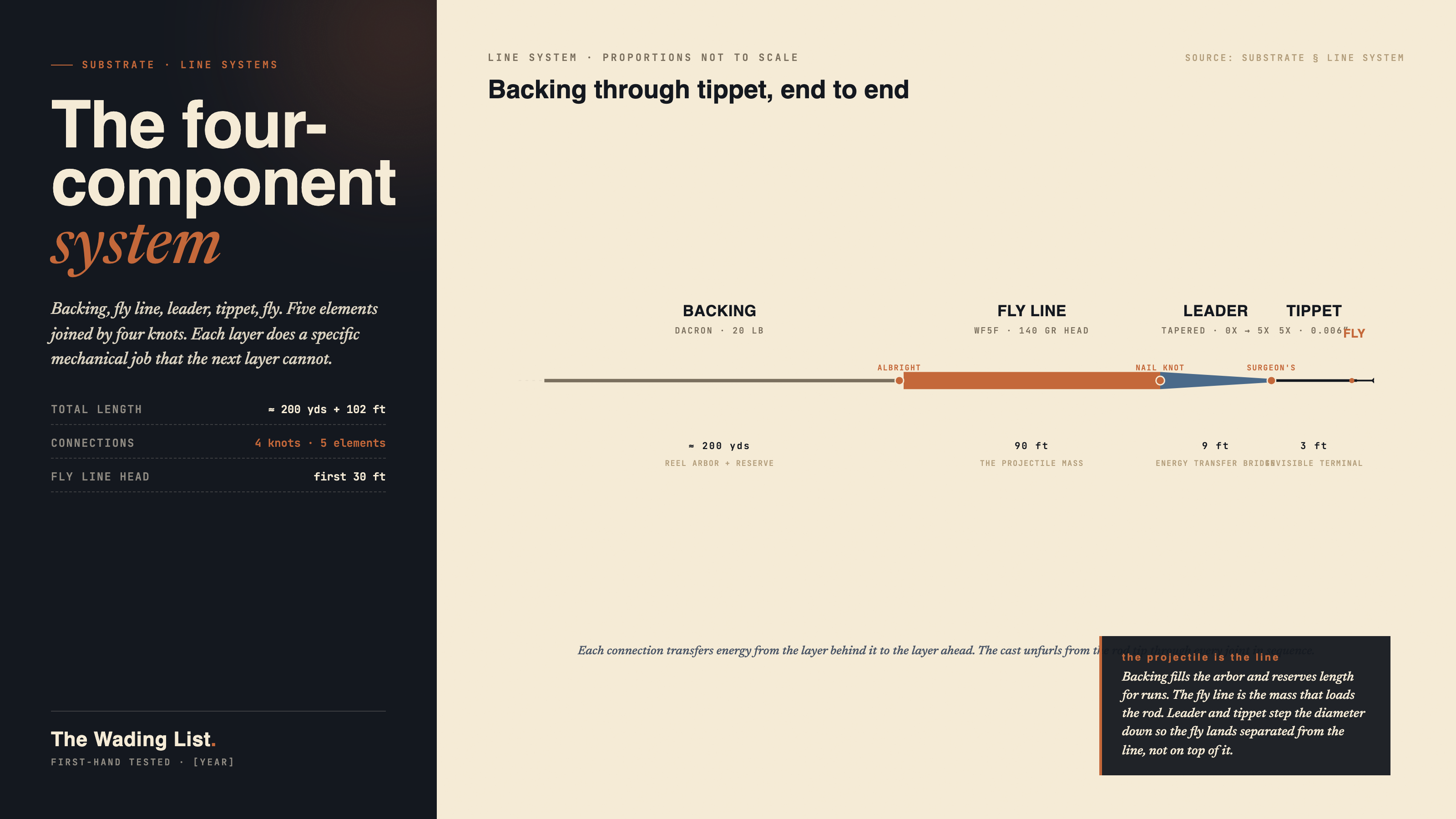
A fly fishing line setup is four components attached in sequence between the reel and the fly: backing, fly line, leader, and tippet. Each component does a specific mechanical job, and the sequence is not interchangeable. Backing fills the reel arbor and reserves hundreds of yards of line for fish that run. The fly line is the projectile mass that loads the rod and carries the cast. The leader is a tapered monofilament that translates the unrolling energy of the fly line down toward the fly. The tippet is the thin, near-invisible terminal section that connects to the fly.
Everything else (weight-forward versus double-taper, fluorocarbon versus nylon, 9-foot trout leader versus 20-foot Euro nymph leader) is variation inside that four-part architecture.
The four-component system
In conventional spin or bait fishing, a single thin monofilament line runs from the reel directly to the lure. The lure’s mass carries the cast; the line is a tether. Fly fishing inverts that completely. The fly weighs fractions of a gram and cannot punch through air on its own, so the line itself is built heavy. That decision (heavy line, light fly) cascades into the rest of the setup. A heavy, brightly colored fly line cannot connect directly to a hook without spooking the fish. So a tapered monofilament leader bridges the visible line to the invisible terminal section. The reel cannot hold 90 feet of thick coated fly line tightly enough to land a running fish, so a thin braided backing fills the arbor underneath the fly line and provides hundreds of yards of reserve. Four layers, each solving a problem the other three create.
The order, from reel out to fly, is fixed: arbor of the reel, backing knot, backing (90 to 300 yards depending on target species), connection knot, fly line (typically 90 feet), loop-to-loop or nail-knot connection, leader (typically 9 feet tapered), tippet ring or surgeon’s knot, tippet (2 to 4 feet, level), clinch knot, fly. That is the entire system.
The anatomy of each component
Backing is the bottom layer on the spool, and it serves two functions. The first is mechanical: it fills the arbor so the fly line stores in large coils rather than tight ones. Tight coils memorize their shape and come off the reel as kinked spirals; large coils come off straight. The second is reserve: when a strong fish runs past the 90-foot length of the fly line, the backing is the only thing between the angler and a lost fish. Standard backing is 20-pound braided Dacron for trout, 30-pound gelspun for saltwater. Trout reels typically hold 100 yards of backing; saltwater flats reels hold 200 to 300 yards under the fly line because bonefish, permit, and tarpon routinely make runs that long.
Fly line is the projectile mass. Modern fly lines are built around a braided nylon or monofilament core coated in PVC or polyurethane. The coating dictates both the line’s taper geometry and its buoyancy (floating, intermediate, sinking, or sink-tip). The American Fly Fishing Trade Association (AFFTA) assigns grain weights to the first 30 feet of every fly line so that rod manufacturers can design blanks that flex optimally under a specific mass. A 5-weight line, the trout standard, weighs 140 grains in that head section, plus or minus 6 grains. The lubricants and UV inhibitors blended into the coating by manufacturers like Scientific Anglers, Rio, and Cortland reduce friction through the rod guides and maintain slickness across temperature ranges.
Leader is the tapered monofilament between the fly line and the tippet. A leader is not a single strand of uniform thickness. It is a tapered geometry consisting of a heavy butt section (the same diameter as the tip of the fly line, so the energy transfer is smooth), a midsection that steps down progressively, and a delicate terminal end. The taper is the entire point. As the loop of the fly line unrolls and reaches the leader, the diminishing diameter allows the energy wave to keep traveling forward and turn the fly over at the end, instead of piling up in a heap on the water.
Tippet is the thin, near-invisible terminal section where the fly is tied. It is level (not tapered), it is the most replaceable part of the system (every time you change a fly, you shorten the tippet by an inch or two), and it is the part where breaking strength is genuinely at risk. The tippet is sold on small spools in standardized diameters keyed to the X-rating system. Anglers typically tie 2 to 4 feet of tippet to the end of a tapered leader rather than fishing the leader to the fly directly, because the tippet is what gets used up over the course of a day.
The taper logic
Fly lines come in four common taper geometries, each engineered for a different presentation problem.
Weight-forward (WF) lines concentrate the mass in the front 30 to 40 feet, with a thin running line trailing behind. The forward weight loads a modern fast-action rod efficiently at typical fishing distances and turns over heavy or wind-resistant flies. Weight-forward is the default for almost everything: dry flies at normal range, indicator nymphing, streamers, saltwater. If you are buying one line for a 9-foot 5-weight trout rod, it is a weight-forward floating line.
Double-taper (DT) lines maintain a consistent diameter through the belly before tapering down at both ends. The geometry excels at delicate short-range presentations because the belly thickness is uniform regardless of how much line is in the air. Double-tapers roll-cast beautifully, mend with precision, and can be reversed on the reel when one end wears out (effectively giving the line two lives). The trade-off is distance: a double-taper does not punch into wind or load a fast rod at long range the way a weight-forward does.
Shooting taper (ST), often called a shooting head, is a short, heavy front section attached to a thin running line. Shooting heads exist for extreme-distance work and for two-handed Spey systems where the rod size dictates a specific head weight. The angler holds the head outside the rod tip, false-casts to load the rod, then releases the running line on the forward cast so the head pulls a long, low-friction trailer through the guides.
Level (L) lines have no taper at all. They are essentially level monofilament. Modern fly fishing uses level lines almost exclusively in one context: Euro nymphing, where the angler keeps the fly line entirely on the reel and fishes 18 to 25 feet of level monofilament directly off the rod tip, with a brightly colored sighter section in the middle to detect strikes. The whole point of a Euro setup is to eliminate the drag-inducing weight of a traditional fly line from the water.
Leader length follows water type and target species. The standard trout leader is 9 feet, knotless and tapered, stepping from a heavy butt down through a midsection to a 4X or 5X tippet. Saltwater leaders are shorter (6 to 9 feet) and built around heavy 40- to 60-pound butt sections that can drive large, weighted flies into coastal winds. Euro nymphing abandons traditional tapers entirely: 18 to 25 feet of level monofilament with a sighter, no taper to speak of. Spey and Skagit setups use specialized heavy butt sections matched to the line system.
The 9-foot trout leader is the most-sold leader length on the planet for a reason. Nine feet is long enough to separate the visible fly line from the fly by a meaningful distance, short enough to turn over reliably under typical trout casting loads. Anything shorter compromises the visual separation; anything longer takes a more skilled caster to turn over cleanly.
The X-rating system
Tippet diameter is measured by the X-rating system, which denotes diameter in thousandths of an inch. The rule is to subtract the X-number from 11 to get the diameter. So 0X is 0.011 inches, 5X is 0.006 inches, 8X is 0.003 inches. The breaking strength scales with diameter (roughly), but the X-rating refers to diameter, not pound-test directly.
| X-rating | Diameter (inches) | Typical breaking strength | Trout fly sizes |
|---|---|---|---|
| 0X | 0.011 | ~15.5 lb | 1/0 to 4 (heavy streamers) |
| 1X | 0.010 | ~13.5 lb | 4 to 8 (large streamers) |
| 2X | 0.009 | ~11.5 lb | 6 to 10 |
| 3X | 0.008 | ~8.5 lb | 8 to 12 |
| 4X | 0.007 | ~6 lb | 10 to 14 (standard trout dry flies) |
| 5X | 0.006 | ~4.75 lb | 14 to 18 |
| 6X | 0.005 | ~3.5 lb | 16 to 22 |
| 7X | 0.004 | ~2.5 lb | 18 to 24 (tiny midges, spooky fish) |
| 8X | 0.003 | ~1.75 lb | 20 to 28 (specialty technical work) |
Pairing tippet to fly size uses a simple rule of thumb: divide the hook size by three to get the tippet X. A size 12 dry fly pairs with 4X tippet (12 ÷ 3 = 4). A size 18 midge pairs with 6X (18 ÷ 3 = 6). A tiny size 24 pairs with 8X (24 ÷ 3 = 8). The match exists because the tippet has to be thin enough that a small fly can move naturally on it (a stiff 3X tippet on a size 22 Trico kills the drift), but heavy enough that an actual hookup does not snap. Too heavy and the fly skates wrong; too light and the fish breaks you off.
Regardless of the rated breaking strength, the knot is what fails first in almost every case. An improved clinch knot retains about 85 percent of the line’s straight-pull strength. A surgeon’s loop retains roughly 95 percent. A poorly tied or unseated knot can retain less than 50 percent. Replacing tippet is cheap; replacing a hooked fish is impossible.
Fluorocarbon versus monofilament
The terminal connection is built from one of two materials: nylon monofilament or fluorocarbon. They behave differently underwater because their chemistry is different.
Fluorocarbon has a refractive index of approximately 1.42, which is much closer to the refractive index of water (1.33) than nylon monofilament (~1.49). The closer the refractive index of the line to the refractive index of the surrounding water, the less the line bends light at the boundary, and the harder it is for a fish to see. Fluorocarbon is therefore significantly less visible to fish under water than nylon.
Fluorocarbon is also denser than water and sinks. Nylon monofilament floats (or sits in the surface film) until it is waterlogged. Density matters in subsurface presentations: a sinking fluorocarbon tippet drops to the depth of a weighted nymph without lifting the fly toward the surface, and a heavy butt section of fluorocarbon helps drive a streamer down. The same property is a liability in dry fly fishing: a sinking fluorocarbon tippet pulls a floating dry fly down through the surface film, which kills the presentation. For dry fly work, nylon mono is the right material.
Abrasion resistance is the third differentiator. Fluorocarbon is harder and more abrasion-resistant than nylon, which matters around coral, sharp rocks, mussel-encrusted structure, and the abrasive jaws of saltwater predators. The molecular chemistry behind this is the carbon-fluorine bond, one of the strongest single bonds in organic chemistry. The high electronegativity of fluorine reduces the polarizability of the polymer chain, producing a dense, highly stable material with weak intermolecular attractive forces. That same structure is what makes fluorocarbon hydrophobic and lipophobic (it does not absorb water or oils), which is why it does not weaken in saltwater the way nylon does over a long day.
The practical rule is: fluorocarbon for nymphs, streamers, saltwater flats, and any presentation where line visibility under the surface is a factor. Nylon for dry flies and dry-dropper rigs where the leader has to sit in or above the surface film.
For a full breakdown of the chemistry, application matrix, and how to choose between them by water type, see our fluorocarbon vs monofilament leader guide.
Common setups by use case
The four-component architecture is fixed. The specifics inside it shift by what you are fishing.
Trout dry fly rig. Weight-forward floating 5-weight line, 9-foot 5X nylon tapered leader, 18 to 24 inches of 5X or 6X nylon tippet, size 14 to 18 dry fly. Floating line so the visible portion sits on top of the water. Nylon tippet so the tippet stays in the surface film and does not drag the fly under. 5X tippet because that is the breaking-strength sweet spot for a standard 14- to 16-size dry fly. The whole rig is engineered to deliver a fly that sits on the surface like a real insect.
Trout nymph rig (indicator). Weight-forward floating 5-weight line, 9-foot 4X nylon tapered leader, strike indicator on the leader, 2 to 4 feet of 4X or 5X fluorocarbon tippet, weighted nymph (and often a second nymph dropped 12 to 18 inches below the first). The indicator keeps the rig at a specific depth and signals the strike. The fluorocarbon tippet sinks and keeps the nymphs in the strike zone. Two flies cover two depths or two patterns.
Streamer rig. Weight-forward floating or sink-tip 6- or 7-weight line, short 4- to 6-foot leader stepping down to 0X to 2X fluorocarbon or stout nylon, a single weighted streamer. The leader is short and stout because a long delicate leader will not turn over a heavy weighted fly, and because a hard predatory strike puts the connection under load. Sink-tip lines are common because they drop the fly to mid-column depth on the retrieve.
Saltwater flats rig (bonefish). 8-weight weight-forward floating saltwater line, 9- to 12-foot tapered leader, 16- to 20-pound fluorocarbon tippet, weighted shrimp pattern (Crazy Charlie, Gotcha). Long leader for separation from a brightly colored line that bonefish can see in clear shallow water. Fluorocarbon for abrasion resistance against coral and sharp bottom. Weighted fly to drop fast onto a moving fish in 1 to 3 feet of water.
Euro nymph rig. 10- to 11-foot 3-weight Euro-specific rod, level fly line (or no fly line in the water at all), 18 to 25 feet of 0.014- to 0.017-inch level monofilament with a brightly colored sighter section in the middle, tippet ring, 4 to 6 feet of 5X to 6X fluorocarbon tippet, weighted nymph (and often a dropper). The whole geometry exists to eliminate the drag of a heavy fly line and let the angler feel and see the strike directly through the level monofilament.
Spey or two-handed rig (steelhead). 12- to 14-foot two-handed rod, Skagit or Scandi shooting head, 10- to 15-foot sink-tip (Skagit) or polyleader (Scandi), short 4- to 6-foot tippet section in 8- to 12-pound test, large weighted streamer or swung wet fly. Skagit heads are short and heavy to throw big, weighted flies for winter steelhead; Scandi heads are longer and lighter for surface-oriented summer-run presentations.
These are starting points, not laws. Anglers customize within each archetype based on water clarity, fish pressure, hatch conditions, and personal preference. The four-component architecture stays the same; the specifics shift.
Related gear
The four-component system spans several gear categories, each of which has its own dedicated guide on the site.
For choosing a fly line itself (taper, density, brand, intended use), our best fly lines for trout compare the Scientific Anglers, RIO and Cortland lines for trout, and the best saltwater fly line guide covers the salt. The line is the single biggest performance variable in a fly setup after the rod, and matching the line to the rod’s design weight is non-negotiable.
For a deep treatment of the terminal connection, fluorocarbon vs monofilament leader covers the chemistry, refractive index, density, and abrasion resistance that determine which material belongs on which presentation.
For tippet specifically, what is a tippet covers the X-rating system, the hook-size-to-tippet pairing rule, knot retention percentages, and how to extend the working life of a tapered leader by re-tipping rather than replacing.
For the rod end of the setup, best trout fly rod covers the 4- to 6-weight freshwater workhorses that pair with the standard 9-foot tapered leader and weight-forward floating line described above. For salt, best saltwater fly rod covers the 8- to 12-weight heavy-line builds that pair with short stout leaders and heavily weighted flies.
The rod, the line, the leader, the tippet, and the fly are the irreducible core of any fly fishing setup. Everything else (the reel, the backing, the indicators, the sink tips, the strike detectors) attaches to or adjusts that core. Get the four-component sequence right and the rest of the gear fits around it.

Leonard Schoenberger is a fly fishing professional and gear specialist with over 20 years of experience on the water. As the manager of Heidarvatn, a world-class sea trout lodge in Iceland, his product recommendations and tactical advice are tested in some of the most demanding conditions on earth. His expertise has been mentioned in The New York Times, the Financial Times, and at the Outdoor Media Summit.