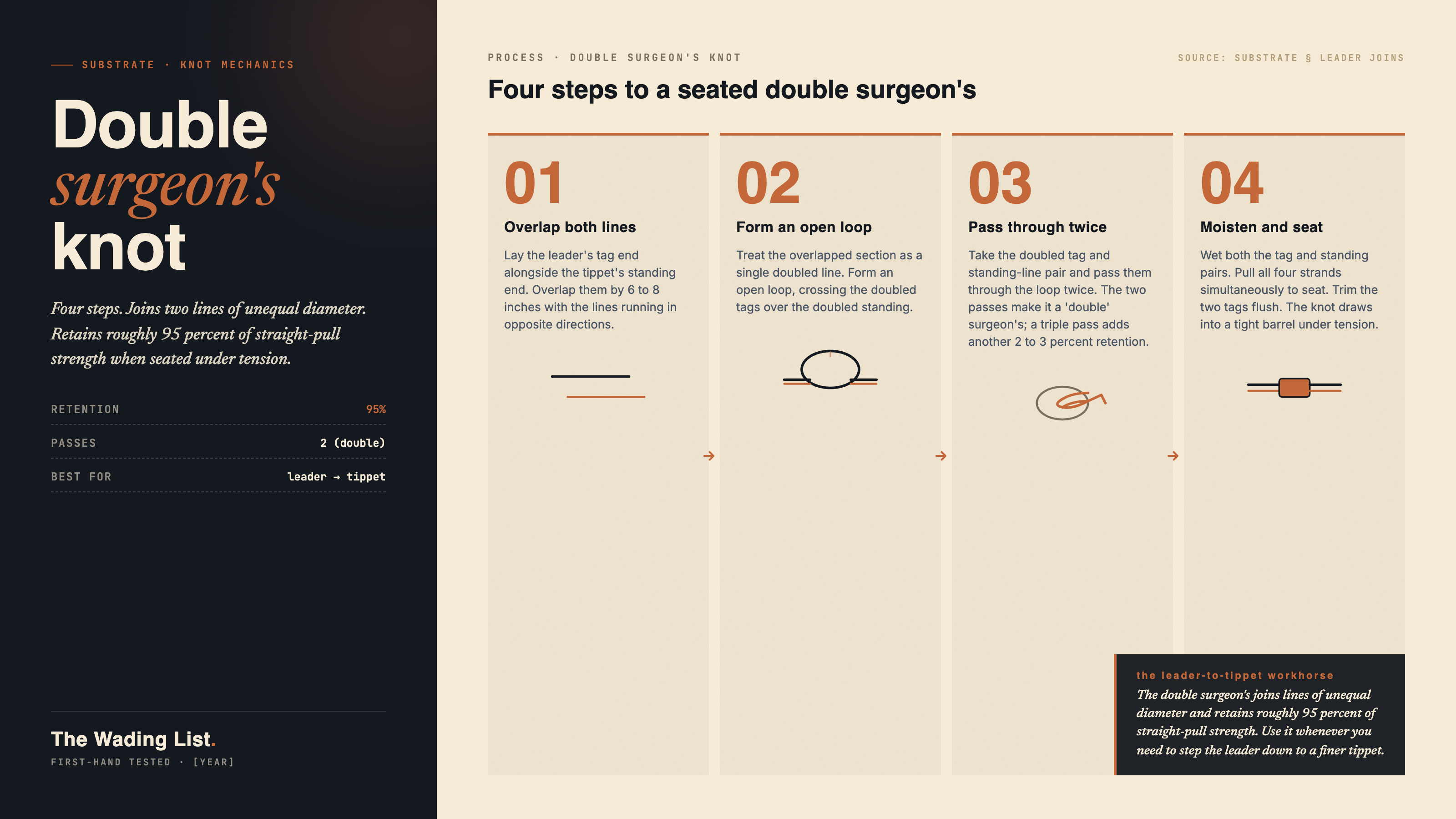
The surgeon’s knot joins two pieces of line of unequal diameter. Its most common use in fly fishing is rebuilding the tapered leader: tying a fresh tippet section onto a leader whose own terminal end has been shortened by repeated fly changes. The knot retains roughly 90 to 95 percent of the breaking strength of the thinner of the two lines being joined, which is the highest retention figure of any practical leader-to-tippet connection.
The version most fly anglers use is the double surgeon’s knot, two wraps through the loop. A triple surgeon’s adds a third wrap and is slightly stronger on heavy mismatches (joining 12-pound butt to 6-pound tippet, for example) but is rarely worth the extra step in standard trout fishing.
How the knot works
A surgeon’s knot is an overhand knot tied with both lines together as if they were one piece. Lay the two pieces parallel, with about six inches of overlap. Form a single loop with the doubled section, like the first half of any overhand knot. Pass the entire doubled tag (both lines together) through that loop. For the double surgeon’s, pass through a second time. Wet the knot. Pull all four ends evenly to seat.
The knot’s strength comes from how the wraps tighten against each other. Each wrap creates a friction surface between the two lines; under tension, the surfaces press inward and grip both lines simultaneously. Because both lines pass through the same wraps in the same direction, the load distributes more evenly than in knots where one line wraps around the other. This is why the surgeon’s knot retains more breaking strength than the blood knot (the older standard for leader rebuilds) when joining lines of different diameter.
Mismatched diameters are where the surgeon’s knot beats every alternative. A blood knot needs the two lines to have similar diameters because the wraps depend on each line gripping its opposite cleanly; mismatch the diameters by more than two X sizes and the blood knot starts pulling out. The surgeon’s knot grips both lines as a single doubled bundle, so the diameter mismatch matters far less. Joining 0X butt section to 5X tippet (a five-X spread) is well within the surgeon’s knot’s working range.
The wet-before-seating rule applies here as much as it does to any knot. The wraps compressing under tension generate friction heat; on fluorocarbon, dry seating produces enough heat to weaken the knot. A short wet of saliva or river water across the wraps before pulling tight prevents the damage.
Tying the double surgeon’s knot
Place the two pieces of line side by side, parallel, with about six inches of overlap. The tag end of each line points in the opposite direction from the other.
Take the doubled section in one hand. Form a loop by laying the two lines back over themselves. The loop should be about three inches across.
Pass the entire doubled tag through the loop. Both lines together, as one bundle. Pull a few inches through.
For the double surgeon’s, pass the doubled tag through the loop a second time, in the same direction. Now you have a loose double-overhand structure with four line ends sticking out: the two long lines (the standing parts) on one side and the two short tags on the other.
Wet the knot. Saliva or water across the wraps.
Pull all four ends, slowly, simultaneously, to seat. Both standing lines and both tag ends should be pulled at the same time so the knot tightens symmetrically. This is the step that separates a clean surgeon’s knot from a sloppy one. If you pull only the standing parts, the tags get drawn back through unevenly and the knot rolls into a lopsided bundle that loses strength.
Inspect the seated knot. The wraps should lie flat, side by side, with no crossing over. Trim both tag ends close to the knot with sharp nippers.
Triple surgeon’s variation
For the triple surgeon’s, repeat the pass through the loop one more time before seating. Three wraps total. The triple is marginally stronger than the double when joining very mismatched lines (heavy butt to fine tippet in saltwater leader builds, for example) and is the version some saltwater anglers default to.
The cost of the triple is bulk. The seated knot is larger, catches in the rod guides more readily during a cast, and uses more line. For standard trout leader rebuilds (joining 4X to 5X, or 3X to 4X, where the diameter mismatch is small), the double is sharper, smaller, and just as strong.
Surgeon’s loop
The surgeon’s loop is the loop-knot version of the same construction. Instead of joining two lines, the surgeon’s loop forms a loop in the end of a single line. Useful for creating a loop in the butt of the leader for a loop-to-loop connection with the fly line.
Double the end of the line back on itself. The doubled section becomes your tag. Form a loop with the doubled section. Pass the doubled tag through the loop twice. Wet and seat.
The surgeon’s loop is faster to tie than the perfection loop and almost as strong. The perfection loop has the advantage of laying straight in line with the standing part (it does not pull off to one side under load), which matters when the loop is at the butt of the leader and you want the leader to track straight off the fly line. The surgeon’s loop tracks slightly off-axis, which is barely noticeable on the tippet but visible at the leader butt. For most fly fishing applications, the perfection loop is the better choice at the leader-to-fly-line junction; the surgeon’s loop is the right call when speed matters or when you need a loop in tippet material in the middle of fishing.
Surgeon’s knot versus blood knot versus square knot
The blood knot is the classic leader-rebuild knot, used widely before the surgeon’s gained popularity in the 1970s and 80s. It is more compact than the surgeon’s (the wraps roll into a tight cylindrical seat) and looks cleaner, but it requires the two lines to be within roughly two X sizes of each other to grip reliably. For matched-diameter joins (rebuilding a leader inside its own tapered section), the blood knot is still common. For mismatched-diameter joins (tippet to leader butt), the surgeon’s knot is the better choice.
The square knot is a name confusion. A square knot is not a fishing knot; it is a reef knot used for joining ropes of similar diameter, and it slips under tension on monofilament. The surgeon’s knot is sometimes mistakenly called a square knot because of the symmetric appearance of the seated wraps, but they are different constructions with very different breaking strengths. Use the surgeon’s knot for fishing; the square knot belongs in a first-aid kit.
The Orvis knot (sometimes called the Orvis tippet knot) is a newer alternative that some anglers prefer for the speed of the tie. It is competitive on strength but less universal in adoption. The surgeon’s knot remains the default leader-rebuild knot across guides and trout anglers because it tolerates mismatch better than any close alternative.
When to use the surgeon’s knot
Rebuilding the tippet section of a tapered leader. Tie a fresh 18 to 24 inches of new tippet to the existing leader’s terminal end. The diameter mismatch is small (one X size, sometimes two), and the surgeon’s knot seats fast and clean.
Building a leader from scratch with a tippet ring or modular sections. Some anglers tie their own leaders from straight monofilament of stepped diameters, using surgeon’s knots at each step. The result is a custom-tapered leader matched to the specific fishing situation.
Adding a dropper for a two-fly rig. The tag end of a surgeon’s knot can be left long (4 to 6 inches) and used as a dropper tag, with a second fly tied at the dropper’s end. This is a fast way to fish a tandem nymph rig without tying a separate dropper loop. The technique is sometimes called the “tag-end dropper” or the “surgeon’s dropper.”
Related gear
Knot tying is one piece of a working leader system. The leader itself, tapered to deliver casting energy from the fly line to the fly, is its own design problem. Our guide to fly fishing line setup covers the full leader build, from butt section through midsection to tippet, and the cases where commercial tapered leaders are right versus building your own with surgeon’s knots.
The tippet is the terminal piece of the leader, the part most often replaced and rebuilt with the surgeon’s knot. Our guide to tippet covers the X-rating system, the fly-size matching rule, and the chemistry difference between nylon and fluorocarbon that changes how the knot seats.
Tying clean knots needs a clean cut. Sharp nippers trim the tags flush against the wraps so the knot does not catch in the rod guides on the next cast. The best fly fishing nippers page covers the differences between forged, carbide-insert, and titanium models, and why a precision-cut tag is the difference between a knot that fishes cleanly and one that catches on every false cast.
When the surgeon’s knot is not the right knot, the improved clinch (tippet to fly) and the perfection loop (loop in the butt) round out the working set. Our fly fishing knots guide walks all four through with the seating technique that matters most for each.

Leonard Schoenberger is a fly fishing professional and gear specialist with over 20 years of experience on the water. As the manager of Heidarvatn, a world-class sea trout lodge in Iceland, his product recommendations and tactical advice are tested in some of the most demanding conditions on earth. His expertise has been mentioned in The New York Times, the Financial Times, and at the Outdoor Media Summit.