Last updated on June 11th, 2026.
Check out the best fly fishing nets on the market in 2026 including landing nets such as trout, rubber fishing and folding landing nets.
When choosing a fishing net you should consider a number of factors. The most important one is where you are going to use it and what (size of) fish you are planning on catching. In most cases a trout net will do in terms of size when targeting freshwater fish. However, if you are after larger species such as pike or salmon you will need a bigger fishing net.
Disclaimer: All products in this guide are independently researched by our team. We only recommend products we believe in and never get paid for the reviews. Learn more about our review process here.
Top Pick: If you want the best fly fishing net out there on the market, go for the Fishpond Nomad Emerger – here is why.
Table of Contents:
Best Nets for Fly Fishing of 2026 Quick Answer Guide
How Do I Carry my Fly Fishing Net?
What is Important in a Good Fly Fishing Net?
In this guide we tell you what to look for in the best fly fishing net, show you our favorites and tell you what you need to know about landing nets. We’ll cover how to attach/carry a fishing net, the differences in materials and styles and in which situations it makes sense to carry a landing net.
Best Fly Fishing Nets of 2026 Quick Answer Guide
1. Best Overall: Fishpond Nomad Emerger
2. Best Newcomer: Simms Daymaker Landing Net
3. Best Short Handle: Aventik Carbon Fiber Landing Net
4. Most exclusive: Brodin Phantom Cutthroat Landing Net
5. Best Value for Money: SF Fly Fishing Soft Rubber
6. Best Aluminum: O‘Pros Driftless Dry Fly Net
7. Best Long Handle: Orvis Wide Mouth Boat Net
8. Best for Big Predators: Frabill Power Catch
9. Best Folding: Oddspro Folding
10. Best Depth: Frabill Wading Net
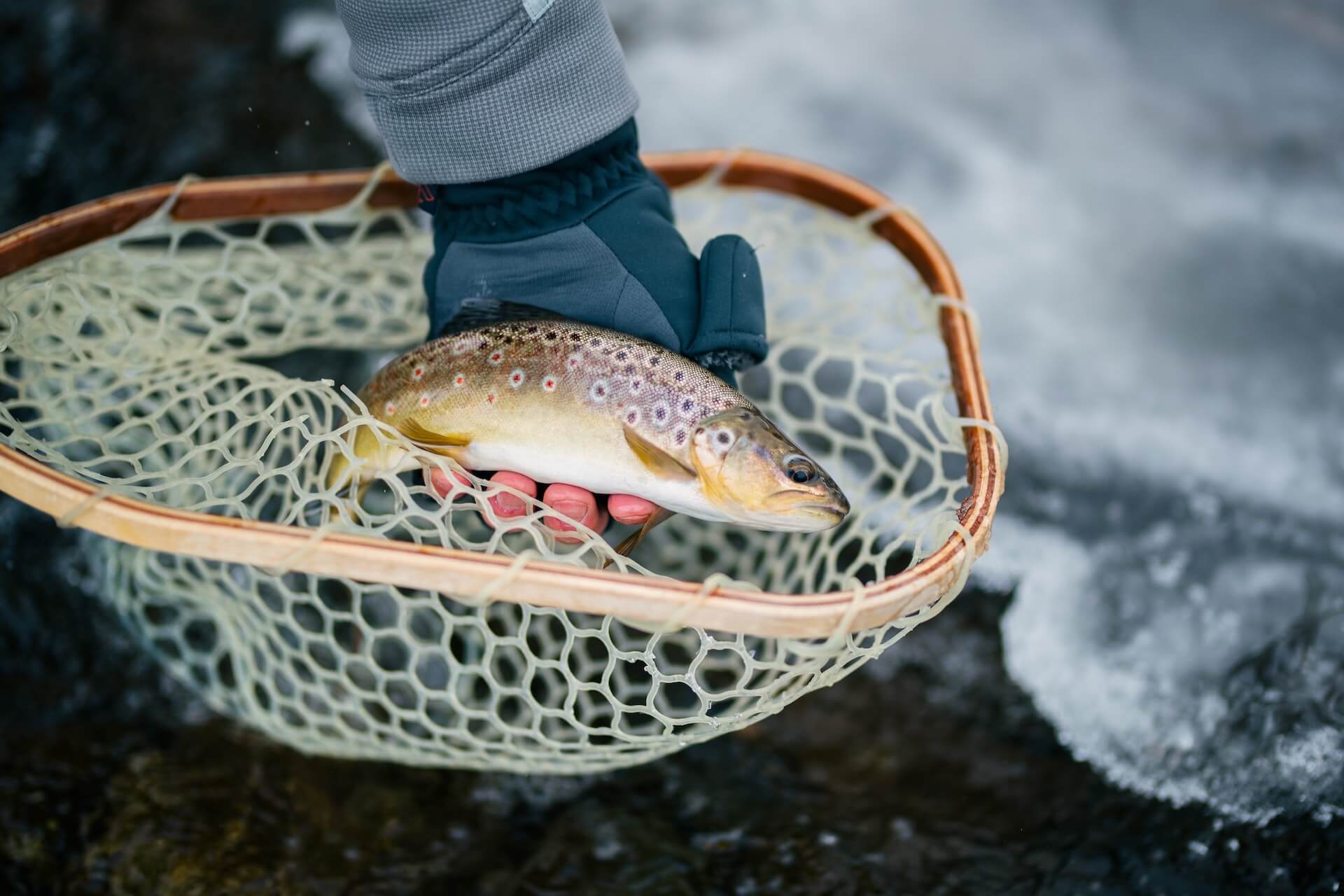
Which are the best Fly Fishing Nets?
Other important factors to consider are: what is the landing net made of and how long a handle to you need? Here is our selection of the best landing nets for each category.
1. Fishpond Nomad Emerger
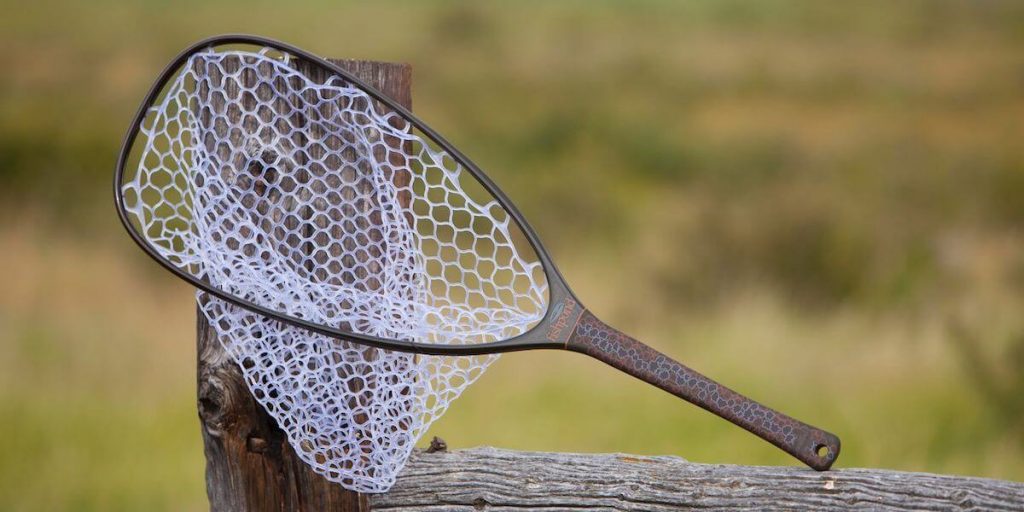
Specs: 32″ Length – 9.8″ W x 18.8″ L Head – Weight: .95lb. Comes with a bag.
Why we picked it:
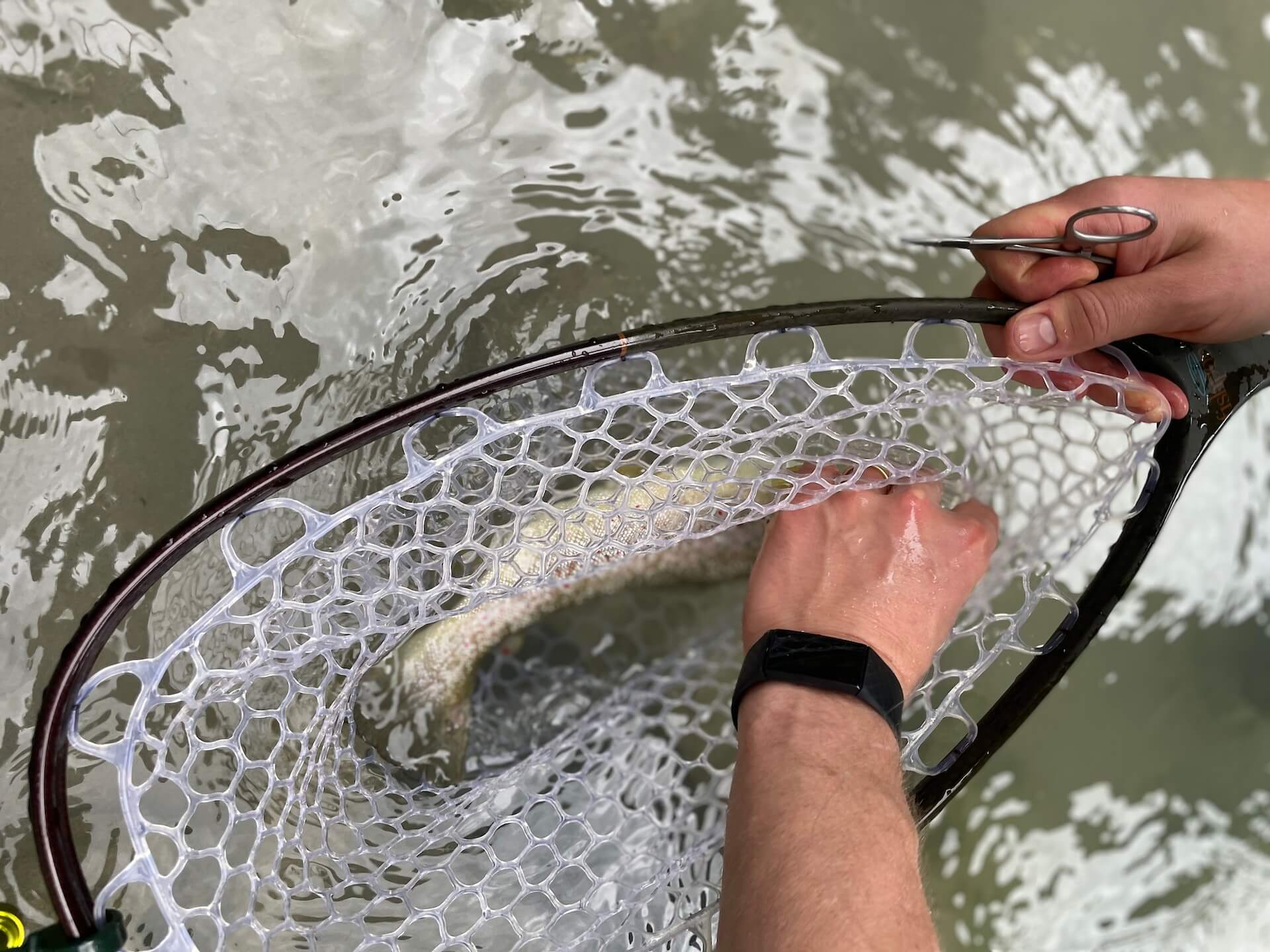
The Fishpond Nomad Emerger (read our in-depth review here) has all the features of a great fly fishing net and is our top choice when it comes to the best fly fishing net – that is if money is not an issue for your decision. Made from carbon fiber/fiberglass material it is built for utmost durability and a long lifespan and from my experience it can definitely live up to that promise. I’ve used the Emerger net for years now and yes, it shows some wear and tear because I use my gear hard, but neither the handle nor the net have lost any bit of their functionality. In case you damage the rubber net, don’t worry as it can be replaced easily.
Another positive aspect of the material is its low weight – an important factor when carrying a landing net all day. The Fishpond Nomad Emerger is also waterproof and floats in case you drop it into the water. As you would expect in that price range the Nomad nets come with a rubber bag for better storage. I’ve found the Nomad Emerger to have the perfect size for a trout fly fishing net. If you’re only fishing smaller creeks with smaller trout you might be better off with a net such as the RFR Carbon Fiber or the small version of the Brodin Eco Clear. But if the rivers you fish hold big trout and you want the best allrounder, go for the Fishpond Nomad Emerger. Its oval shape makes sure you can easily net even big trout and they safely stay in the net.
The Fishpond Nomad Emerger is made to be worn with fly fishing packs and fly fishing vests. Another great way to attach a landing net to your jacket or vest is a magnetic net release such as the Fishpond Confluence. The Fishpond Nomad Emerger comes in two colors: Brown Trout and Original. I’ve also had no issues at all with the grip on the handle of the Nomad Emerger. A friend once told me that he found these handles a bit slippery when wet, but I could not reproduce his concerns even when paying full attention to it when submerging the Fishpond Nomad Emerger. As you can see from my review, I am full of praise for that fly fishing net – it’s for a reason. Years of loyal service make me convinced that this is the best fly fishing net out there on the market.
Pros:
– Fantastic build quality
– Great design
– Replaceable rubber net
Cons:
– Can be obstructive for smaller people when tucked into the wading belt in the back of your waders
2. Simms Daymaker Landing Net
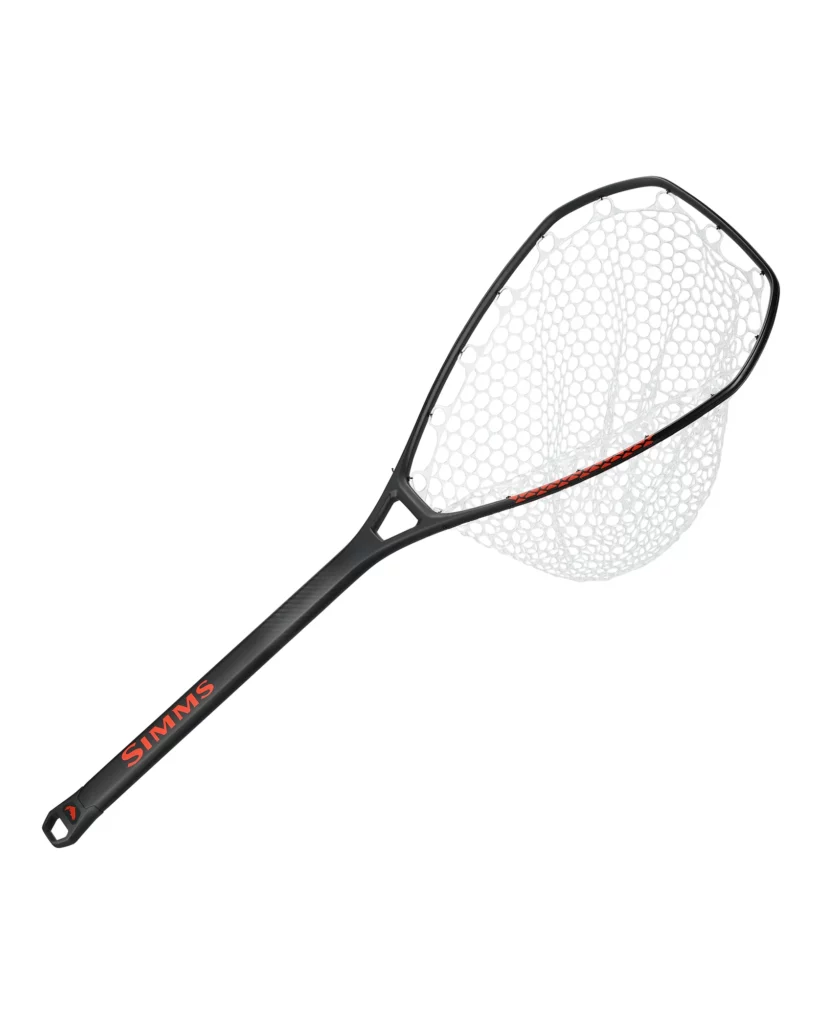
Specs: Length: 38″, Hoop Width: 13″, Hoop Length: 18″, Weight: 17 oz. (medium size) and Length: 23″, Hoop Width: 11″, Hoop Length: 15″ WEIGHT: 12 oz. (small size)
Why we picked it:
In my eyes it was only a matter of time until Simms would produce a landing net. Safe to say it took some time, but they got it right with the Simms Daymaker Landing Net (Read in-depth review here). The net comes in two versions, one with a shorter handle and one with a longer handle.
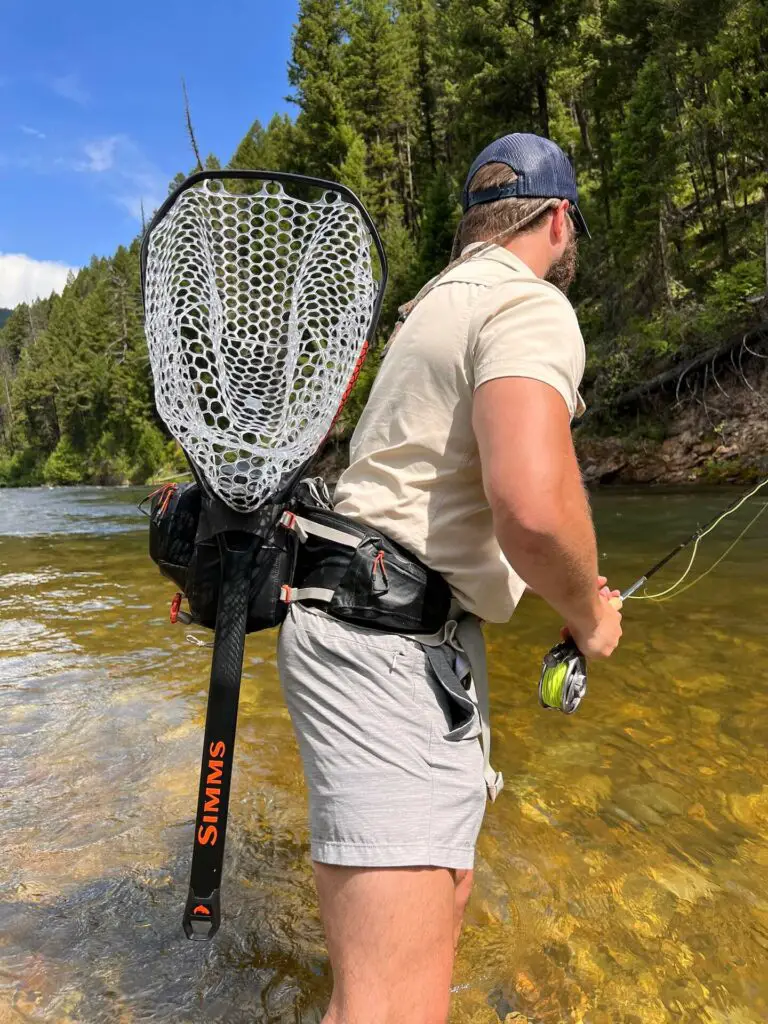
You would expect the medium sized one with the longer handle to be an ideal boat net. But it performed well during our wade trip to the Gallatin river as well. The longer handle gives you a little extra reach for example if you’re fishing a deeper run. However, it takes some getting used to handling the longer handle in the beginning.
The shorter version of the Simms Daymaker Net features a shorter handle and the hoop is slightly smaller (Length: 18″ vs 15″ and Width: 13″ vs 11″). This makes the smaller version the ideal net for wade trips and a great companion if you often walk to the river and are passing bushes that might get stuck with the medium size version.
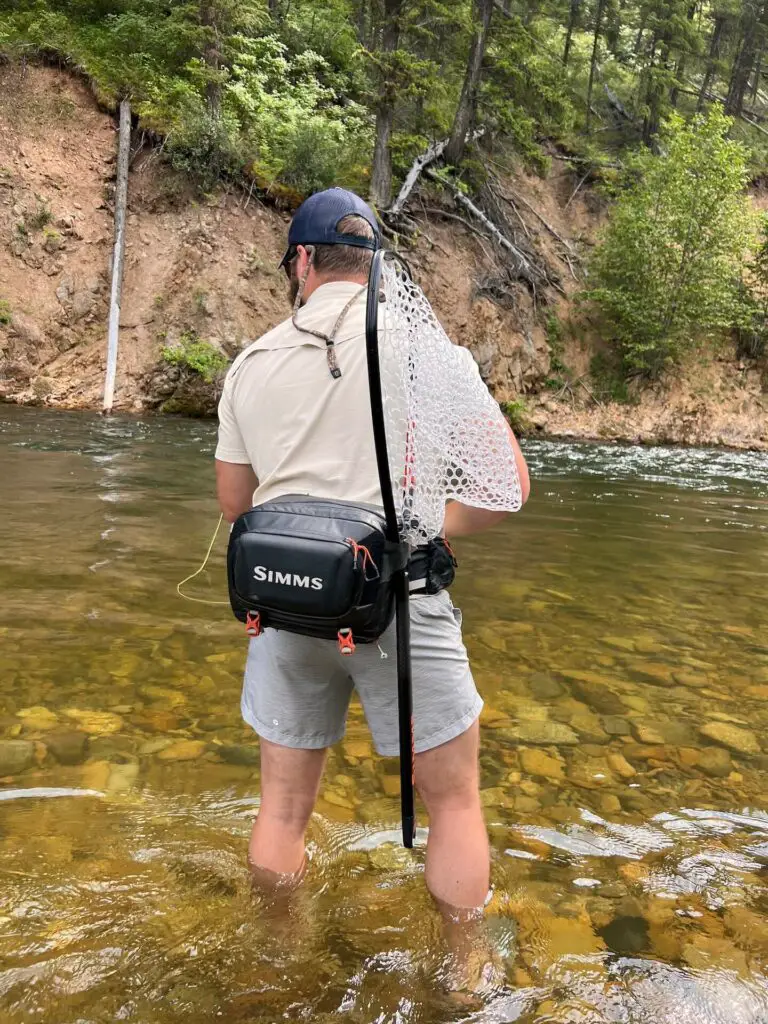
What’s great about both sizes is their weight. At only 17 oz and 12 oz respectively they are very lightweight. Plus, their carbon composite construction makes them float in the water in case you drop them. The only downside of this net is the depth of the basket. Like with other nets, we’ve experienced that bigger fish can flop out of the net since its depth is only about 12″. We also found the handle on the medium size version to be quite big around. Hence, you might have trouble safely landing a bigger fish when your hands aren’t huge.
My verdict: Simms entered the world of fly fishing nets the way you would expect them to. No matter which version of the Simms Daymaker you’re going for, you’ll be sure to purchase a quality landing net that will perform for years to come and is extremely light to carry around.
Pros:
– Excellent build quality
– Very lightweight
Cons:
– Handle is quite big around
– Basket could be a little deeper to prevent flopping out of big fish
3. Aventik Carbon Fiber Landing Net
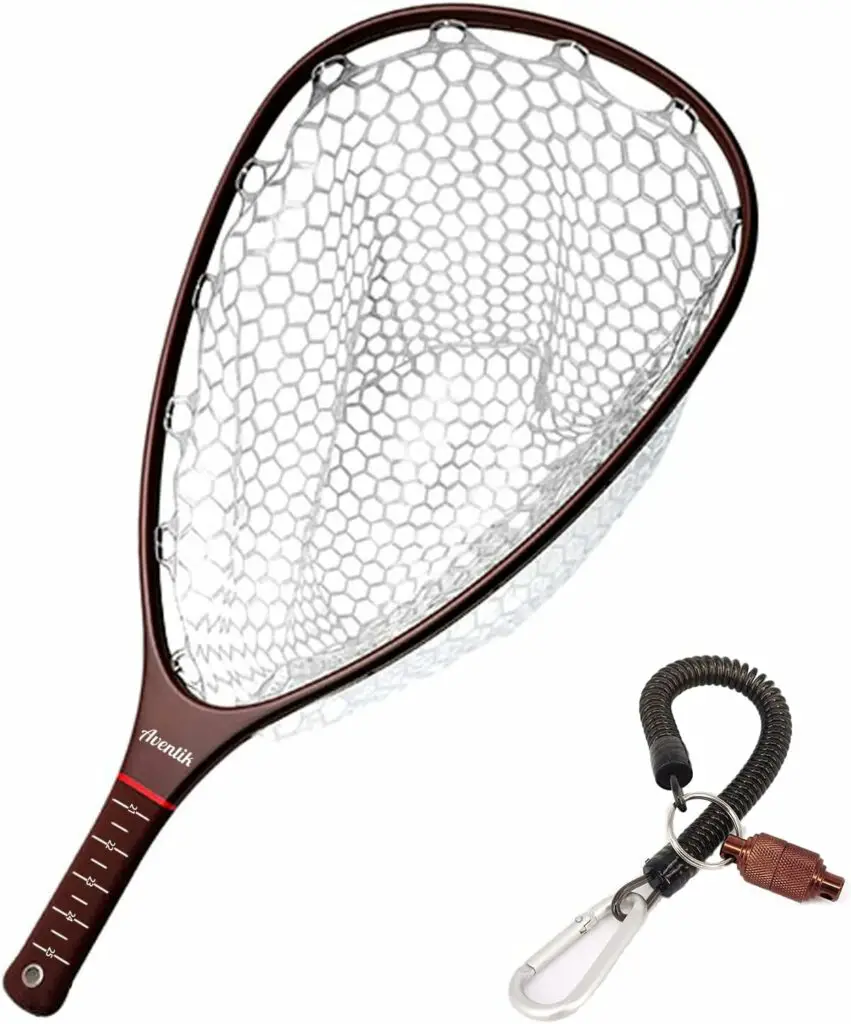
Specs: 18″ x 13″ x 12″
Why we picked it:
Here comes a landing net that is similarly built as the Fishpond Nomad Net Emerger: the Aventik Carbon Fiber. Made from carbon fibre, this trout net is an excellent choice if you are looking for the utmost in low weight.
Out of the box the Carbon Fiber comes with a magnetic release that you can attach to your vest, sling or pack. With the help of a lanyard you can attach it and always have it ready to land a fish. This fly fishing net also comes with a so called ghost net made of clear rubber that is great for spooky fish. I’ve found the shorter handle to be great if you’re fishing tight quarters where space is limited and you quickly want to net and release your catch. Compared to the Fishpond Nomad Emerger, the handle on the RFR is obviously shorter. Hence if you want the utmost in reach, this is not the right landing net for you.
Pros:
– Compact dimensions
– Very lightweight
Cons:
– Handle is rather short
4. Brodin Eco Clear
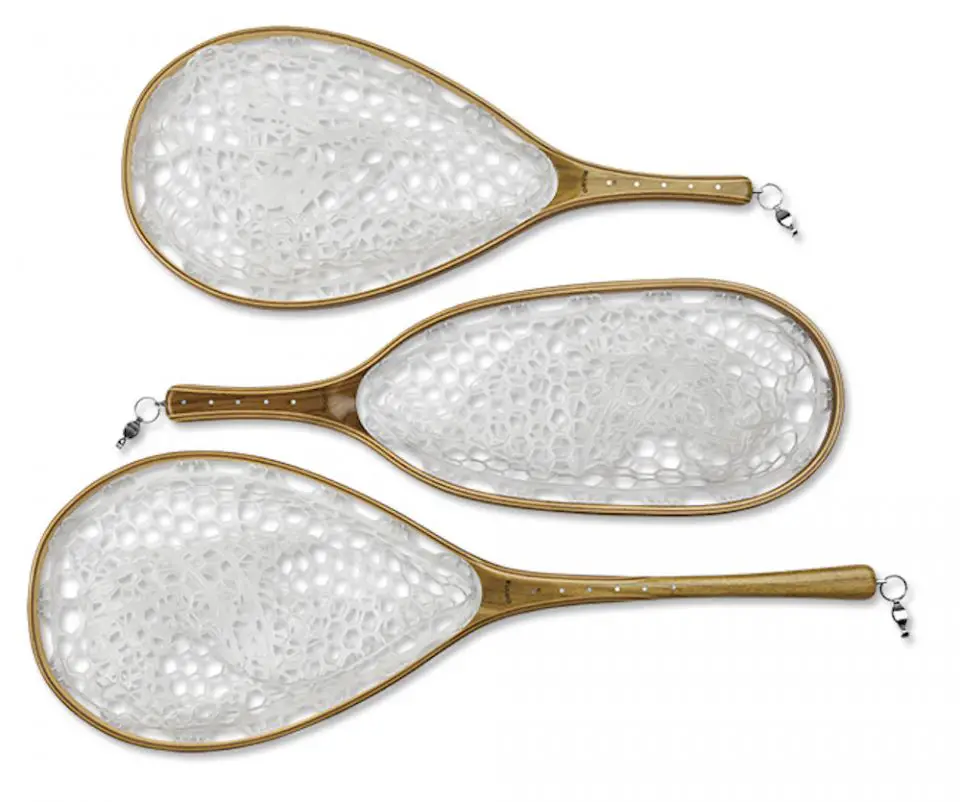
Specs: 22″ x 13″ x 3″
Why we picked it:
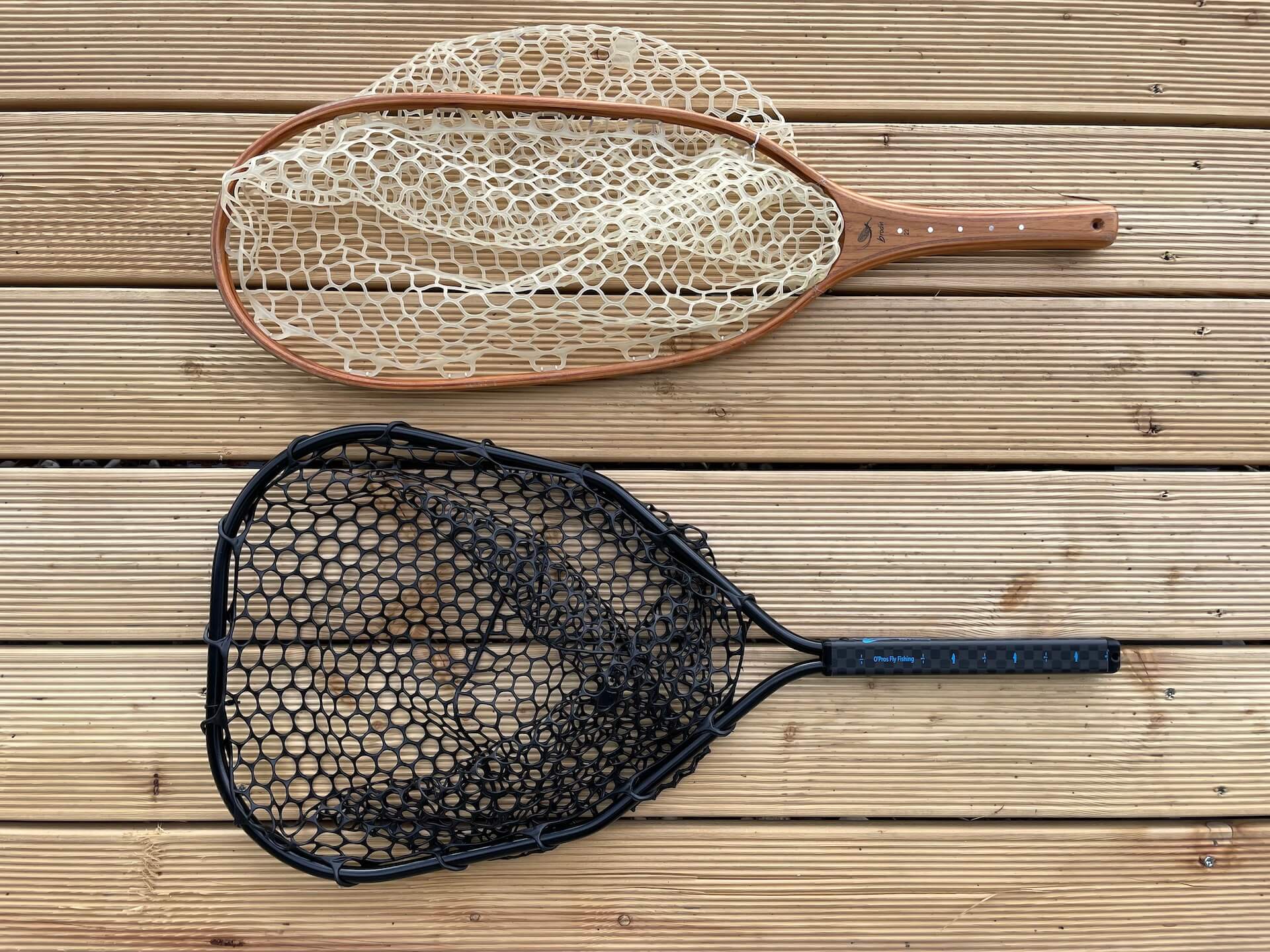
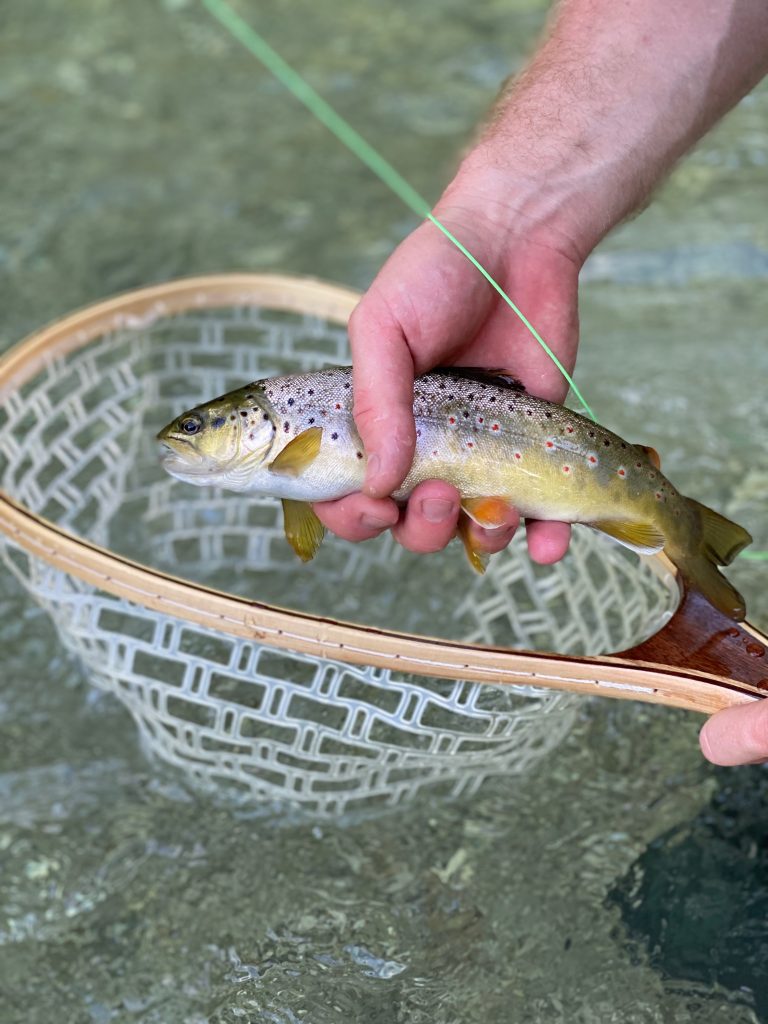
If you are into wooden fly fishing nets and want the ultimate in style and quality, there is no way around the Brodin Eco Clear (Read our in-depth review here). This model is perfect for fish ranging up to 20″, hence making it a perfect trout net.
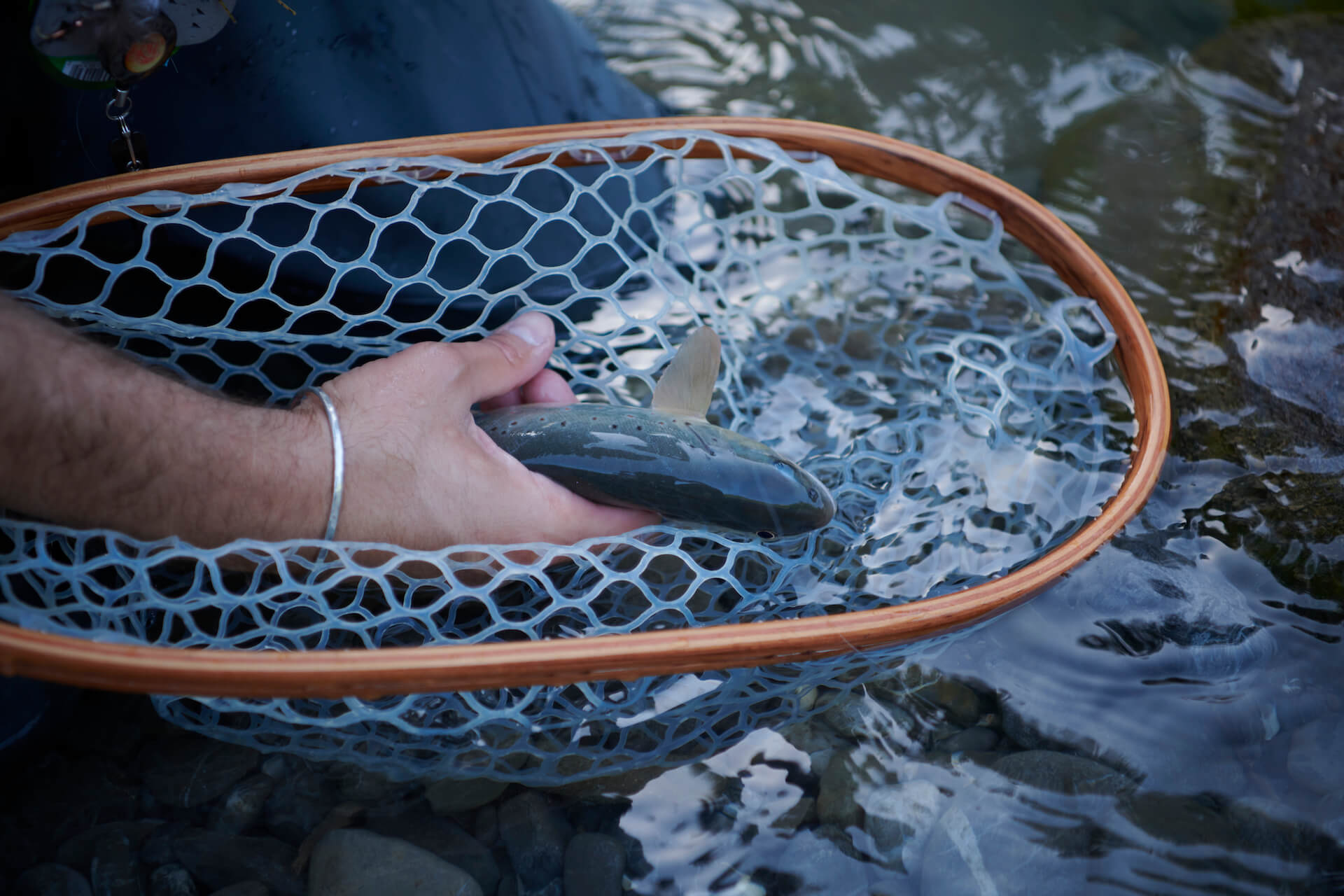
The eco-clear rubber is a good choice if you are fishing creeks with spooky fish since it is almost invisible for the fish in the moment of netting them. The Brodin Eco Clear comes in different sizes depending on the species you’re after and whether your fishing from a boat or from the bank of a river. The wooden handle is equipped with a clip that allows you to attach the net to the back of your wading jacket or vest.
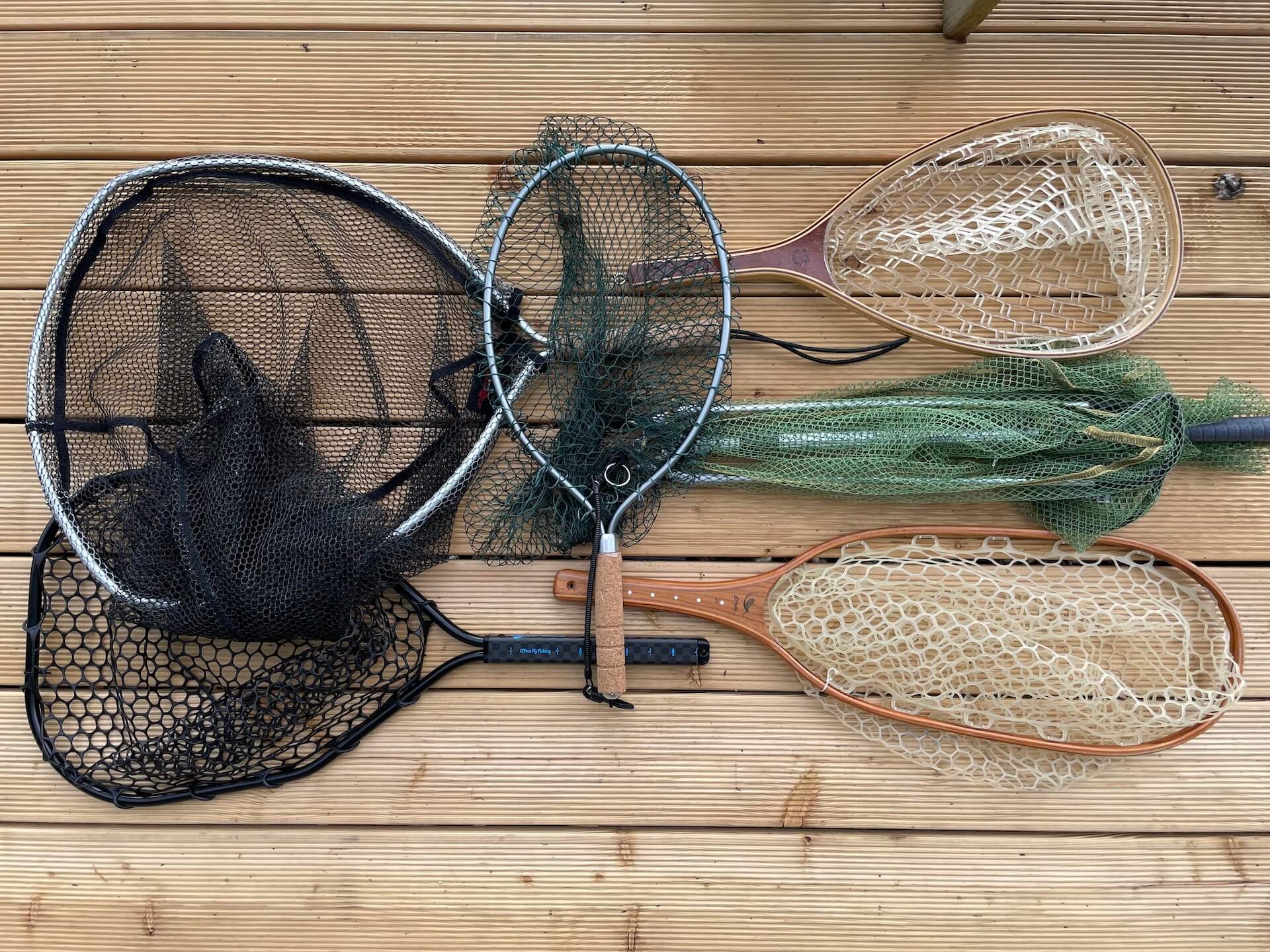
Personally, I’ve become a big fan of the Brodin Eco Clear for its classic looks. My favorite shape is the longer oval one (the one in the middle in the picture above) since, similarly to the Fishpond Nomad Emerger, it offers the highest degree of versatility when out fishing for trout. And another positive aspect of this more elongated shape is the fact that if you tuck it in between your hip bag and waders, the slimmer shape prevents you from getting stuck in the bushes when heading out to the water.
Pros:
– Fantastic build quality
– Comes with a clip
– Net is replaceable
Cons:
– Not the right choice if you are hunting trophy trout because of the size of the rubber net
5. SF Fly Fishing Soft Rubber Trout
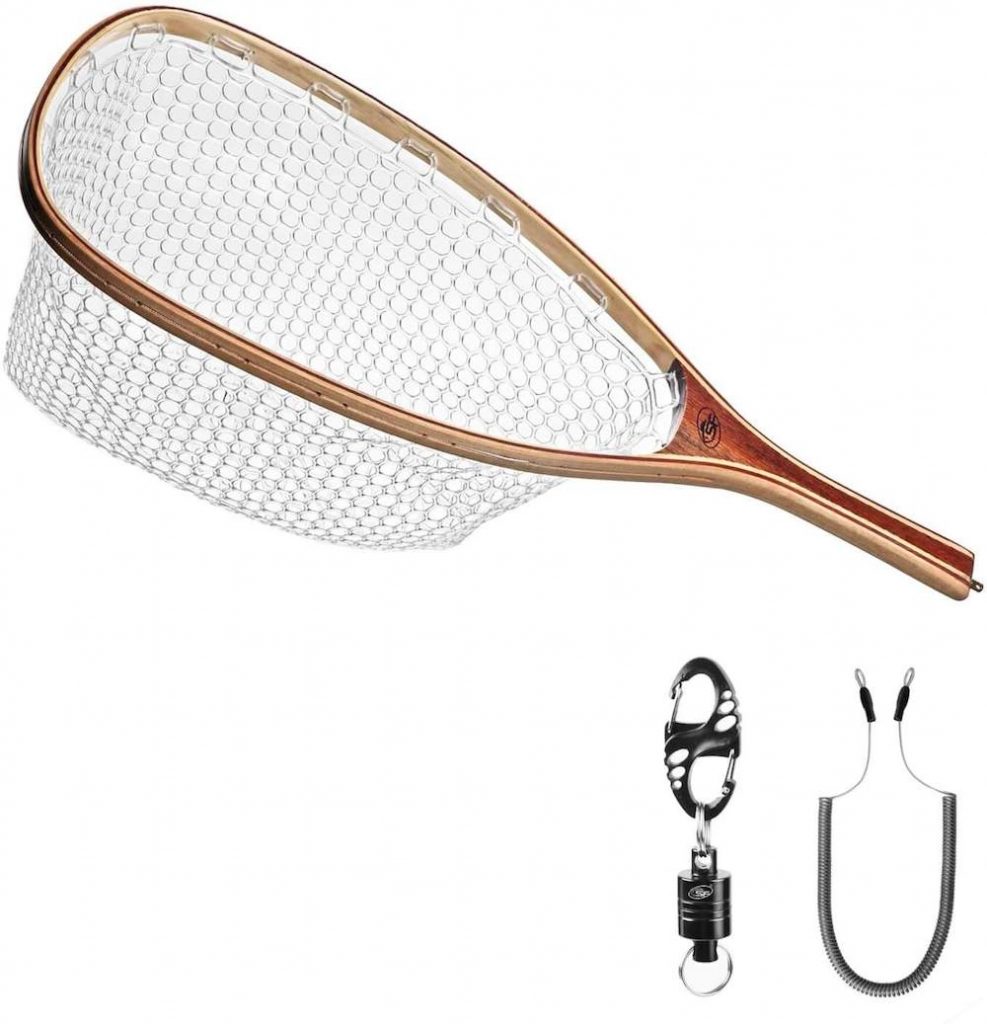
Specs: 16.1″ x 9.4″ x 8.3″ – comes with a Magnetic Release
Why we picked it:
The SF Fly Fishing Soft Rubber is another great choice for fly fishermen. It has a rubber net just like the Fishpond Nomad Emerger. However, the frame is made of wood. This gives this one a much more classic look. The handle is a bit shorter than the Nomad one and the rubber is not as deep. These factors make the SF Fly Fishing Soft Rubber a great choice for smaller streams and creeks.
A great feature of the SF Fly Fishing is the fact that it comes with a magnetic release. This makes it easy to attach it to the back of your wading jacket or fly fishing vest. The wooden handle feels good in your hands and since it’s made of wood, the SF Fly Fishing Soft Rubber floats as well.
Pros:
– Solid built quality
– Comes with magnetic release
– Wooden handle feels good in your hand
Cons:
– Rubber net is quite shallow
– Only advisable for smaller streams and creeks
6. O’Pros Driftless Dry Fly
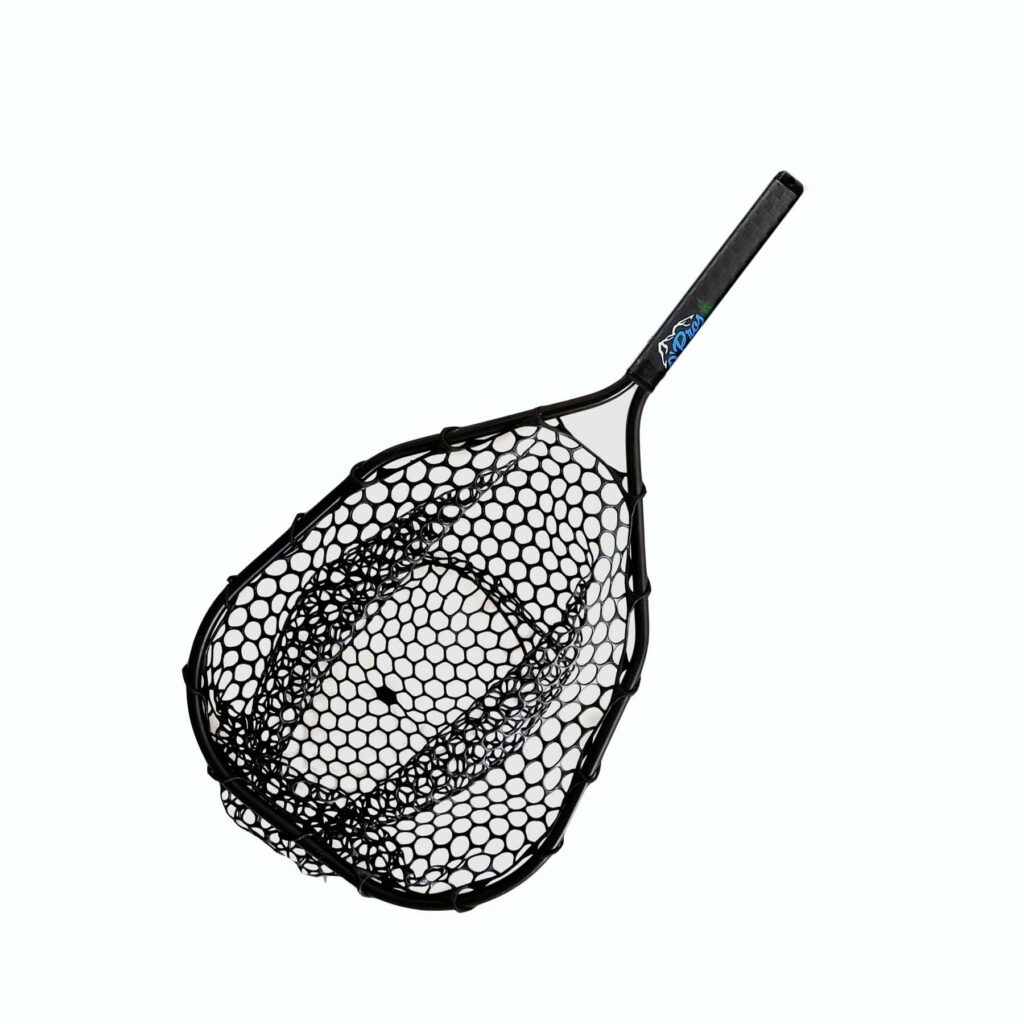
Specs: aluminum hoop (19″ x 14″), depth: 12″ or 16″
Why we picked it:
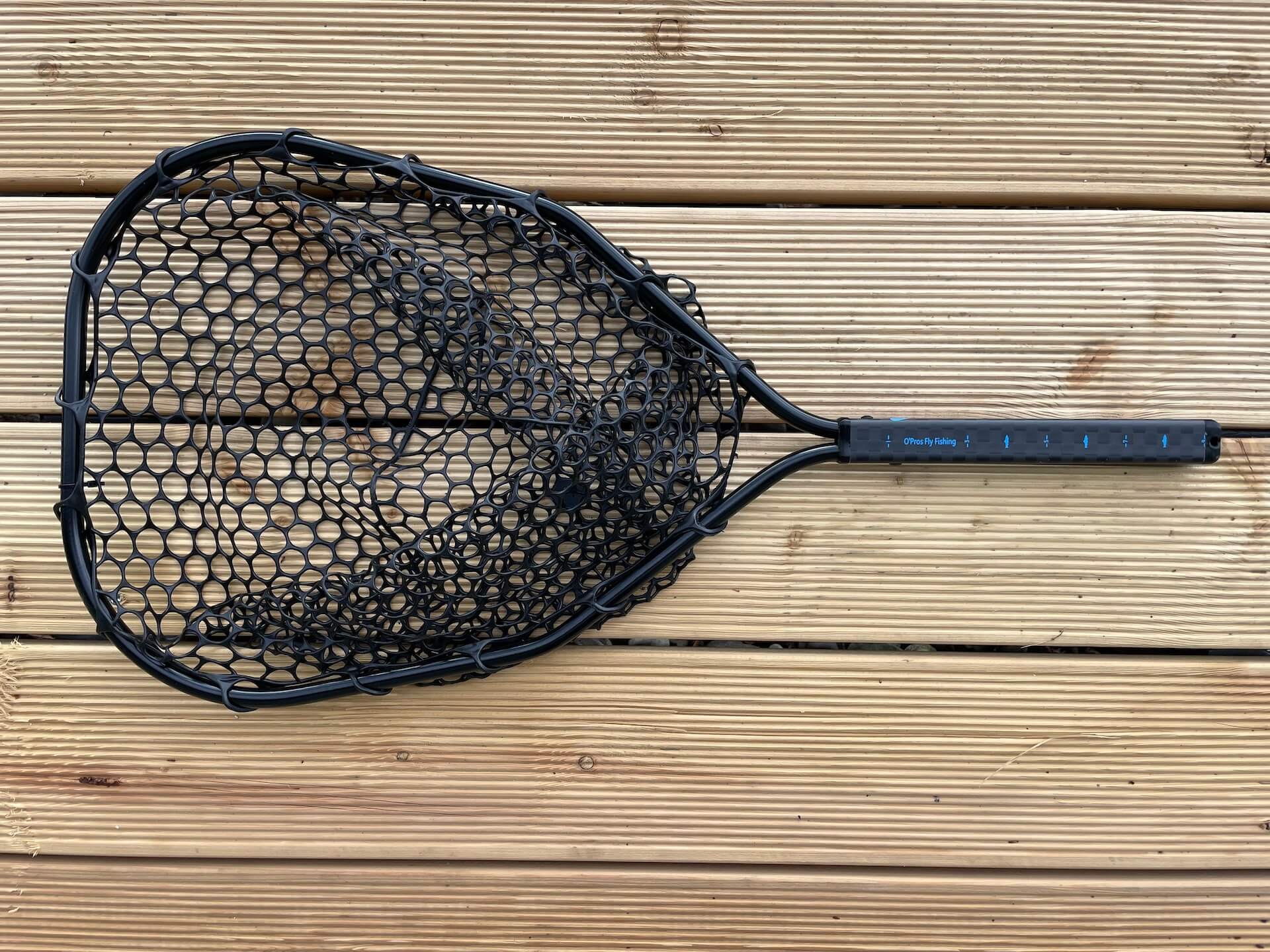
The O’Pros Driftless Dry Fly Net (read in depth review here) is a sturdy landing net that convinced us with its fresh style and color options. You can basically create your custom fly fishing net by picking your favorite handle design, frame color and rubber bag color. You can also decide whether you want the depth of your net to be 12″ (which is certainly enough for most trout or bass fishing) or even 16″ (which is a good idea if you can expect big trout at your river for example).
Especially the sturdiness of the rubber convinced us on the O’Pros Driftless Dry Fly. It’s also incredibly lightweight plus it comes with a lifetime warranty which is great if you put your tackle to the test. If you want a modern, stylish looking one, go for the O’Pros Driftless Dry Fly.
Pros:
– Very sturdy
– Different net depths to choose from
– Lifetime warranty
Cons:
– Can be a little obstructive when casting due to its wider shape
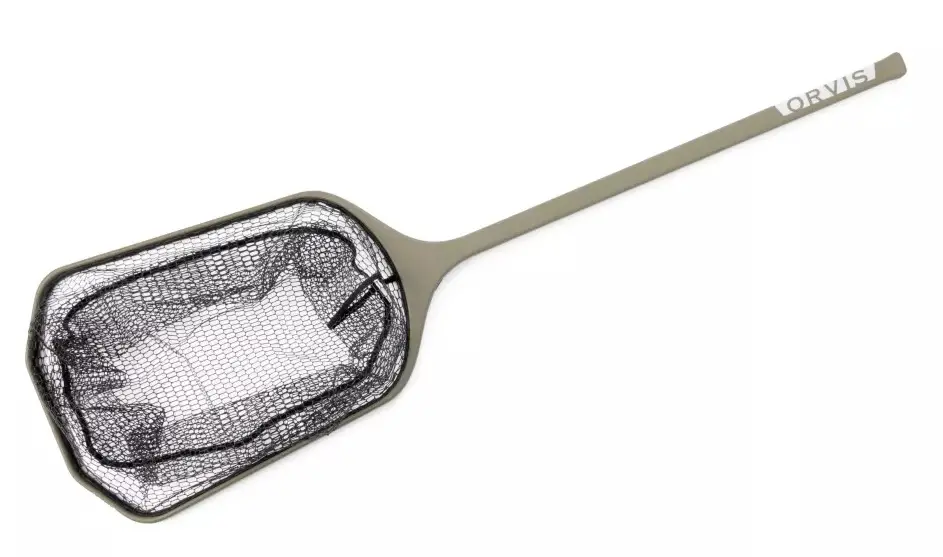
7. Orvis Wide Mouth Guide Net
Specs:
Overall Length – 37.5 | Overall Width – 12.75” | Hoop Length – 17.5″ | Bag Depth – 10.5” (also available as a hand net with shorter handle). Available in green and black.
Why we picked it:
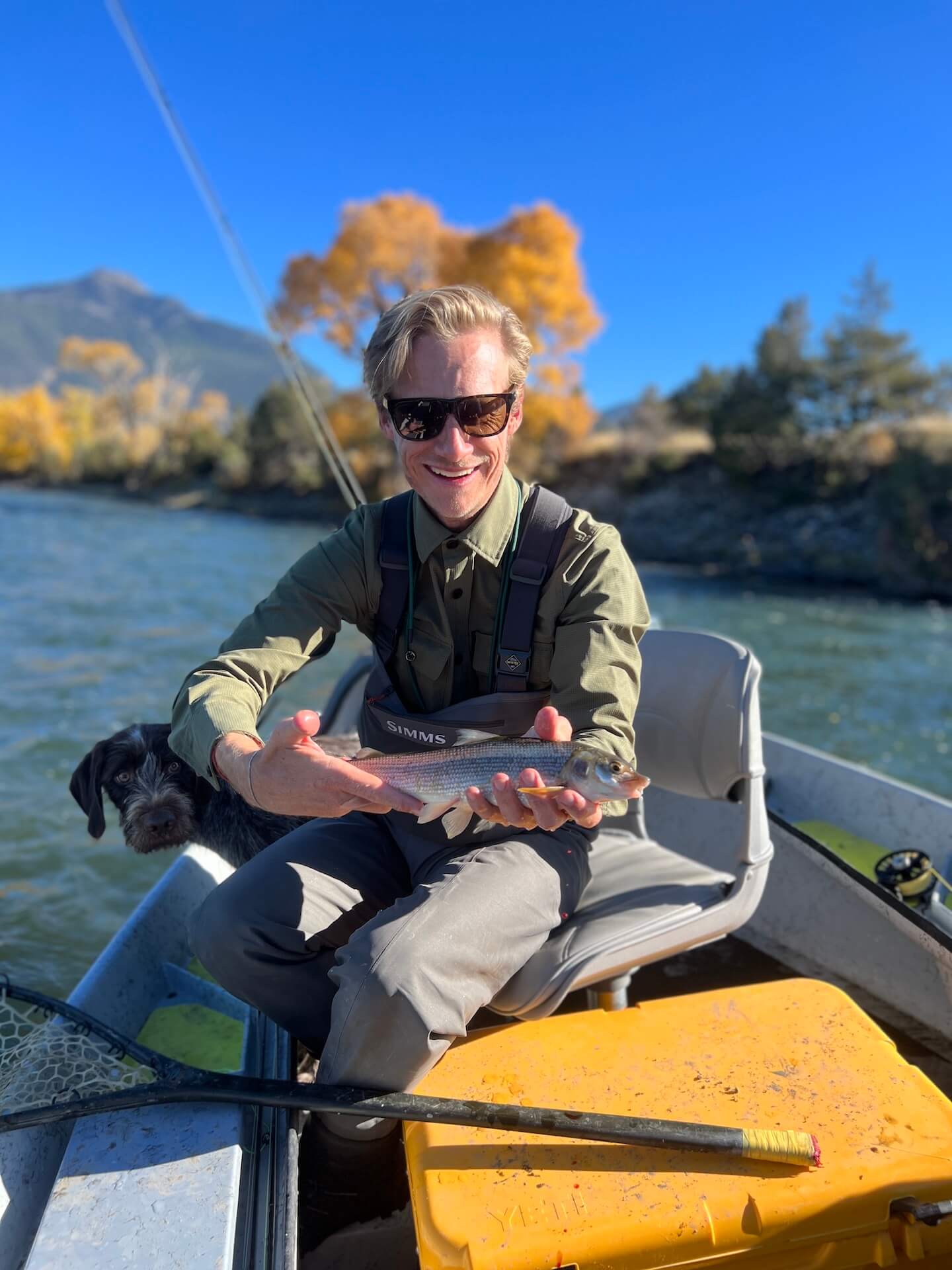
If you are a serious fly fisherman and fish a lot from a boat or steeper river banks, the Orvis Wide Mouth Guide Net is a great choice for you. Yes, this landing net doesn’t come cheap at almost $200 but its build quality is outstanding and you can use it in many fishing situations.
The boat net version of the Orvis Wide mouth is used by many professional anglers around the globe. If you want a little more manoeuvrability, go for the hand version. If you want to be agile and tuck your trout net into your wading belt, the hand net version is the way to go.
Just like the Fishpond Nomad Emerger, the Orvis Wide Mouth is made from carbon fibre and also floats if you accidentally drop it into the water.
Pros:
– Multiple options to choose from
– Great landing net for a boat
– Lightweight, yet very sturdy
Cons:
– We found the composite material to not be very scratch resistant
– Depth of the net could be deeper (10.5″ only) to prevent big fish from flipping out
8. Frabill Power Catch
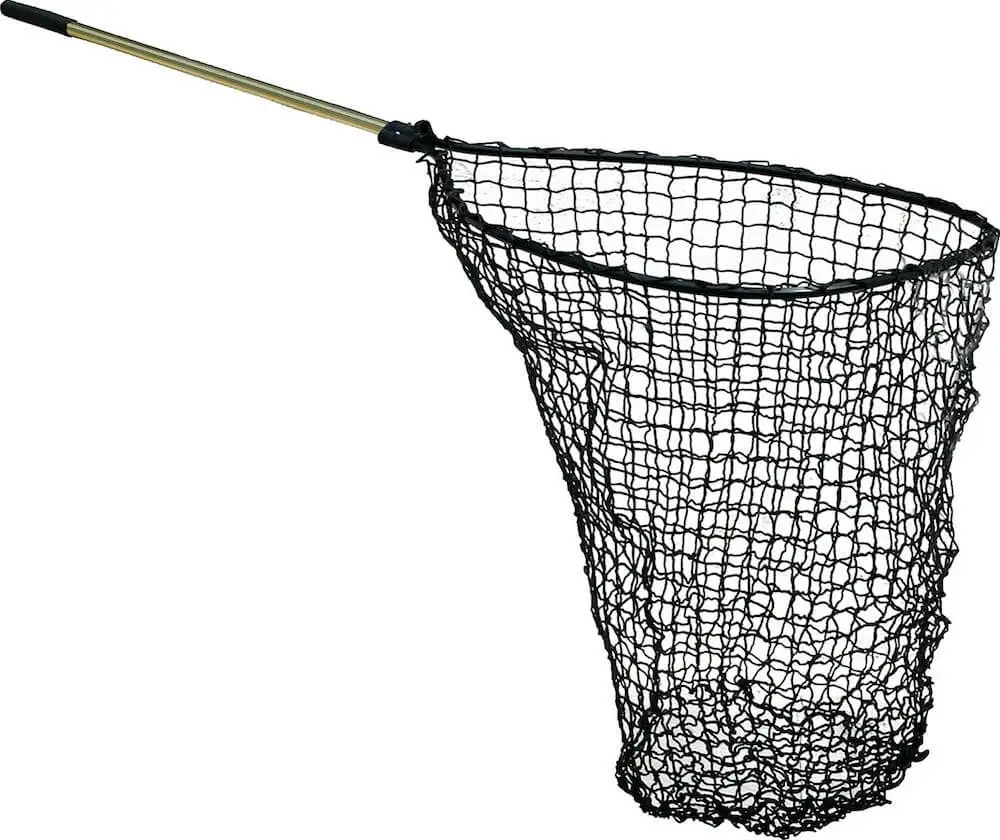
Specs: 26″ x 30″ wide – 38″ depth (48″ depth option)
Why we picked it:
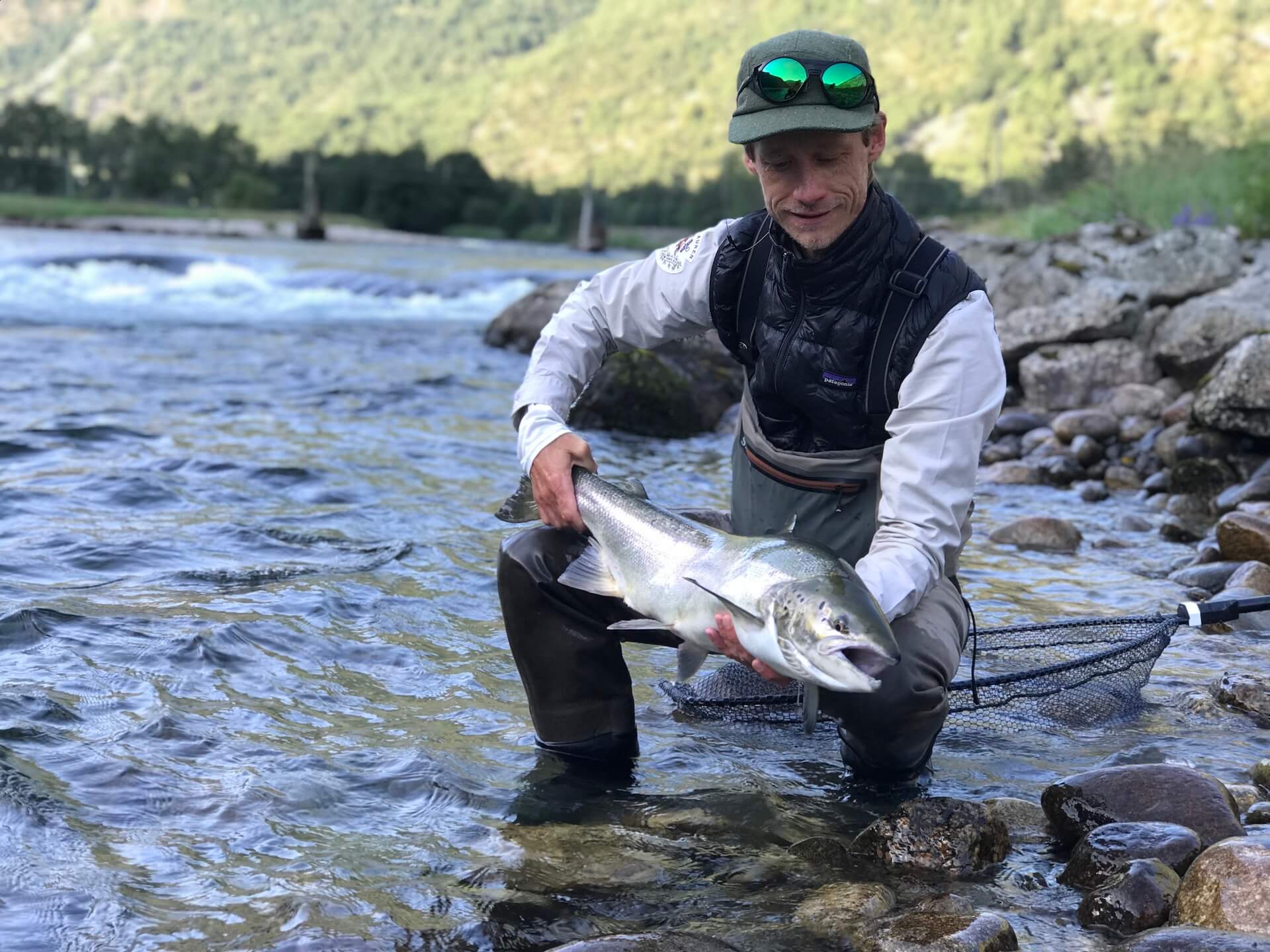
The Frabill Power Catch is our #1 choice for a big fly fishing net. And when we say big we mean it. This one comes in a 26″ x 30″ standard version with a 48″ handle and 38″ net depth. If that is not big enough for the fish you are targeting there is a 48″ depth version as well. The Frabill Power Catch is the ideal tool if you are after big pike or musky or even saltwater species like salmon or small halibut.
If you still don’t think the Power Catch version is big enough then there is the Frabill 8450 Power Catch Big Kahuna (pictured above). It comes with hoop sizes of 32″ x 41″ and even 40″ x 44″. The Frabill don’t come cheap. But when you target these big fish whether in freshwater or in saltwater you shouldn’t compromise on quality. There is nothing worse than losing the fish of a lifetime because of a poorly made product.
Pros:
– Comes in a wide variety of sizes to hold even the biggest fish
– Sturdy build quality
Cons:
– Dark net can spook fish when the water is really clear
9. ODDSPRO Folding
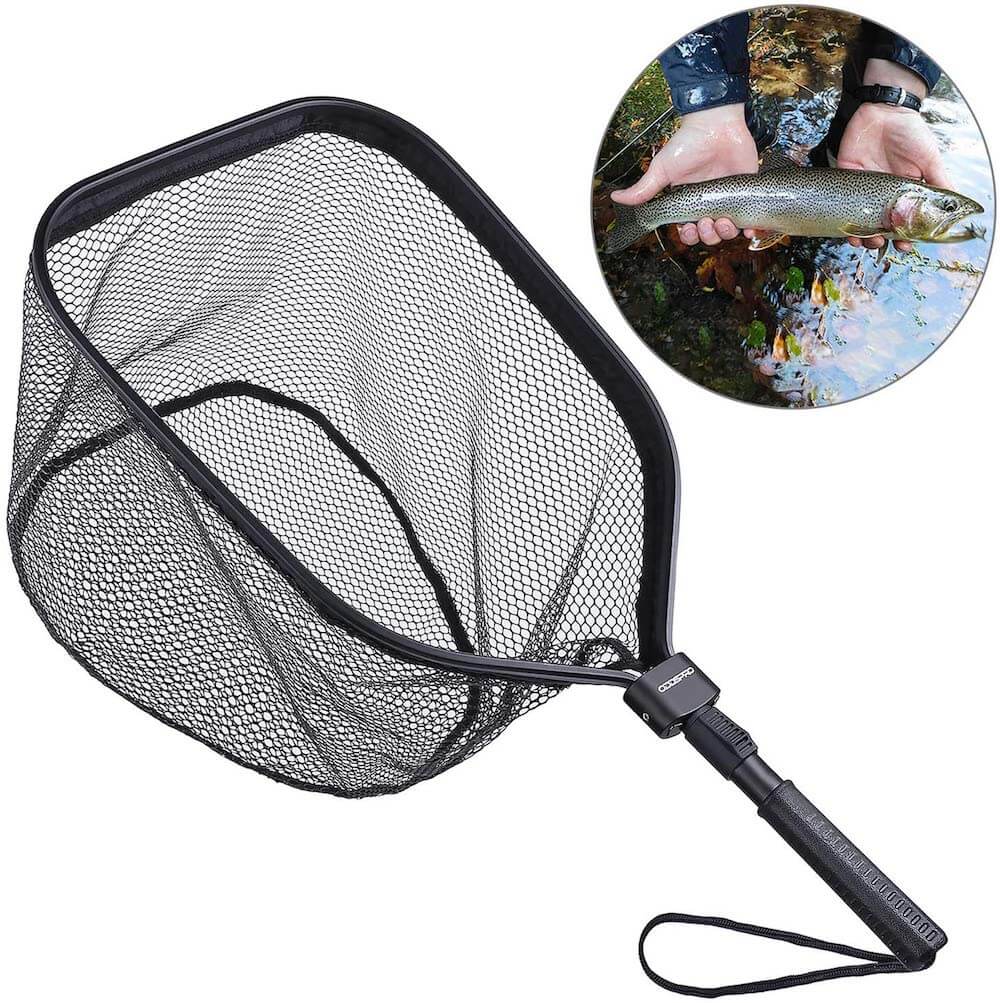
Specs: 11.5″ x 15.5″ x 10″ hoop size. Handle length: 8.5″
Why we picked it:
The Oddspro Folding is a great choice if you want a landing net with compact dimensions. Made from carbon fiber and fiberglass, the Oddspro features a handle that can be folded and hence makes it easier to store it. Due to its dimensions the Oddspro Folding is an excellent choice if your main target species is trout and grayling. Its net is a bit deeper than the SF Fly for example and can hence hold bigger fish.
The OddsPro features a rubber coating nylon mesh that does not harm the fishes’ mucus.
Pros:
– Affordable
– Compact and easy to carry and store
Cons:
– Hooks get stuck more easily it the nylon net than in the bigger mesh sizes of the rubber ones
10. Frabill Wading Net
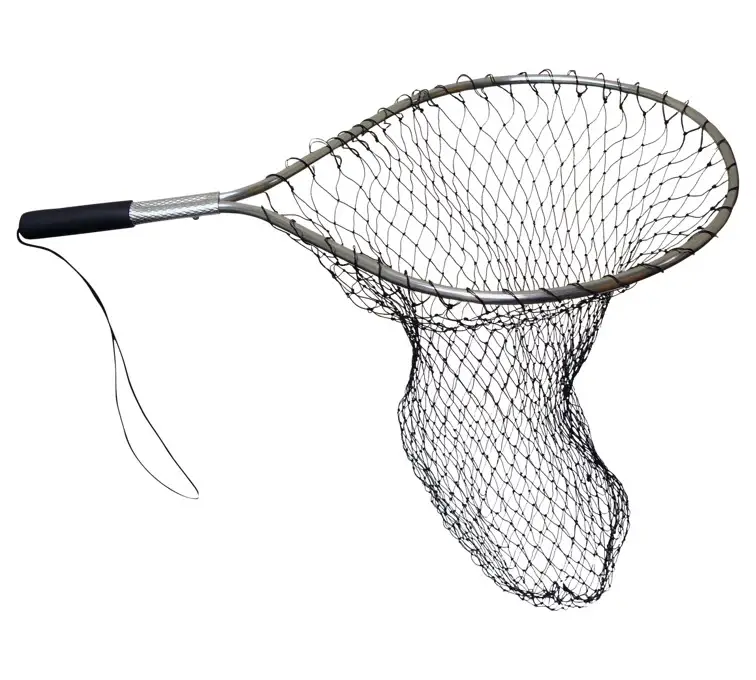
Specs: 17″ x 19″ hoop size. 30″ depth. Handle length: 8″.
Why we picked it:
The Frabill Wading Net rounds off or review of the best landing nets. This one is a straight forward landing net that ticks all the boxes of a quality product. It is a great choice if you are looking for a handy net that can cope with big fish. Its net depth of 30″ makes sure that even big trout stay where they are supposed to.
The Frabill features an aluminum loop and a rubber coated handle to ensure a safe grip no matter the conditions. The short length of the handle ensures you can safely using with one hand (which is crucial if you are fishing on your own and don’t have a buddy to net your catch).
Pros:
– Simple aluminum landing net that does what it’s supposed to well.
– Good choice for sea trout as well.
Cons:
– Consider exchanging the leash to something a little more sturdy
How Do I Carry my Fly Fishing Net? Use a Fly Fishing Net Leash
A fly fishing net comes in handy when you are trying to land a big fish standing in the river. The decisive question in order to have it ready when it counts is: how do I attach or carry it?
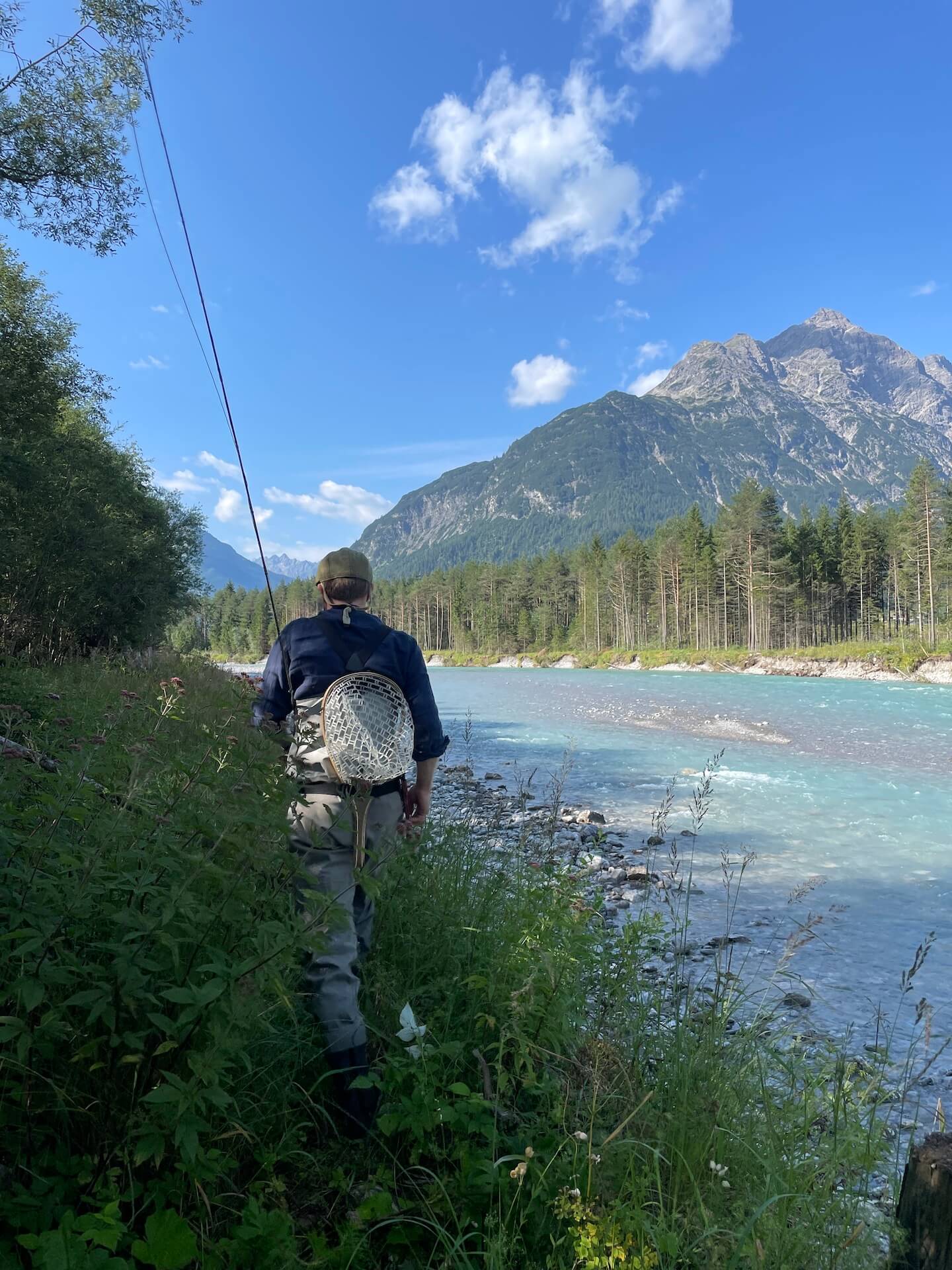
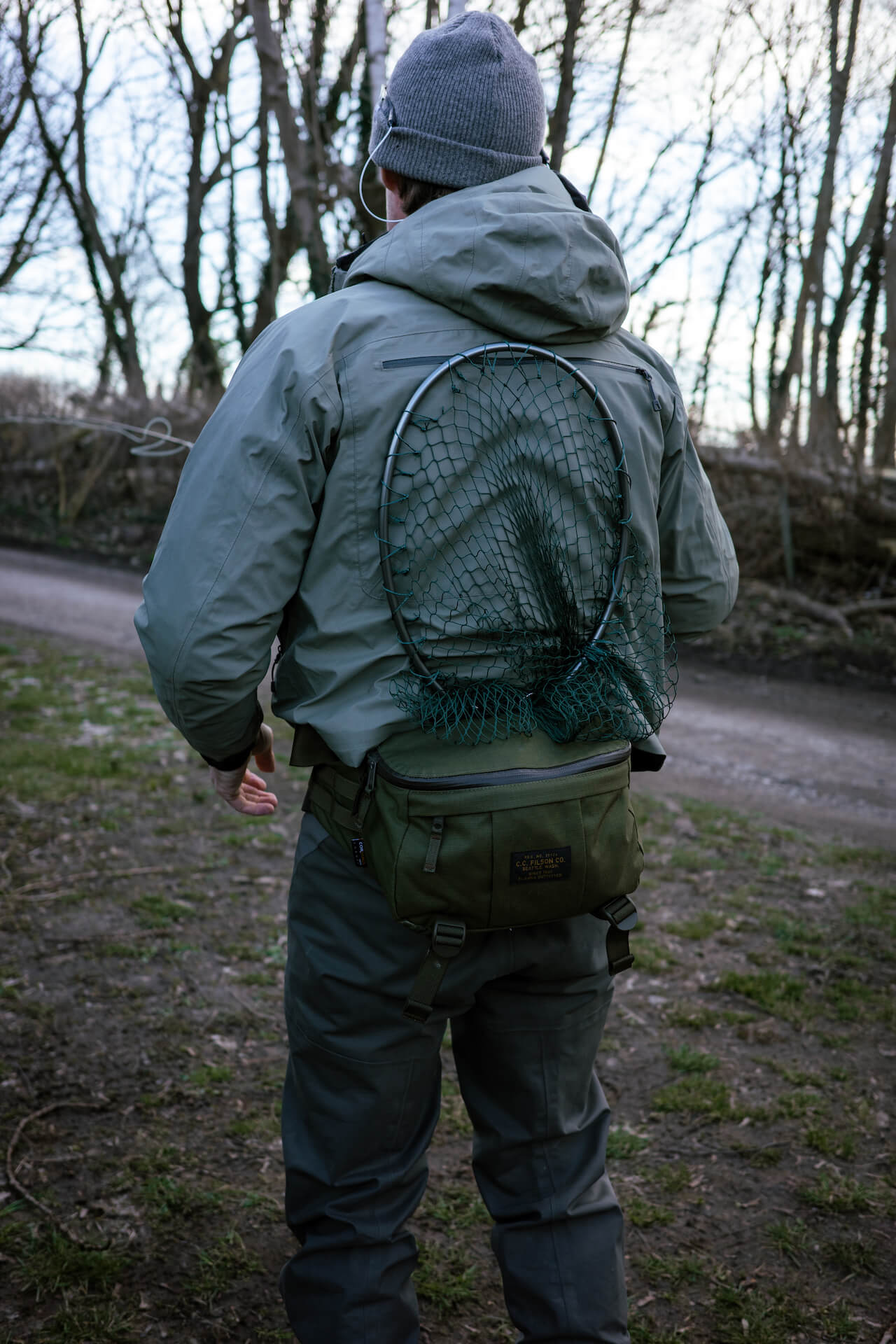
There are two way to comfortably carry your landing net. The first one is to carry it in your fly fishing hip pack, sling pack or fly fishing vest. Most modern day packs, slings or vests have sleeves to hold your fly fishing net.
The other comfortable way to carry it is to attach it to the back of your waders or wading jacket using a fly fishing net leash. That’s a small magnet with a lanyard. When you are ready to land your fish, you simply grab it and pull. The magnet releases the net and you can land the fish. It’s a very nice and comfortable way to carry your landing net as it is out of the way when you are casting but easily accessible when you need it. Here are a few releases that we recommend:
Comparison Table
| Product | Overall Size | Hoop Size | Net Depth | Weight | Frame material | Handle material | Floating | Price in $ |
| Fishpond Nomad Emerger | 32″ | 9.8″ W x 18.8″ | 12″ | .95lb | Carbon fiber | Carbon fiber | Yes | 159.95 |
| Simms Daymaker Landing Net (medium) | 38″ | 13″ x 18″ | 14″ | 17 oz | Carbon fiber | Carbon fiber | Yes | 199.95 |
| Aventik Carbon Fiber Landing Net | 26″ | 18″ x 12″ | 12″ | Carbon fiber | Carbon fiber | Yes | 64.99 | |
| Brodin Phantom | 30″ | 20″ x 9″ | 14″ | 10 oz | Hardwood | Hardwood | No | 159.00 |
| SF Fly Fishing Soft Rubber | 24.4″ | 16.1″ x 9.4″ | 10″ | Hardwood | Hardwood | Yes | 35.00 | |
| O‘Pros Driftless Dry Fly Net | 30″ | 19″ x 14″ | 12″/16″ | 1 lb | Carbon fiber | Carbon fiber | Yes | 114.99 |
| Orvis Wide Mouth Guide | 37.5″ | 12.75″ x 17.5″ | 10.5″ | 0.63lb | Composite material | Composite material | Yes | 198.00 |
| Frabill Power Catch | 48″ | 26″ x 30″ | 38″ (48″) | Aluminum | Aluminum/Rubber | No | 133.00 | |
| Oddspro Folding | 24.6″ | 11.5″ x 15.5″ | 10″ | 11.2 oz | Plastic | Plastic | No | 27.99 |
| Frabill Wading Net | 27″ | 17″ x 19″ | 30″ | Aluminum | Aluminum/rubber | No | 23.99 |
What is important in a good fly fishing net?
A good fly fishing net should have a solid built quality no matter where you use it. There is nothing worse than losing a big fish because your landing net is too small or poorly built and breaks when it counts.
Frame Material
There is a wide range of materials used to make fly fishing nets. The most popular ones are wood, aluminum and fiberglass. Wood gives it a more classic look and makes sure it floats. Aluminum and fiberglass are strong and light and more modern materials to them.
Handle Grip
Aluminum and fiberglass almost always feature grips made from rubber. This ensures a solid grip and prevents the fly fishing net from slipping out of your hand when landing a fish. In wooden ones the handle is most often made from wood as well.
Size
As you can see in our recommendations above there is a wide variety of products available on the market. The most common size is a trout net. Depending on your fishing situation you should choose one that suits you best. As a rule of thumb you should remember to always use one that can hold the biggest fish you can expect to catch.
Price
Just like with the sizes the prices of fly fishing nets can vary significantly. Smaller wooden trout nets can be found in the $40-$50 range. Handmade more exclusive ones can easily reach three digit price tags.
Generally speaking fishing nets get more expensive the better the built quality and the better the components used such as the Fishpond Nomad for example. Also: the bigger and stronger the fish the more sturdy your landing net needs to be. A high quality landing net is a worthy investment.
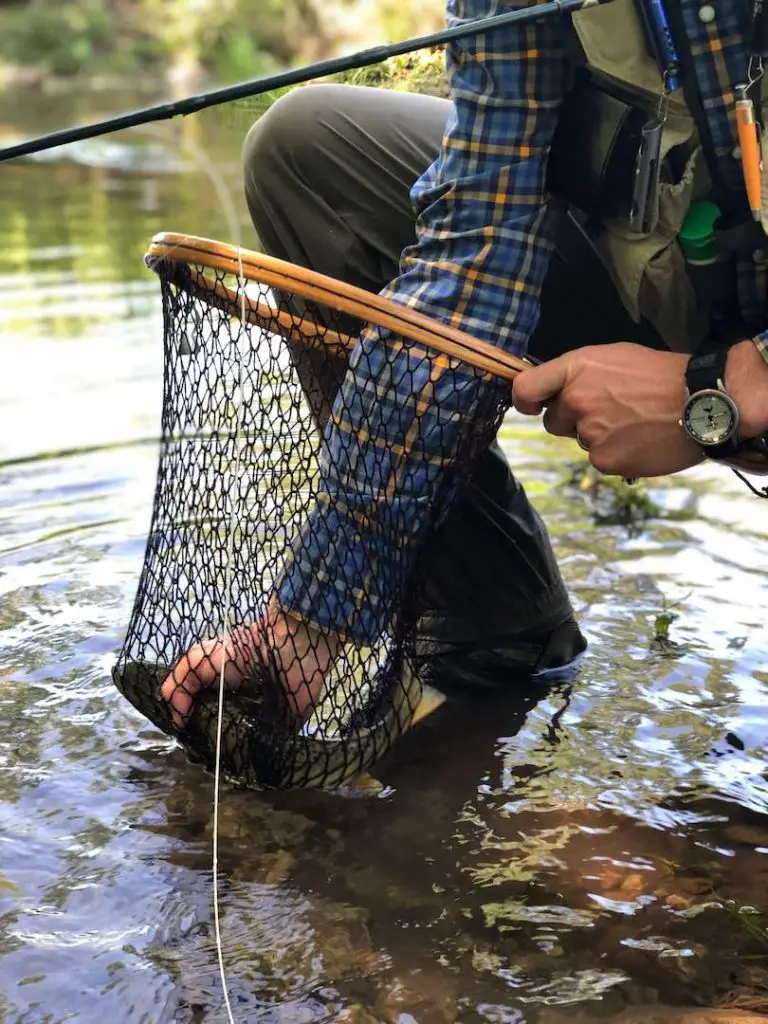
Conclusion: Best Fly Fishing Net
As you can see there is wide range of products on the market. To find the right one you really have to ask yourself where you are going to put it to use mostly. Only then can you decide what fly fishing net you should get: a classic trout one, a folding landing net, a long handle one, etc.
A high quality fish landing net is a good investment no matter what kind of fly fishing you practice.


Last update on 2026-06-15 / Affiliate links / Images from Amazon Product Advertising API
Frequently Asked Questions: Best Fly Fishing Nets
u003cstrongu003eWhat is a fly fishing net, and why is it essential for anglers?u003c/strongu003e
A fly fishing net is a specialized net used by anglers to land and safely handle fish after they’ve been hooked. It helps prevent injury to both the fish and the angler, and it’s a valuable tool for catch-and-release practices.
u003cstrongu003eWhat should I look for when choosing the best fly fishing net?u003c/strongu003e
When selecting a fly fishing net, consider these factors:
Net Material: Look for durable, fish-friendly materials that won’t harm the fish’s protective slime layer.
Net Size: Choose a net with an appropriate size and depth for the fish you’ll be targeting.
Handle Length: Opt for a handle length that allows you to comfortably reach the water without overreaching.
Netting Style: Consider rubberized or knotless netting to minimize tangling and damage to fish fins.
Portability: Choose a net that is easy to transport and store, especially if you’ll be hiking to fishing locations.
u003cstrongu003eAre there different types of fly fishing nets available?u003c/strongu003e
Yes, there are several types of fly fishing nets:
Landing Nets: Used to scoop fish out of the water during catch-and-release.
Folding Nets: Feature collapsible frames for easy storage and transportation.
Boat Nets: Designed for use on boats and larger bodies of water.
u003cstrongu003eIs there an optimal net size for different fish species?u003c/strongu003e
The optimal net size varies depending on the fish species. For small trout and panfish, a net with a smaller hoop size is sufficient. Larger fish like salmon or pike will require a larger net to accommodate their size.
u003cstrongu003eCan I use any fishing net for fly fishing, or do I need a specific type?u003c/strongu003e
While you can use a general fishing net for fly fishing, it’s recommended to use a net specifically designed for fly fishing. Regular fishing nets might have larger gaps in the netting, which can lead to tangling and damage to the fish’s delicate fins.
u003cstrongu003eWhat’s the benefit of using a rubberized netting material?u003c/strongu003e
Rubberized netting is fish-friendly, as it doesn’t remove the fish’s protective slime layer or cause tangling. It’s less likely to harm the fish and is often considered a more ethical choice for catch-and-release fishing.
u003cstrongu003eCan I attach a fly fishing net to my fishing vest or pack?u003c/strongu003e
Many fly fishing nets come with attachment options, such as D-rings or magnets, allowing you to secure the net to your fishing vest or pack for easy access while wading.
u003cstrongu003eHow should I properly clean and maintain my fly fishing net?u003c/strongu003e
To maintain your fly fishing net:
Rinse the net with freshwater after each use to remove debris and prevent odors.
Store the net in a cool, dry place to prevent mold or mildew growth.
Inspect the net for any damage and repair or replace parts as needed.
u003cstrongu003eAre there nets suitable for saltwater fly fishing?u003c/strongu003e
Yes, some fly fishing nets are designed for saltwater use, featuring materials that resist corrosion from saltwater exposure.
u003cstrongu003eCan I use a fly fishing net for other types of fishing?u003c/strongu003e
While fly fishing nets are designed with fly anglers in mind, they can also be used for other fishing styles, especially if catch-and-release is practiced. Just ensure the net is appropriate for the species you’re targeting and the fishing environment.
Our Expertise
Why you should trust us: For this review we’ve put all kinds of fly fishing nets to the test ranging from wooden landing nets, to modern one made from carbon fiber, folding landing nets and landing nets for big predators. Our goal is always the same: tell you the honest truth about each product so you can make a solid purchase decision. We can do that because we never get paid for reviews and are proud of our editorial independence.
Read more of our guides:
The Ultimate Guide to Fly Fishing Vests
Ultimate Guide to Streamer Boxes
Guide to the Best Fly Fishing Sunglasses
Disclaimer: Some of the links in this article are affiliate links. If you click on one of them and end up purchasing a product we earn a small commission at no extra cost for you. We only recommend products we believe in ourselves.
A landing net is the last piece of gear that touches a fish before it goes back. The mesh material, the hoop geometry, and how long the fish spends in the net all decide whether the release is a release or a delayed kill. This guide reviews ten nets I have fished across trout streams, salmon rivers, and saltwater, ranked by how well each one protects the fish, not by brand prestige.
How a landing net affects a released fish
Trout metabolism is governed by water temperature. They feed and recover most efficiently between 50 and 65 degrees F. Above 68 degrees F, dissolved oxygen in the water drops sharply, the fish is already in a low-oxygen environment before it is hooked, and the additional stress of a fight plus a slow release is frequently lethal even when the fish swims away looking fine (substrate: water temperature is the absolute governor of trout metabolism, dissolved oxygen plummets above 68 degrees F, stress of being caught in low-oxygen water is frequently lethal even if the fish is released).
The net is where the survivable release becomes a recoverable release. Two mechanisms matter. First, the mucus layer that coats salmonids is an active immune and osmoregulatory barrier. Knotted nylon mesh strips it; soft rubber-coated mesh does not, and that difference shows up as fungal infection on the flanks of fish landed in cotton or knotted nylon weeks later. Second, the longer a fish stays held against the body of a net while you free a hook, take a photo, and reposition, the longer it is unable to ventilate water across its gills. A hoop and basket that let the fish sit fully submerged with its head pointing upstream while you work is the difference between thirty seconds out of water and a fish you watch swim away strong.
Brook trout, native char rather than true trout, are at the extreme end of this sensitivity. They require highly oxygenated, exceptionally cold water and are intolerant of habitat degradation (substrate: brook trout require exceptionally clean, cold, highly oxygenated water and are highly sensitive to habitat degradation). Anadromous fish add another layer. Atlantic salmon returning to freshwater have ceased feeding entirely and are running on stored energy for the spawn (substrate: adults cease eating entirely once they re-enter freshwater to spawn). Every minute that fish spends fighting and held out of the water is metabolic budget pulled away from the spawning push it physically cannot replace. Pacific Oncorhynchus species die after spawning by design (substrate: anadromous Pacific salmon are strictly semelparous, they die after spawning), but the wild-population status of most of them means a stressed release on a kelt or a fresh fish before it reaches its redd matters at the watershed level.
The practical reading. If you are fishing summer trout water creeping toward 68 degrees F, the net is more important than the rod. If you are fishing Atlantic salmon water under fly-fishing-only catch-and-release regulation (substrate: many Atlantic salmon rivers now operate under strict catch-and-release and fly-fishing-only regulations), the same rule applies even harder. Every net reviewed below is judged first on whether it protects the fish, then on whether it is comfortable to carry.
Below, the ten nets I have fished, organized so you can find the one that matches the water you actually fish. Trout-stream sizing first, then guide-boat sizing, then big-fish sizing for pike, sea-run browns, and saltwater. For each pick: the spec block, the conditions I tested it in, what it does well, what it does not.
What separates a net that protects fish from one that injures them
Mesh material
The single most consequential decision in a landing net is the material of the bag, not the frame. Soft rubber-coated mesh and clear silicone-rubber mesh slide against a fish without abrading its mucus layer. Knotted nylon does the opposite: every knot is a point load that scrapes slime off contact. Cotton mesh, still common on inexpensive imports, absorbs water and dries slowly, and the absorbed water carries pathogens between fisheries. If a net you are considering does not specify rubber-coated or silicone mesh, treat it as a kill net regardless of price.
A secondary mesh question is mesh opening size. Tight-weave rubber holds tiny hooks like size 20 midges better than wide-weave rubber, but a hook stuck in tight rubber takes longer to free and the fish pays the time cost. The compromise most reviewed nets here strike (Fishpond, Brodin, Aventik, O’Pros) is a medium-weave rubber that catches up size 14 to 18 hooks routinely but releases them with one tug.
Hoop geometry
Hoop shape decides whether the fish sits calm in the basket or thrashes against the rim. An oval or teardrop hoop with the long axis pointing away from the handle accommodates the length of the fish and gives slack room for the tail to settle. A round hoop the same width as the fish forces the body to curl, which is the position that triggers most violent flop-out attempts. The Fishpond Nomad Emerger (18.8 inch long axis) and the Brodin Eco Clear oval are sized for trout to about 20 inches; the O’Pros Driftless at 19 by 14 inch covers up into the low-twenties; the Frabill Power Catch at 26 by 30 inch and the Big Kahuna at 32 by 41 or 40 by 44 inch are for pike, musky, and big sea-run fish where curling a 36 inch fish in a 20 inch hoop is the failure mode.
The other geometry variable is bag depth. A shallow basket (10 inches or less) is fine for small trout and bad for anything you want to net-photograph in the water, because the fish keeps levering its tail against the bottom and pivoting out. A 12 to 16 inch basket is the trout-stream all-rounder. The 30 inch Frabill Wading depth and the 38 to 48 inch Power Catch depth are sized for fish that will run a second time after they are in the net.
Hoop frame material
Wood (ash, walnut, hardwood laminates as on the Brodin) floats, hand-feels right, and is heavier than carbon or aluminum. Carbon fiber or carbon-fiberglass composite (Fishpond, Simms Daymaker, Aventik) is the lightest viable frame material, floats by construction (sealed air cavities), and accepts the kind of abuse a wading angler delivers without splintering. Aluminum (O’Pros, Frabill) is sturdier than carbon for the largest-fish category and accepts powder coat for color options, but does not float unless the handle is foam-cored. The choice is mostly aesthetic and weight, with one substrate-adjacent exception: in salt and in highly mineralized water, aluminum oxidizes and carbon does not. Saltwater anglers should default to carbon or epoxy-sealed wood.
Handle and reach
Handle length is the variable that separates a wade net from a boat net. A 9 to 11 inch handle keeps the net out of the way when wading and tucks into a wading-belt loop or a magnetic D-ring on the back of a vest. A 17 to 19 inch handle (Simms Daymaker medium, Orvis Wide Mouth Guide) gives a guide or a deep-run wading angler the reach to scoop a fish that is still 3 feet from the bank, and is the right answer when you are fishing alone in current heavy enough that you cannot wade closer. A 38 to 48 inch handle (Frabill Power Catch) is a boat net by definition; in waders it will catch on every overhanging branch.
The grip itself matters less than reviewers usually claim, but two failure modes are real: bare carbon fiber is slippery when wet and cold, and uncovered aluminum is slippery when oiled by fish slime. A textured rubber overgrip or a cork-style finish (Orvis, O’Pros) is the recoverable design.
Retention system
How the net rides on you between fish decides whether you reach for it before the fish is exhausted or after. Three systems are common. A clip on a coiled lanyard, often paired with a tuck into the back of the wading belt, is the cheapest and the slowest to deploy. A magnetic release (a small rare-earth magnet on the vest D-ring, mated to a steel ring on the net handle) is the fastest to deploy and the easiest to reset one-handed; this is the system shipped with the Aventik Carbon Fiber and the SF Soft Rubber, and it is what I run on the Fishpond Nomad Emerger using a separate Fishpond Confluence magnet. A captive bungee-and-D-ring system (the standard on most vests and the slot on sling packs) is the most secure against losing the net on a fall but slower than a magnet on the draw.
The retention question is where the net intersects the rest of your kit. If you are running a sling pack, the net attaches at the back of the sling and a magnet works well. If you are running a vest, the net attaches at the rear D-ring and a magnet is fastest. If you are running a hip pack, the net usually rides in a vertical rod-tube-style sleeve at the side; magnets are awkward there and a clip-and-bungee is the default. See our guides to fly fishing vests and fly fishing sling packs for how the net mount integrates into each carry system.
Matching hoop size to target species
The substrate divides the freshwater target list into salmonid genera (substrate: Salmo, Oncorhynchus, Salvelinus), and the practical netting sizing follows the genus more than the common name.
Resident brown trout (S. trutta fario) in a small or medium stream are the 14 to 20 inch hoop class. A Fishpond Nomad Emerger, a Brodin Eco Clear oval, an Aventik Carbon Fiber, or a Simms Daymaker small all fit this category. Resident rainbow trout (O. mykiss in the river phase) are the same class.
Big resident brown trout in a tailwater or a lake (substrate: brown trout grow toward piscivory; the lacustrine ecotype) push into the 18 to 24 inch hoop class. The Simms Daymaker medium, the O’Pros Driftless 19 by 14 inch, and the Orvis Wide Mouth Guide 12.75 by 17.5 inch are the sweet spot. Anything past 24 inch on a wild brown deserves a net you can fully submerge with the fish horizontal.
Sea-run brown trout, Atlantic salmon grilse, and sea-run brook trout (substrate: anadromous trutta ecotype; Atlantic salmon grilse return after a single sea-winter; brook trout salters of the Northeastern coast) are the 20 to 26 inch hoop class with a 14 to 20 inch deep basket. The Orvis Wide Mouth Guide handles grilse; the Frabill Wading Net handles sea-runs and is what I have run on the Baltic.
Multi-sea-winter Atlantic salmon and large Pacific Chinook are the 26 to 30 inch hoop class, and the Frabill Power Catch is the answer.
Pike and musky in freshwater, and saltwater species like permit and bonefish on shallow flats, are a different category. Pike and musky go in the Power Catch 32 by 41 inch or the Big Kahuna. Permit and bonefish are typically released without netting at all on a tarpon or bonefish flat (substrate: bonefish coloration provides near-perfect camouflage over sandy bottoms; permit feed heavily on crabs and shrimp on shallow mudflats), with a wet-hand release alongside the boat; when a net is used it is a soft rubber bag on a wide hoop. Tarpon (substrate: 100-pound-plus tarpon, abrasive mouth) are not netted; they are released boatside with a lip grip or by simply popping the leader. A “boga grip” lip-clamp is the saltwater alternative to a net for fish too large to hoop.
The decision rule. The hoop should be 2 to 3 inches longer than the longest fish you reasonably expect, the basket should be at least 50% of the hoop length deep, and the mesh should be soft rubber. The rest is preference.
Net retention and one-handed netting in current
The decisive moment with a landing net is the third or fourth pass of a tired fish, when one hand has the rod high and the other has to extract the net, deploy it, and slide it under the fish without breaking the angle of the rod. That is a one-handed operation. The retention system is what makes it possible.
A magnetic release (a steel ring at the head of the net handle and a rare-earth magnet on the rear D-ring of a vest or sling) lets you reach over your shoulder, pull, and have the net in your hand in one motion. Resetting it after the release is a one-handed push back onto the magnet. Brands ship variations: the Aventik comes with a magnet in the box, the SF Soft Rubber comes with a magnet, the Fishpond Nomad Emerger pairs cleanly with the Fishpond Confluence magnet sold separately.
A bungee-and-D-ring retention (the slot on most slings and the rear D-ring on most vests) is more secure if you take a fall, slower on the draw, and is what most non-magnet nets default to. A simple clip-and-coiled-lanyard is the cheapest and the most prone to swing into the back of your knees while wading.
For where the net mounts on the rest of your carry system, see fly fishing vests, fly fishing sling packs, and fly fishing hip packs. The net is part of the pack stack, not an accessory bolted on after.
Conclusion
The right fly fishing net is the one that matches the fish you actually catch most often, mounts cleanly to the pack or vest you actually wear, and uses soft rubber-coated mesh that does not strip the slime layer the fish relies on for fungal and osmotic defense. For most trout fishers on most rivers, the Fishpond Nomad Emerger is the one I keep coming back to, and it is what I carry into the Heidarvatn sea trout fishery where landed-fish survival is the metric the lodge is measured by. If your water holds bigger fish, scale up: the Simms Daymaker medium and the O’Pros Driftless are the next step, the Orvis Wide Mouth Guide if you fish from a boat or off steep banks, the Frabill Power Catch if you are after pike, musky, or large sea-run Atlantic salmon. None of these are cheap, and none of them need to be replaced inside a decade with sensible care. A bad net is a recurring tax on the fish you release; a good net is paid for once.
Three questions. Drop the rest. The eliminated questions are restatements of body content; FAQ schema is more valuable when the answers are substantive.
Q1: Why does mesh material matter so much? A: A fish’s skin is covered in a mucus layer that does two things: it is an active immune barrier against bacteria and fungi, and it controls osmotic balance between the fish’s body and the surrounding water. Knotted nylon mesh and cotton mesh scrape that layer off on contact. Soft rubber-coated mesh and clear silicone-rubber mesh slide against the fish without removing it. A fish landed in a knotted net often swims away looking fine and develops fungal lesions over the next week or two; a fish landed in soft rubber recovers cleanly. For catch-and-release water, rubber mesh is not a preference, it is the baseline.
Q2: What hoop size do I need for trout? A: The hoop should be 2 to 3 inches longer than the longest fish you reasonably expect, and the basket depth should be at least half the hoop length. For most resident trout streams that means a 14 to 20 inch hoop with a 12 to 16 inch basket. For tailwater fish in the 20 to 24 inch range, scale up to 18 to 22 inch hoop. For sea-run brown trout, grilse, or Pacific salmon, 20 to 26 inch hoop with a 14 to 20 inch basket. Curling a long fish into an undersized hoop is the most common cause of flop-out injuries.
Q3: Magnetic release or bungee-and-D-ring? A: A magnetic release is faster to deploy one-handed and is the system I run on every wade trip. A bungee-and-D-ring retention is more secure against losing the net in a fall and is the default on most vests and slings. If you fish water where a slip is likely (canyon water, slick wading), use the bungee. If you fish predictable wading and value the third-of-a-second saved on the draw, use a magnet. The Aventik and SF Soft Rubber ship with magnets; the Fishpond pairs with a Fishpond Confluence magnet sold separately.

Leonard Schoenberger is a fly fishing professional and gear specialist with over 20 years of experience on the water. As the manager of Heidarvatn, a world-class sea trout lodge in Iceland, his product recommendations and tactical advice are tested in some of the most demanding conditions on earth. His expertise has been mentioned in The New York Times, the Financial Times, and at the Outdoor Media Summit.