Last updated on September 5th, 2026.
The thermocline is the layer in a lake where water temperature drops sharply between the warm surface mixed layer above and the cold, dense layer below. In a summer-stratified lake it is the narrow band, often only a few feet thick, that separates a sun-warmed top of 70°F or higher from a bottom that may sit near 40°F. The temperature change across that band is severe enough to behave like a physical barrier. Density rises as water cools toward 4°C, and the cold, dense water below resists mixing upward through the warmer, lighter water above.
For most of the summer, that barrier is also where the fish live. Game fish need both their preferred temperature band and enough dissolved oxygen to support sustained activity. Above the thermocline the water has oxygen but is often too warm. Below it the water is cool enough but, in the lakes that stratify hardest, has been stripped of oxygen by decomposing organic matter that the cold dense layer cannot replenish from the surface. The thermocline itself, and the few feet of water just above it, is the slice where both requirements are satisfied. Targeting that slice is the difference between a productive summer lake day and casting blind over empty water.
This page walks the physics of stratification, the species-temperature-and-oxygen math that puts fish where they are, the methods for locating the thermocline with or without electronics, and the decision logic for how to fish the column once you have it pinned.
How the lake stratifies and why the bottom goes anoxic
Water reaches its maximum density at about 4°C (39°F). Above and below that temperature it is less dense. In spring, after ice-off, the entire water column sits near 4°C and mixes freely, driven by wind and small temperature differentials. As surface water warms through late spring and early summer, the warmer water becomes lighter and floats on top. Wind keeps the upper layer mixed and homogenous. By mid-summer the lake has settled into three distinct zones.
The epilimnion is the warm upper mixed layer. It is in contact with the atmosphere, exchanges oxygen freely through the surface, and is stirred by wind and wave action so its temperature is roughly uniform top to bottom within the layer. In a typical temperate lake in July or August it sits between 68°F and 80°F.
The thermocline (or metalimnion, the term limnologists use for the same band) is the transition zone where temperature drops fast with depth. A common signature is a 1°F drop per foot of depth, sometimes much steeper. This is the slice where density is changing fastest, which is what blocks vertical mixing.
The hypolimnion is the cold lower layer. Below the thermocline the water is dense, dark, and physically isolated from the surface for the entire stratified season. Temperatures hold near 4°C in deep lakes and somewhat warmer in shallower ones. Oxygen in this layer is whatever was trapped there in spring, minus whatever organic decomposition has consumed since. In productive lakes with high organic input, the hypolimnion goes anoxic by late summer. Anything that sinks (dead plankton, fish carcasses, terrestrial debris) decomposes on the bottom, and the bacteria doing that work consume the dissolved oxygen. Because the cold dense water cannot mix upward to the oxygenated surface, the oxygen is not replaced. By August in a fertile lake there may be no usable oxygen below 25 to 30 feet.
The seasonal break is fall turnover. As surface water cools through autumn and approaches 4°C, it becomes denser than the water below it and sinks. The stratification collapses, the column mixes top to bottom, and oxygen returns to the deep water. The thermocline disappears until the next summer rebuilds it.
Why fish hold at the thermocline (temperature plus oxygen, not either alone)
The thermocline is not magic. It is where two requirements happen to overlap. Game fish need a temperature band that suits their metabolism, and they need dissolved oxygen above roughly 4 to 5 parts per million to feed and recover from exertion. The thermocline is the depth where, in a summer-stratified lake, both numbers line up.
Largemouth and smallmouth bass feed actively in the 60°F to 75°F band, which the how to catch bass breakdown spells out in more detail. In a stratified lake by mid-July, the epilimnion has crossed 75°F and the dissolved oxygen in shallow weedbeds has dropped under the heat. Bass push down to the cooler, still-oxygenated water at or just above the thermocline, often holding off submerged points and creek-channel breaks that intersect that depth. Smallmouth in deep rocky lakes do the same thing earlier and stay deeper longer than largemouth do.
Trout sit in a narrower thermal window. Trout feed heavily between 50°F and 65°F (10°C to 18°C), and above 68°F dissolved oxygen drops and the fish become stressed. In river systems with continuous current, the how to fish in river framing applies: there is no thermocline, only seams and oxygenated riffles. In summer lakes with a stratified column, trout pin themselves at the depth that holds both 55°F to 65°F water and 5 ppm oxygen, which is almost always at or in the thermocline. The how to catch trout approach to lakes essentially comes down to finding that band and presenting a fly or lure at exactly that depth.
Walleye sit deeper than bass through summer. They tolerate 65°F to 72°F but prefer 60°F to 65°F when they can get it. In a stratified lake they hold tight to structure at the upper edge of the thermocline, where the temperature is right and the light is dim enough for their large low-light eyes. Kokanee, the landlocked sockeye form, hold deeper still, often 30 to 60 feet down, suspended in the cold side of the thermocline where the 50°F band sits. Lake trout in cold, deep, well-oxygenated northern lakes are the outlier. They sit below the thermocline entirely, in the cold hypolimnion, because those lakes are deep and clean enough that the bottom layer never goes anoxic. In a more typical productive lake, lake trout cannot live there in summer because the oxygen is gone.
The general rule for a summer lake is to assume the fish are within five feet of the top edge of the thermocline, on the warm side. The exact band shifts species to species, but the principle holds: predator and prey both crowd the slice where temperature, oxygen, and food supply intersect, and that slice is the upper thermocline.
Finding the thermocline (with electronics and without)
The cleanest way to locate the thermocline is with electronics. A modern sonar unit with the sensitivity cranked up will show the thermocline as a horizontal band of return across the screen, sometimes called the “fuzzy line” or “fizzy line” by lake guides. The acoustic signature is real: the density gradient across the temperature break reflects sound enough to register, especially when sensitivity is pushed to 85 to 95 percent on the manual setting. Below that band the screen often goes empty or shows scattered noise, which is the dead zone where fish are not holding. Above and within the band, arches and ball-shapes indicate fish and bait.
Downscan and side-imaging sonar make the band easier to read because they slice the column vertically and present it as a near-photograph. The thermocline appears as a visible horizontal stratum at a consistent depth across the boat’s track. Note that depth, then fish it.
A temperature probe paired with a dissolved oxygen meter gives the same answer with no interpretation required. Lower the probe in one-foot increments and record temperature and DO at each depth. The thermocline is the band where temperature drops fastest. The fish-holding band is the depth or two above where DO is still 5 ppm or higher. Field meters cost less than a single midrange rod and answer the depth question definitively. This is the approach a guide working an unfamiliar lake uses to set up a day, and it is the approach to default to when the sonar reading is ambiguous.
Without electronics there is still a usable heuristic. Surface temperature plus lake depth gives a reasonable first guess. Stained, productive lakes in temperate regions stratify with the thermocline at roughly 8 to 15 feet by mid-summer. Clear, deep lakes can push it to 30 to 60 feet. The clearer the water, the deeper the sunlight penetrates, the deeper the warm mixed layer extends, and the deeper the thermocline sits. A secchi-disk reading, or a quick visual check of how deep an outboard’s lower unit is visible, is enough to estimate the band within a few feet.
Surface signs help. A clean, sharp-edged temperature plume around an inflowing creek mouth or spring often marks the boundary where warmer surface water meets a cold input that is sinking to its density-equivalent depth, which is frequently the upper thermocline. Loon and merganser dive depths, when observable, also bracket the productive zone. The birds work the same fish-holding column the angler is trying to find. The how to find fishing spots approach to reading an unfamiliar lake leans heavily on these surface cues when electronics are not available.
Fishing above, in, and below the thermocline
The decision is depth-control, and it cascades into line choice, lure or fly choice, and presentation cadence.
The water above the thermocline is the surface and shallow mixed layer. Fish hold here in low light, at dawn and dusk, when the warm-water stress is lowest and bait is on the move. Topwater poppers, surface plugs, and shallow-running crankbaits all work in this window. A floating line with a popper or a shallow streamer covers it on fly tackle. Productive depths run from the surface to about ten feet, depending on how deep the epilimnion extends. This is the window where surface action happens, and it shuts down as the sun climbs.
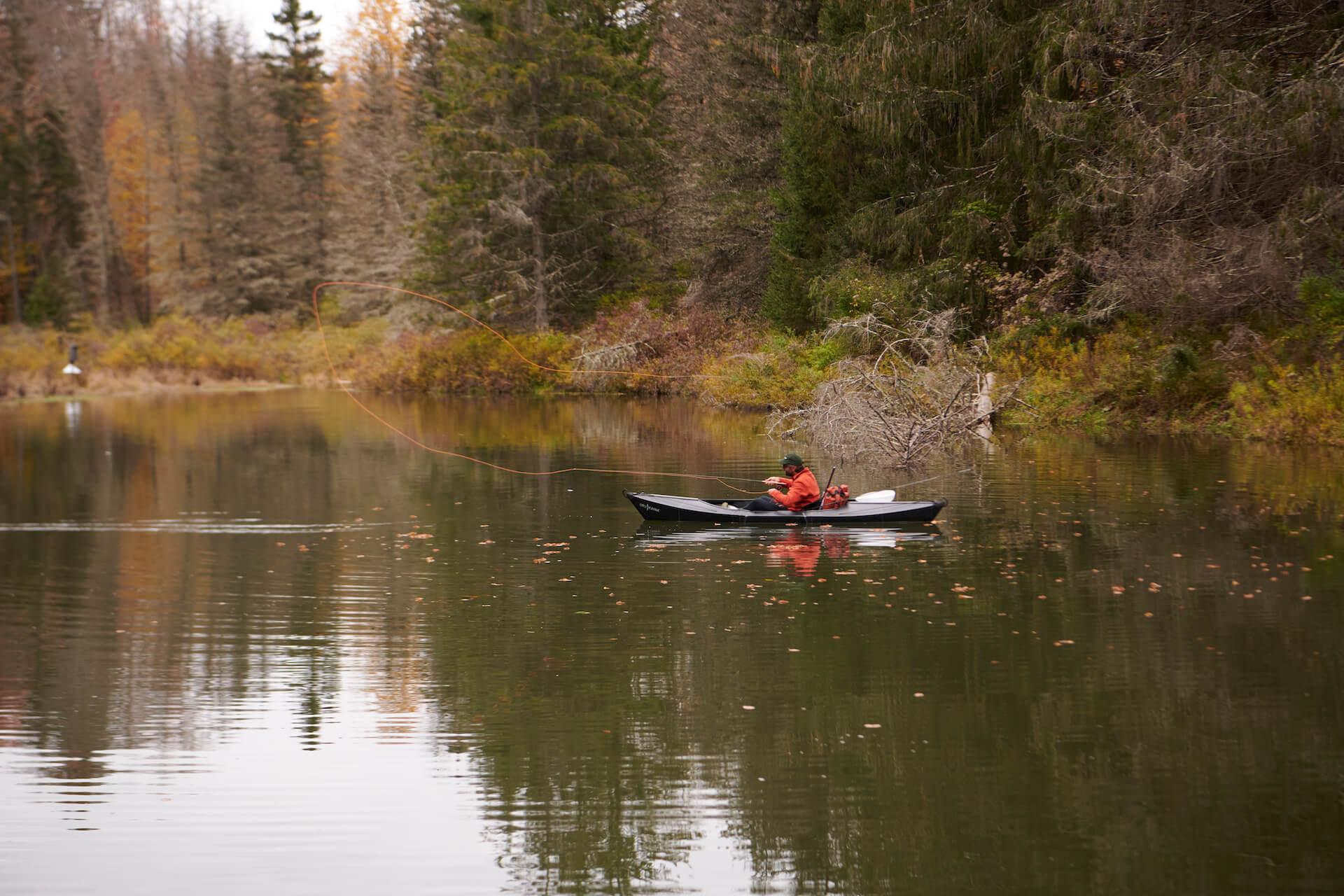
The thermocline itself, and the five feet of water directly above it, is the main productive band through the heat of the day. The depth is fixed (whatever the sonar shows), and the goal is to keep the lure or fly at that depth long enough for fish holding there to take it. Vertical jigging is the conventional-tackle default: a jig or a vertical-presentation lure dropped to thermocline depth and worked in place. Drop-shot rigs hold a softbait at a precise distance off the bottom or off the sonar band. Downriggers let trolling presentations run flat at thermocline depth without surfacing on the inside of turns. On fly tackle, the answer is a full-sinking line or a heavy sink-tip with a count-down to depth before retrieving. This is the depth-targeted lure selection problem covered in the what bait do bass like write-up: the bait choice is downstream of the depth requirement, not upstream of it. Match the depth first, then pick the lure or fly that runs at that depth.
The water below the thermocline is, in most stratified lakes through mid-to-late summer, not worth fishing. The dissolved oxygen is below the threshold game fish will tolerate. Lures dropped through it pass through dead water on the way down and on the way back up. In the deep, clean, cold lakes where the hypolimnion stays oxygenated (lake trout water, deep alpine lakes, large oligotrophic systems), the rule reverses and the productive band can extend well below the thermocline. Most productive bass, walleye, and trout lakes do not work that way. Stay at or above the band.
Getting to the productive offshore depth in the first place is its own problem. A bank angler can sometimes reach a steep shoreline drop where the thermocline intersects close in, but more often it sits over deeper water beyond casting range. A small craft, a float tube, or one of the best inflatable fishing kayaks for getting offshore quietly is what unlocks the open-water thermocline targets that no bank cast can reach.
One last input. Atmospheric and weather changes do not move the thermocline directly, but they shift fish behavior at the thermocline. The same barometric pressure effects that drive a pre-front feeding push on shallow bass also drive a feeding push on suspended thermocline fish. A pre-front afternoon over a known thermocline structure is one of the most productive summer windows for deep-holding fish. Read the depth band, read the weather, and fish the overlap.

Leonard Schoenberger is a fly fishing professional and gear specialist with over 20 years of experience on the water. As the manager of Heidarvatn, a world-class sea trout lodge in Iceland, his product recommendations and tactical advice are tested in some of the most demanding conditions on earth. His expertise has been mentioned in The New York Times, the Financial Times, and at the Outdoor Media Summit.