Last updated on September 30th, 2026.
Spey casting is a two-handed fly casting technique that uses the surface tension of the water to anchor the leader and load the rod, rather than aerializing the line behind the angler the way a traditional overhead cast does. It originated on the River Spey in Scotland in the nineteenth century, where steep banks and dense bankside trees made a conventional backcast impossible. Anglers built long two-handed rods (initially out of greenheart wood, now graphite) and developed a casting motion that swept the line across the water in a D-loop, then fired it forward without ever putting the fly directly behind them.
The technique is now used wherever traditional backcast room is limited, where the angler needs to cover long distances with sustained casting (winter steelhead, Atlantic salmon), or where a heavy sink-tip or large fly demands more rod and more energy than a single-handed cast can deliver. Spey is the umbrella term; the discipline has subdivided into three line-system families (traditional Spey, Skagit, Scandi) and a vocabulary of specific casts that fit different wind and water conditions.
The mechanics of the D-loop
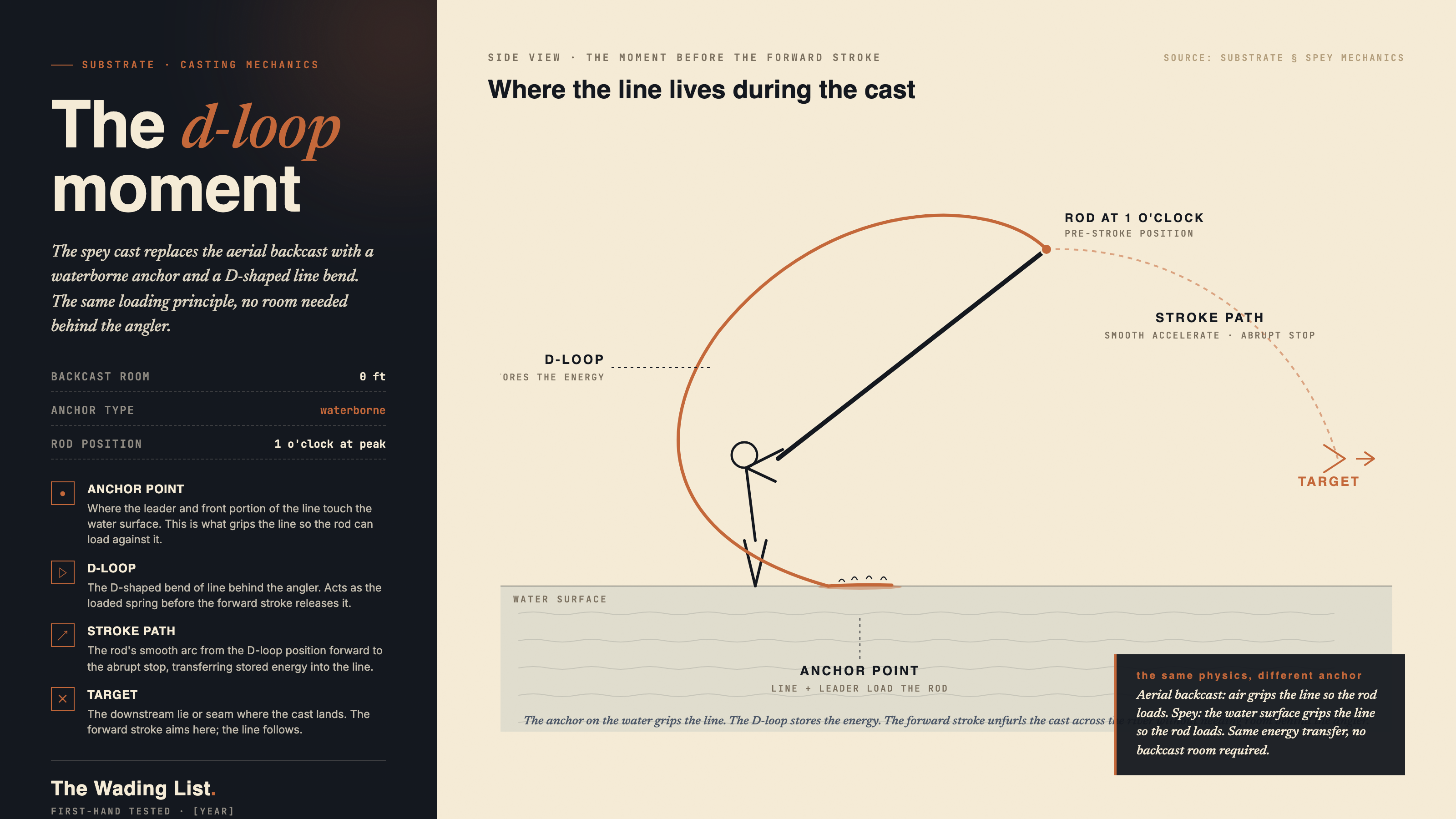
The defining feature of a Spey cast is the D-loop. Instead of aerializing the full fly line behind the caster in a straight backcast, the angler sweeps the line across or behind themselves so that part of the line lifts off the water in a curving arc while the leader and fly remain anchored to the water surface. The shape, viewed from the side, is a capital D: the rod tip and the line behind it form the curve of the D, the water surface and the anchored leader form the straight back.
The anchor is the critical piece. Where the fly and the leader (and on Skagit casts, a portion of the heavy head) lie on the water, surface tension holds them in place during the casting stroke. The angler then accelerates the rod forward, and the rod loads against the resistance of the anchored leader plus the mass of the line in the D-loop. When the rod tip stops at the end of the forward stroke, the energy releases into the line and the cast unrolls forward.
This is why Spey casts can deliver heavy flies long distances without aerializing the line. The conventional overhead cast has to lift the entire line into the air on the backcast and fight gravity the whole time; the Spey cast keeps most of the line at or near the water and uses the anchor as a fulcrum. A 13- or 14-foot two-handed rod with a 540-grain Skagit head can deliver an eight-inch articulated streamer 80 feet across a wide river with two casting strokes and no backcast room behind the angler.
The two-handed rod itself is essential to the mechanics. The lower hand on the cork provides a fulcrum for the upper hand to lever against. The lower hand pulls in during the forward stroke while the upper hand pushes out; the combined motion drives the rod tip through a much greater arc than a single-handed cast can produce, and the longer rod (typically 12 to 15 feet) gives the casting stroke more leverage and more tip speed.
The three line systems
Modern two-handed fly fishing has divided into three line-design families, each optimized for different water and fly conditions.
Traditional Spey lines are long-belly designs, with the head extending 60 to 70 feet from the rod tip. The cast is long and flowing, the loops are elegant and somewhat large, and the line carries enough mass to lift large traditional Atlantic salmon flies and turn them over. This is the original system, suited for fishing classic Atlantic salmon rivers (the Spey, the Tweed, the Cascapédia) with greased-line surface presentations or sub-surface wet-fly swings. Modern long-belly Spey lines are still used by traditionalists and by anglers fishing dry-line techniques for salmon.
Skagit lines were developed in the Pacific Northwest in the 1990s and early 2000s for winter steelhead fishing. The Skagit head is short (typically 23 to 30 feet) and very heavy, often 480 to 600 grains for a 7- or 8-weight rod. The short heavy head lets the angler throw large weighted flies and heavy sink-tips (10 to 15 feet of T-11, T-14, or T-17 sinking material) with minimal back-stroke room. Skagit casts are short and powerful, with deep anchors and aggressive loads. This is the line system for winter steelhead in tight Pacific Northwest rivers (the Skykomish, the Sauk, the Skagit itself) and for any application that demands big flies and fast sink rates with limited back-stroke room.
Scandi lines (short for Scandinavian) sit between the two. The head is moderate length (30 to 40 feet), lighter than Skagit and shorter than traditional Spey, designed for delicate surface or near-surface presentations with smaller flies. Scandi casts are graceful and quiet, suited for summer steelhead, sea-run brown trout, and Atlantic salmon in clear-water conditions where heavy splashy Skagit casts would spook the fish. Scandi lines pair with a tapered polyleader (5 to 14 feet, in various sink rates from floating to fast-sinking) instead of heavy T-material tips, giving the angler granular control over depth.
The three systems are not interchangeable on the same rod and reel without changing lines. A Skagit head on a Scandi-tuned rod casts poorly; a traditional Spey line on a fast Skagit-design rod casts even worse. The rod and the line are designed together, and most two-handed anglers carry one rod per system, or a switch rod (10.5 to 11.5 feet) that compromises between the three.
The specific casts
Within Spey casting, individual casts are named by the water conditions they fit, particularly wind direction. The major categories split into “splash and go” (waterborne-anchor-then-immediately-fire) and “waterborne anchor” (sustained anchor with the line resting on the water throughout the cast).
The Single Spey is a splash-and-go cast for downstream wind from the angler’s casting-arm side (wind in the face if the angler is right-handed and the river flows left-to-right). The line sweeps in a curving arc out from the angler, lands briefly on the upstream side of the angler, and is immediately fired forward. The anchor is just long enough to load the rod; the line is in the air for most of the cast.
The Double Spey is a waterborne-anchor cast for downstream wind from the angler’s opposite side. The line is gathered into a sustained anchor downstream of the angler before being swept into the D-loop and fired forward. The cast is slower and more deliberate than the Single Spey but works in wind conditions where the Single Spey would put the line into the angler.
The Snap-T (or Circle Spey) is a waterborne-anchor cast that uses a sharp rod-tip snap to set the anchor upstream of the angler. Useful when the angler needs to reposition the anchor without sweeping the rod across the body.
The Snake Roll is a fast splash-and-go cast for downstream wind on the opposite side from the casting arm. The rod tip traces a Z or S pattern through the air, setting a brief anchor and firing the line immediately.
The Perry Poke is an adjustment cast for re-setting the anchor when a cast has gone awry; the angler pokes the rod tip forward into the water briefly, repositioning the anchored line for a clean second attempt.
For Skagit specifically, the Sustained Anchor cast (also called the Sustained Touch and Go) and the Cack-Handed cast are the working pair, each fitting a different wind direction.
Spey rod versus single-handed fly rod
A Spey rod is built fundamentally differently from a single-handed rod.
Length: 12 to 15 feet for a Spey rod, versus 8 to 10 feet for a single-handed fly rod. The longer rod provides leverage for the two-handed casting motion and reach for line control after the cast.
Grip: Spey rods have a top grip (where the upper hand drives the rod) and a lower grip on the cork above the reel (where the lower hand pulls in during the forward stroke). Single-handed rods have one grip.
Line designation: Spey rods are designated by line weight using a different scale than single-handed rods. A 7-weight Spey rod and a 7-weight single-handed rod are not the same; the Spey rod is designed to load with grain weights three to five times heavier than the single-handed equivalent. AFFTA standards exist for both but they are separate scales.
Action: Most modern Spey rods are medium to medium-fast action, with enough flex through the blank to drive the deeper casting strokes the technique requires. Fast-action stiff Spey rods exist (the Sage Method, the G. Loomis Asquith Spey) but are specialist tools; medium-fast is the all-around starting point.
Reel: Spey reels are large-arbor, sealed-drag designs in the 9- to 12-weight range, carrying 200 to 300 yards of backing under the fly line. Steelhead and salmon both make long, fast runs; the reel matters here in a way it does not for trout.
A switch rod is the compromise: 10.5 to 11.5 feet long, designed to be cast either single-handed or two-handed depending on the situation. Switch rods work but they compromise both: they are heavier in the hand than single-handed rods and shorter in casting leverage than Spey rods. For anglers who fish water that needs both techniques (smaller rivers with occasional brush behind the casting position), the switch rod earns its place; for dedicated Spey water, a full Spey rod is the better tool.
When Spey casting is the right answer
Tight back-stroke room with consistent need for distance is the classic Spey scenario. Rivers with steep banks, dense bankside vegetation, or the angler wading deep enough that aerializing a line is awkward.
Sustained swing fishing for steelhead or Atlantic salmon. Spey casting matches the swing presentation naturally; the cast lays the line across the current, the angler mends, the fly swings through the holding water on a tight line. Repeating this presentation across a long pool, for hours, is what Spey rods are designed to do.
Heavy sink-tips and large flies. Skagit lines specifically were developed because conventional fly lines could not deliver T-14 sink-tips and three-inch leech patterns from a single-handed rod without exhausting the angler in an hour. The Skagit Spey rod and head let the angler fish heavy gear all day.
Distance combined with line control after the cast. The long rod’s reach lets the angler mend at distance, control swing speed, and lift line out of conflicting current seams in ways a single-handed rod cannot match.
When Spey is not the answer: trout fishing in moderate water with normal backcast room (the single-handed 5-weight or 6-weight outperforms a switch rod for accuracy and presentation), small-stream brook trout fishing (a 3-weight is the right tool, not a 13-foot Spey rod), or any situation where the angler is targeting fish that hold in close, sight-fished positions (the long rod hampers precision at short range).
Related gear
The two-handed rod is the foundational tool for Spey casting. Action profile, line designation, and length all matter, and matching the rod to the line system (Skagit, Scandi, or traditional Spey) is essential. Our guides to the best spey rods for steelhead and the best salmon fly rods cover the rods themselves.
The line system itself is half the equation. Skagit heads with sink-tips for winter steelhead, Scandi heads with polyleaders for summer steelhead and Atlantic salmon, long-belly Spey lines for traditional dry-line work. Our guide to the best fly lines for trout includes trout spey and Skagit shooting heads; Spey lines for salmon are a specialist subset.
A large-arbor sealed drag fly reel is mandatory for Spey. Steelhead and salmon make long fast runs; an unsealed click-pawl reel will fail in the conditions Spey water demands. Our guide to the best fly reels for salmon covers the sealed-drag reels built for those runs.
The leader system for Spey is its own subset, depending on whether you are fishing Skagit (heavy T-material sink tips, with short heavy mono leaders), Scandi (polyleaders in various sink rates), or traditional Spey (long tapered nylon leaders). Our guide to fluorocarbon vs monofilament leader covers the terminal-tackle decision, which applies in two-handed fishing the same way it does single-handed.

Leonard Schoenberger is a fly fishing professional and gear specialist with over 20 years of experience on the water. As the manager of Heidarvatn, a world-class sea trout lodge in Iceland, his product recommendations and tactical advice are tested in some of the most demanding conditions on earth. His expertise has been mentioned in The New York Times, the Financial Times, and at the Outdoor Media Summit.