Last updated on May 26th, 2026.
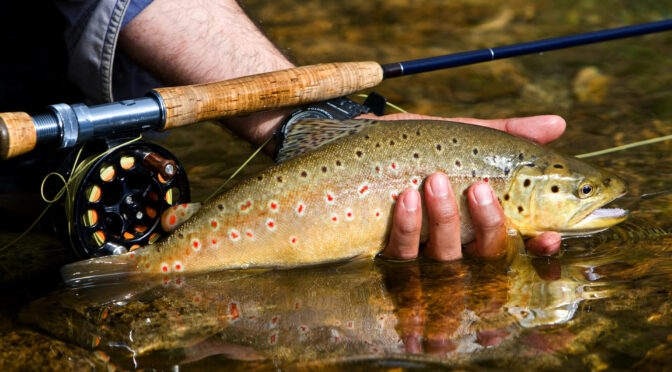
The honest answer to what trout eat is not a jar of pink dough. Trout feed on aquatic insects drifting along the riverbed and hatching in the surface film, on terrestrial bugs that get blown into the water on a summer afternoon, on small baitfish darting through the shallows, and on crustaceans grubbing through the gravel. Worms and PowerBait will catch hatchery-pellet-conditioned stocker trout in put-and-take ponds. They will rarely catch a wild brown trout holding behind a midstream boulder on a freestone river, because that fish is keyed in on what is actually drifting past its nose.
The fly fisher’s version of the question is therefore not “what bait” but “what imitation.” A trout’s diet across a season is dominated by four insect orders, a handful of non-insect food groups, and a few seasonal terrestrials. Every effective fly pattern is a deliberate imitation of one of those food categories in one of its life stages. Match the food, match the stage, get the drift right, and the fish eats. That is the entire game.
If you came here looking for spinner blades and dough bait, the brief detour below explains where bait fishing for trout fits and why this magazine answers the question with flies instead.
What trout actually eat
The bulk of a trout’s calories in moving water comes from four orders of aquatic insects: mayflies (Ephemeroptera), caddisflies (Trichoptera), midges (Chironomidae), and stoneflies (Plecoptera). Each order cycles through distinct life stages, and trout will selectively key in on whichever stage is most abundant and most vulnerable in a given moment.
Mayflies hatch through a unique double moult. The nymphs live for months or years on the riverbed, feeding and breathing through abdominal gills. When they emerge, they moult into a sexually immature winged stage called a dun, which rests on the surface film while its wings dry and is wildly exposed to predation. Within twenty-four hours the dun moults again into the sexually mature spinner, which mates over the water and falls dead onto the surface as a spent spinner. Trout exploit each of these stages with different presentations: nymphs deep, emergers in the film, duns on top, spinners flat in the meniscus at dusk.
Caddisflies skip the dun-spinner moult and pupate underwater, cutting out of their silken pupal cocoons and swimming rapidly to the surface. That frantic ascent is why caddis emergences trigger such aggressive, splashy takes. Adults skitter and flutter on the surface rather than sitting still like mayfly duns, which is exactly the behaviour an Elk Hair Caddis is designed to imitate when twitched on a downstream swing.
Stoneflies are different again. Their nymphs do not swim well. They crawl along the bottom of well-oxygenated streams for one to four years, then migrate to shore and crawl out of the water to hatch on rocks and streamside vegetation. That means stonefly nymphs are constantly available to trout grubbing the rocks, but stonefly adults only matter when the females return to the water to lay eggs. Big stonefly hatches on rivers like the Madison or the Deschutes will move trout to the bank to intercept egg-laying adults.
Midges hatch year-round, including in the dead of winter when nothing else is moving. They tolerate low dissolved oxygen, the larvae often turn bright red from a hemoglobin analog (the bloodworms that some bait fishers buy), and they are the entire food supply on many tailwaters during the cold months. A size 22 zebra midge is often the difference between a fish in winter and a fish-less afternoon.
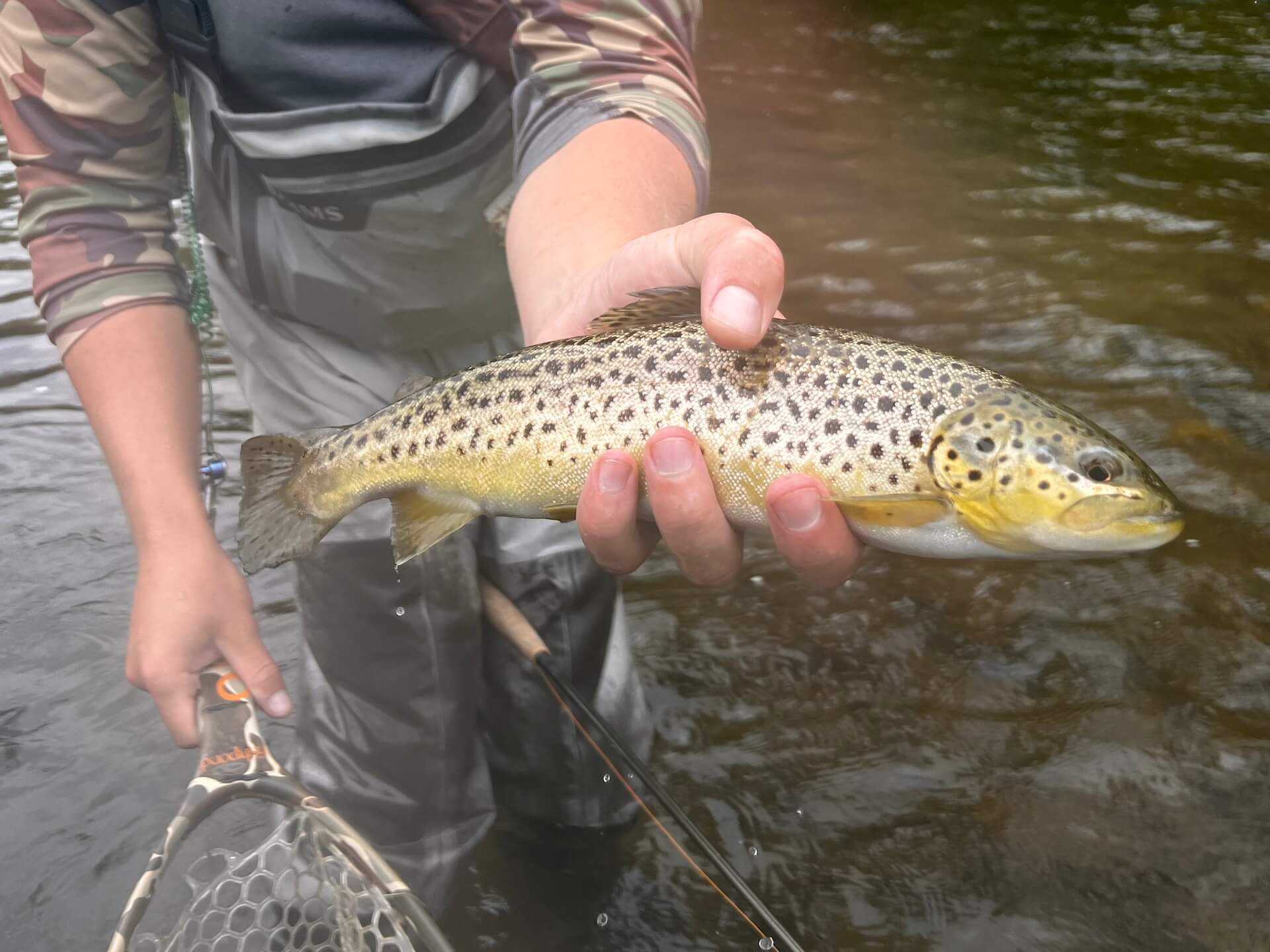
Beyond the four insect orders, trout eat: terrestrial insects (grasshoppers, ants, beetles, crickets that fall in from streamside vegetation), small baitfish (sculpins on the bottom, dace and shiners in the water column), crustaceans (scuds and sowbugs in spring creeks, crayfish in warmer rivers), and as they grow larger, other fish. Brown trout in particular shift heavily toward piscivory as they push past sixteen inches, which is why streamer fishing produces the largest fish of the year on most rivers.
Fly patterns matched to the diet
Translate the food categories into the fly box and the structure becomes simple. Every pattern is doing one of four jobs.
Dry flies float on the surface and imitate adult insects (or terrestrials) sitting on the film. The Adams is the most-tied dry fly in the world for a reason: its grey body and grizzly-and-brown mixed hackle suggests a generic mayfly dun across dozens of species. The Parachute Adams adds a horizontal hackle wrapped around an upright wing post, which sits the body flush in the film the way a real dun sits. The Elk Hair Caddis, designed by Al Troth in 1957, uses stiff elk-hair wing fibres that ride high and skitter like an adult caddis. Comparaduns, Sparkle Duns, and Hi-Vis Spinners cover the specific genus situations: PMD, Blue Wing Olive, Trico, March Brown, Hex.
Nymphs imitate the underwater stages: mayfly nymphs, caddis larvae and pupae, stonefly nymphs, midge larvae. The Pheasant Tail Nymph, tied originally by Frank Sawyer on the English chalkstreams, suggests a generic mayfly nymph and catches fish on every continent. The Hare’s Ear Nymph is its scruffier, buggier cousin, equally suggestive of mayfly nymphs and caddis pupae depending on the size and weight. The Copper John adds a heavy tungsten or brass body for fast sink rates in deep, fast water. Weighted stonefly nymphs in size 4 through 10, the Tungsten Perdigon at the heavy end of the Euro nymphing spectrum, and a zebra midge or RS2 in the size 18 to 22 range cover the rest.
Streamers imitate baitfish, sculpins, leeches, and other large prey. The Woolly Bugger is the universal streamer, a marabou-tailed, palmered-hackle pattern in black, olive, or white that catches everything from brook trout to bonefish. Sculpzilla and Zoo Cougars are heavier articulated patterns for hunting big browns. Clouser Deep Minnows, with their barbell eyes that ride hook-point-up, imitate fleeing baitfish and work as well in a trout river as they do on a saltwater flat. Streamers fish on a strip-and-pause retrieve, not a dead drift; the rhythm imitates an injured baitfish, which triggers a predatory strike rather than a feeding take.
Terrestrials imitate land-born insects that have ended up in the water. Hopper season in the Mountain West is its own discipline: a Chernobyl Ant, Fat Albert, or foam-body hopper dropped tight against the bank in August is the most reliable trout-on-top fishing of the calendar. Foam beetles in size 14 and 16 cover overhanging tree water in early summer. Ant patterns, particularly cinnamon and black flying ants, become important after a flying-ant fall in late summer when the trout will refuse everything else.
A practical trout box does not need every pattern. It needs an Adams, a Parachute Adams, and an Elk Hair Caddis for dries; a Pheasant Tail, a Hare’s Ear, and a Copper John for nymphs (in sizes 12 through 18, plus a few weighted stoneflies); a black and an olive Woolly Bugger for streamers; and a foam hopper plus a beetle for terrestrials. That covers more than ninety percent of trout-fishing situations across North America and Europe.
Matching the hatch
Specific genera matter when the trout get selective. Pale Morning Dun (PMD) hatches typically run mid-morning through early afternoon in the summer; size 16 cream-yellow comparaduns or sparkle duns are the standard. Blue-Winged Olive (BWO) hatches prefer cool, overcast, drizzly afternoons; size 18 to 20 olive parachutes match them. Tricorythodes (Tricos) provide a tiny, prolific mid-morning hatch from July through October on slow-water rivers; the spinners fall around 9 to 11 a.m. and size 22 black-and-white spinners are the answer. The Hexagenia limbata (Hex) hatch on the slow rivers and lakes of the upper Midwest and the Northeast is the opposite extreme: a size 4 or 6 yellow drake pattern fished in the fading summer light, often producing the largest trout of the year.
The rise form itself tells you what stage the fish is eating. A trout porpoising at the surface, showing its dorsal fin and back but never its mouth, is taking emergers just below the film. Switch to a soft-hackle wet fly swung across the current, or a CDC-winged emerger pattern fished in the surface film, and the takes become reliable. A splashy, aggressive take usually means caddis adults; the fish is chasing a moving target. A barely visible sip, leaving only a small bubble or dimple, means spent spinners trapped in the surface film at dusk. A head-and-tail rise where the fish shows both ends in sequence indicates nymphs in the upper water column, which calls for an unweighted nymph or emerger fished just under the surface. Reading the rise form correctly cuts most of the trial-and-error out of fly selection.
Streamers, terrestrials, and the seasonal arc
Across a season the productive presentation shifts. Cold water in early spring favours deep nymphs and streamers swung slowly across the current; trout metabolism slows below forty degrees Fahrenheit and the fish are not going to chase. Spring hatches of caddis and the first BWOs bring fish to the top by late April. Summer is the hopper-dropper window in the Mountain West, the PMD and Trico window on most rivers, and the time to fish before the water hits the high sixties (above sixty-eight Fahrenheit, dissolved oxygen plummets and trout become so stressed that catch-and-release often kills them). Autumn streamer fishing produces the largest browns of the year as pre-spawn fish turn aggressive. Winter belongs to midges on tailwaters, with a few exceptions for sluggish streamer work on warmer afternoons.
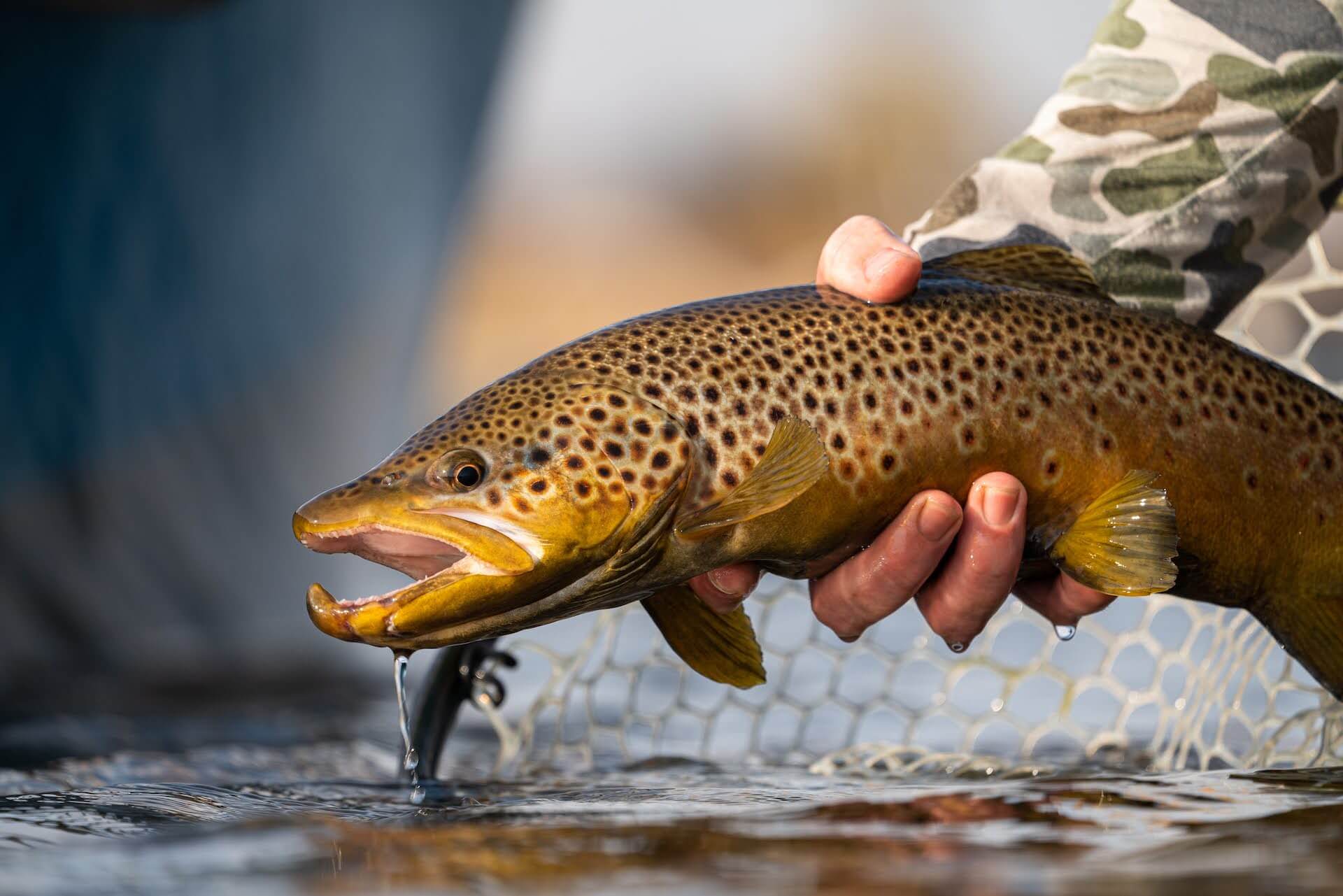
The seasonal arc is also why a fly box organised by food category beats a box organised by colour or by pattern name. The question on any given morning is which life stage is going to be most exposed to feeding fish, and the answer is a fly category before it is a specific pattern.
What about bait fishing for trout
Bait fishing for trout is legal on most waters and is how a large fraction of trout fishers actually fish. Worms (nightcrawlers, red worms, mealworms), salmon eggs, PowerBait dough, live minnows on a small jig, and a handful of spinning lures (Rooster Tails, Panther Martins, Kastmasters) will catch trout, particularly stocker rainbows that have been raised on pellets and have not yet learned to feed on natural food. On many small-stream waters that hold only stockers, bait outfishes fly tackle by a wide margin.
Where it stops working is wild trout in water with abundant natural forage. A wild brown holding behind a boulder in a freestone river is eating drifting nymphs and emerging insects all day; it has no reference for a worm bouncing along the bottom and even less for a clump of pink dough. The same fish will eat a well-presented Hare’s Ear nymph because the Hare’s Ear is exactly what its prey looks like.
There are also waters where bait is prohibited outright (fly-fishing-only sections, catch-and-release water with single-barbless-hook rules, many private spring creeks and chalk-stream beats), and waters where the regulation exists because bait-caught trout deep-hook at much higher rates and survive catch-and-release at much lower rates than fly-caught fish. For that reason, every major conservation organisation in the trout-fishing world (TU, Wild Steelhead Coalition, Atlantic Salmon Federation) advocates for fly tackle on wild fisheries.
The Wading List is a fly-fishing magazine. The answer to “what bait to use for trout” on this site will always be a fly that imitates what the trout are actually eating, presented in a way that mimics how the real food behaves. That is more work than threading a worm onto a hook. It also catches more fish, more selectively, on the waters that matter.

Leonard Schoenberger is a fly fishing professional and gear specialist with over 20 years of experience on the water. As the manager of Heidarvatn, a world-class sea trout lodge in Iceland, his product recommendations and tactical advice are tested in some of the most demanding conditions on earth. His expertise has been mentioned in The New York Times, the Financial Times, and at the Outdoor Media Summit.