Last updated on September 30th, 2026.
A steelhead is a rainbow trout. The two carry the same scientific name (Oncorhynchus mykiss), the same chromosomes, the same egg, and the same fry. What separates them is a life-history switch that some O. mykiss flip and others don’t: anadromy. The fish that stays in the river its entire life is a rainbow. The fish that drops to the salt or to a Great Lake, grows for two to four years on a marine diet, and returns to spawn is a steelhead. The same parents can produce both forms in the same redd, and a steelhead’s resident-form offspring can produce future steelhead. Same species, two life histories.
This page covers three species comparisons at once because that is how anglers actually encounter the question on the water. Steelhead vs rainbow is the anadromy question and the iteroparity question. Cutthroat vs rainbow is the native-range question, the hybridization question, and the cutbow problem. Rainbow vs brown trout is the genus-level question (Oncorhynchus vs Salmo), the introduction history, and the behavioral split that decides whether you are matching a hatch or swinging a streamer. The biology drives the fishing in every case.
Why steelhead and rainbow trout are the same species
The genus Oncorhynchus split from the Atlantic Salmo lineage roughly 20 million years ago. Within it, rainbow trout (O. mykiss) sits alongside the six anadromous Pacific salmon species: Chinook, coho, sockeye, chum, pink, and the Asian masu. Five of those six are strictly semelparous. They run upriver to spawn, they die, and their decaying bodies feed the watershed. Rainbow trout and their anadromous form, the steelhead, are the exception in this lineage. They are iteroparous. A steelhead can survive the spawn and return to the ocean as a kelt, rebuild condition over a winter and a feeding season, and run again. Survival to a second spawn runs roughly 10 to 20 percent of the spawning population, and a small subset of fish in the Great Lakes and Pacific basins have logged three or four spawning returns. This is the single biggest reason wild steelhead populations matter for catch-and-release ethics: the fish you let go can spawn twice more.
The anadromous switch starts with smoltification, an endocrine cascade that retools a parr’s body for saltwater. The fish loses its parr marks and pink stripe, turns silver-chrome, develops a rounder head and a heavier tail, and switches its osmoregulatory machinery so it can drink salt water and excrete the salt through specialized gill cells rather than dilute freshwater through its kidneys. Coastal rainbow trout (O. m. irideus) and the Columbia River redband (O. m. gairdneri) are the two subspecies that produce most North American steelhead. After one to four years feeding at sea, the fish uses solar and magnetic navigation to find the coast, then chemical imprinting to find its exact natal stream. The homing is precise enough that populations isolated by stream stay genetically distinct, and tributary-by-tributary stocks have evolved their own run timing, body shape, and average size.
The Great Lakes complicate the picture. When stocked rainbow trout were planted into the Lakes starting in the late 1800s, some of them found enough open water to express the migratory life history without ever encountering salt. A Great Lakes steelhead undergoes the same physical changes as a Pacific steelhead, feeds for two to three years on alewives and smelt, runs the tributaries to spawn, and returns to the lake. The mechanism is anadromy without the ocean, and from the angler’s perspective the fishery looks and behaves like West Coast steelheading scaled to inland rivers.
Steelhead vs rainbow on the water
A resident rainbow in a Western river is a feeding fish with a feeding window. It holds in a current seam, watches for drifting nymphs and emerging duns, and takes naturally when it sees the right size and silhouette. The fly fishing is dead-drift nymphing under an indicator, dry-and-dropper rigs through the seams, and matching the local hatches: blue-winged olives in the spring and fall, pale morning duns and caddis through summer, golden stones and salmonflies in the early-summer windows where those bugs run. A 9-foot 5-weight covers most of it. The fish thinks about its food.
A steelhead returning to spawn is not feeding. It carries the muscle memory of feeding aggressively at sea and it will strike a fly, but the trigger is not hunger. It is territorial, reactive, or a vestigial response to a stimulus that looks like prey or threat. This changes the entire presentation logic. Steelhead anglers swing a fly across and downstream on a heavy sink-tip or Skagit head, present an intruder or a marabou tube fly through the holding water, and cover lots of river methodically. The fish that grabs is the fish whose reactive trigger pulls when the fly passes through its window. You do not match a hatch for a steelhead. You cover water.
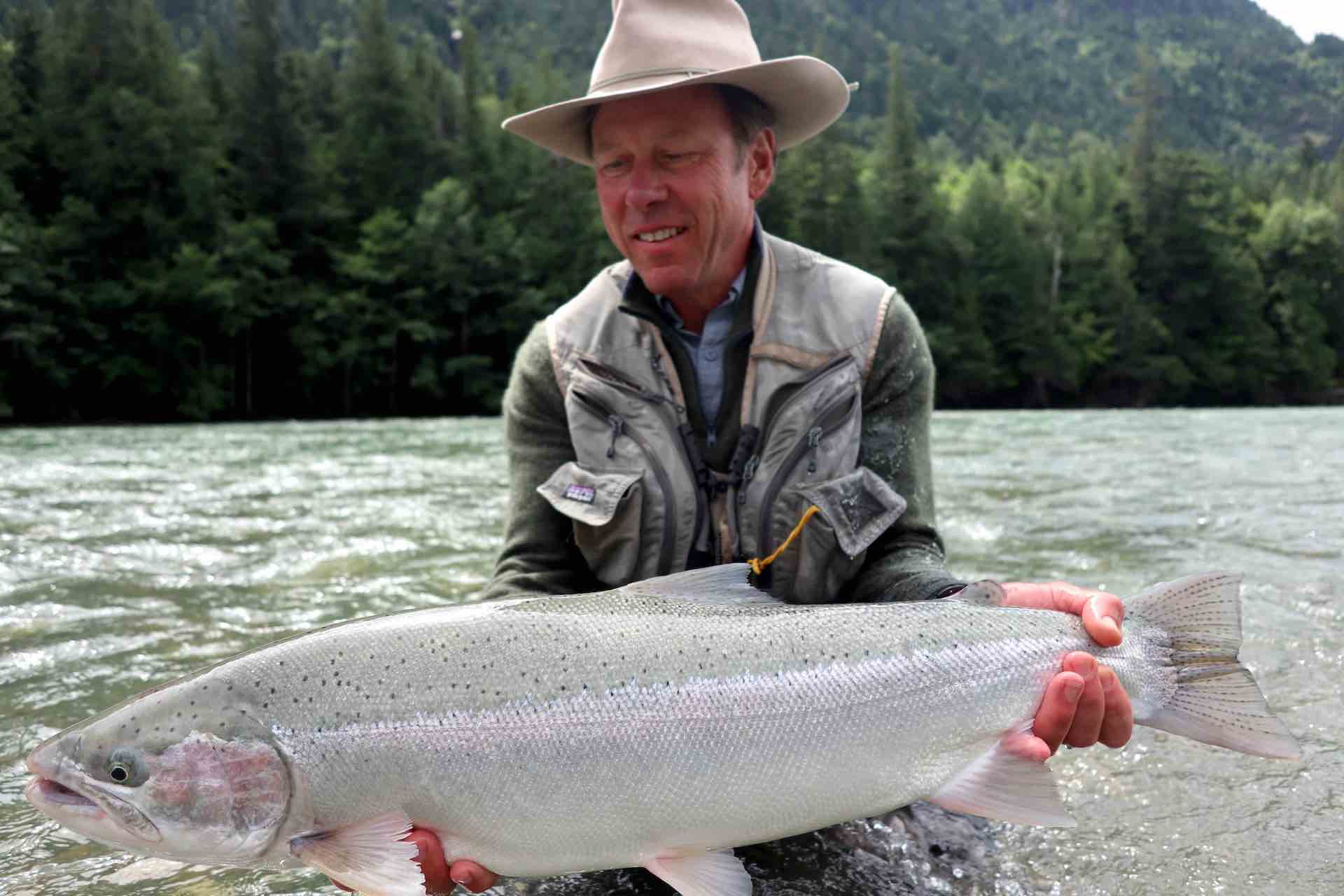
The gear scales with the difference. Steelhead rods run 7 to 9 weights in single-hand, 6 to 8 weights in two-hand spey lengths from 12’6″ through 14′. The lines are heavy by trout-rod standards because the flies are heavy and air-resistant and the river demands a long mend or a tight swing. A summer-run fish on the upper Deschutes might come up to a waked dry, and that fishery uses a Scandi head and a small skater, but the dominant winter game on the Olympic Peninsula or in the Great Lakes tributaries is heavy lines, heavy sink-tips, and heavy flies. The fish weighs five to twenty pounds depending on the system, fights like it has spent two years in current ten times stronger than the river, and pulls drag in a way a stream rainbow simply cannot.
Run timing matters more for steelhead than for any resident trout fishery. Winter-run fish enter freshwater sexually immature and hold through winter to spawn in spring, which means December through March is the prime window on coastal systems. Summer-run fish enter freshwater sexually immature in summer and hold through fall and winter to spawn the following spring, which gives June through October fisheries on systems like the North Umpqua, the Deschutes, and the Idaho Snake tributaries. Great Lakes steelhead push into tributaries in fall behind spawning salmon (the chrome October fish that eat egg patterns are eating salmon spawn, not feeding territorially), hold through winter, and spawn in spring.
Cutthroat vs rainbow, and the cutbow problem
Cutthroat trout (Oncorhynchus clarkii) is the sister species to rainbow trout within the same Pacific genus. The two split early enough to develop distinct ranges and traits but late enough to remain fully interfertile. The visual identifier is the red or orange slash mark along the underside of the lower jaw, the trait the species is named for. Cutthroat divide into four major evolutionary clades: Coastal (O. c. clarkii), Westslope (O. c. lewisi), Lahontan (O. c. henshawi), and Yellowstone or Rocky Mountain (O. c. bouvieri), each adapted to a distinct historical drainage and each with subspecies inside it.
The hybridization issue is the central conservation problem in cutthroat country. Where rainbow trout are introduced into cutthroat range, the two species spawn together and produce fertile offspring called cutbows. A cutbow carries a partial slash, intermediate spotting, and traits drawn from both parents. After several generations of backcrossing, the genetic signature of the native cutthroat dilutes and the local population shifts toward rainbow. Pure Westslope cutthroat populations in Montana, pure Lahontan populations in the Truckee basin, and pure Yellowstone cutthroat in Yellowstone Lake have been hammered by this exact mechanism, made worse by the illegal introduction of lake trout (Salvelinus namaycush) into Yellowstone Lake which decimated the spawning population that fed grizzlies and otters for centuries.
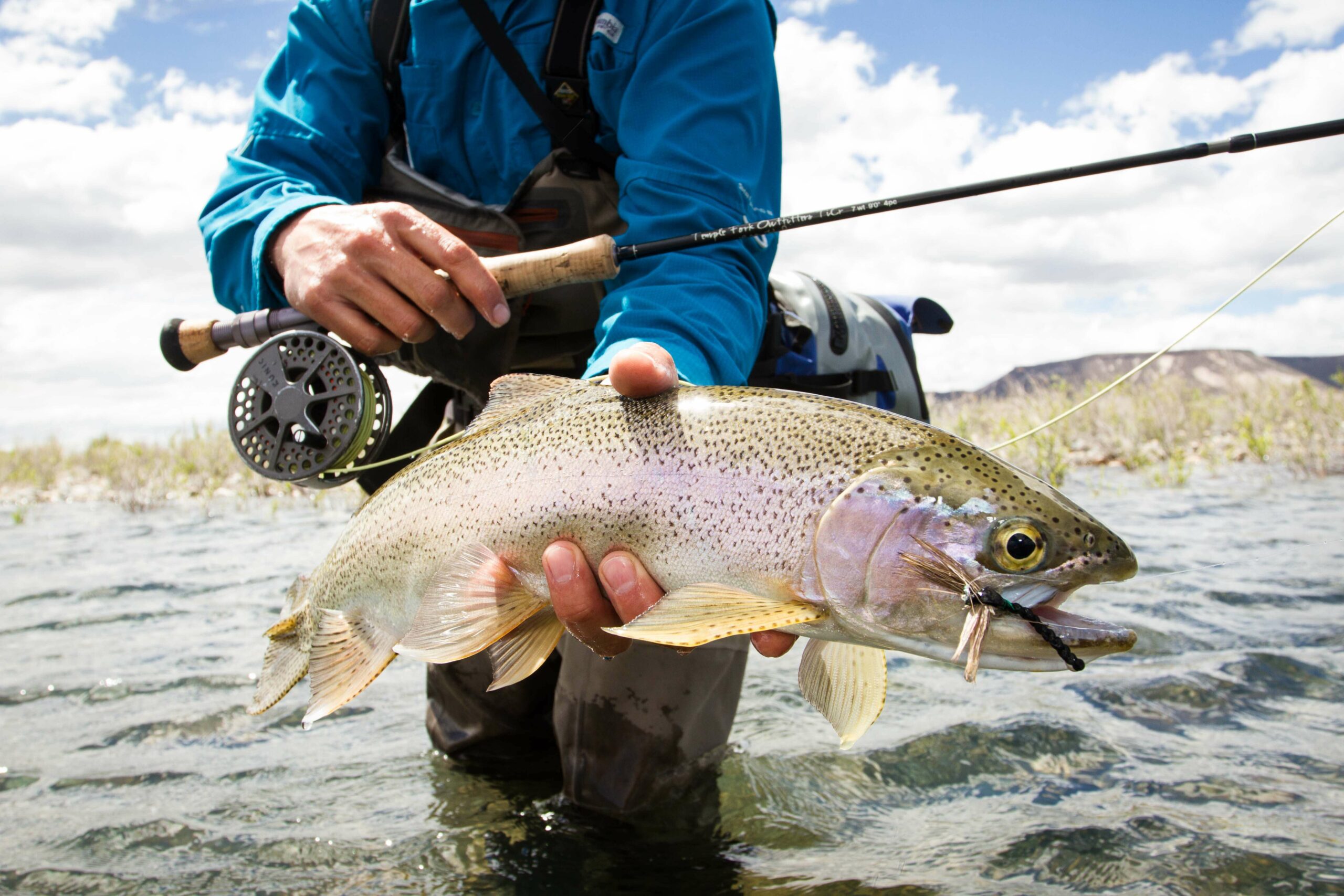
For the angler, the ID question on a Western river often reduces to: is this a pure cutthroat, a pure rainbow, or a cutbow somewhere on the gradient between them. Slash present and clean, with no rainbow stripe and the typical cutthroat spotting concentrated toward the tail: pure cutthroat. Rainbow stripe present, no slash, spotting evenly distributed: pure rainbow. Faint slash plus partial stripe plus mixed spotting: cutbow. The fishery shifts with it. Coastal cutthroat in saltwater estuaries fish on small baitfish and shrimp imitations. Westslope cutthroat in mountain freestoners are some of the most generous dry-fly fish on the continent. Yellowstone cutthroat in the Lamar drainage rise to hoppers and beetles with the kind of slow, deliberate take that defines summer cutthroat fishing.
The one cutthroat life-history wrinkle worth knowing: Coastal cutthroat trout (O. c. clarkii) is semi-anadromous. The fish runs to estuaries and nearshore salt to feed, but stays close to its natal stream rather than running to open ocean like a full steelhead. The salt-run cutthroat fishery on Puget Sound and the Olympic Peninsula is its own small genre, with anglers stripping baitfish patterns through beaches and estuary mouths for fish that may weigh two to five pounds and carry a chrome cast from their time in the salt.
Rainbow vs brown trout
Rainbow trout (Oncorhynchus mykiss, Pacific genus) and brown trout (Salmo trutta, Atlantic genus) are the two species most fly fishers think of when they think of trout, and they are not closely related. Twenty million years of evolutionary separation puts them on different branches of the Salmonid family. The brown trout’s native range covers Europe, West Asia, and North Africa, and the species was introduced to the United States in 1883 via egg shipments from Germany and Scotland. Rainbow trout, native to the Pacific drainages of North America and northeast Asia, traveled the opposite direction at the same time. Both species now circle the globe; pure native populations in their original ranges are increasingly rare.
The behavioral split between them matters more than the spotting. Rainbow trout are spring spawners, generally surface-oriented as juveniles and through their middle weight class, and remain heavily insectivorous through most of their lives. Brown trout are fall spawners, more crepuscular and nocturnal, and shift toward piscivory as they grow. A large brown trout in a Western tailwater is eating sculpins, juvenile trout, and crayfish more than mayflies, which is why the streamer-junkie subculture of fly fishing fixates almost entirely on browns. A large rainbow in the same water is more likely still drifting nymphs and rising to emergers, with a streamer take more opportunistic.
The thermal tolerance differs too. Brown trout tolerate warmer water than rainbow trout, surviving and feeding up to roughly 65°F (18°C) before stress begins, where rainbows stress closer to 70°F (21°C) but with a tighter optimal feeding window in the mid-50s through low 60s. Native chars like brook trout cap out earlier than either. In a warming river the species shifts in the order char then rainbow then brown, with brown trout occupying water that has lost the cold-water population.
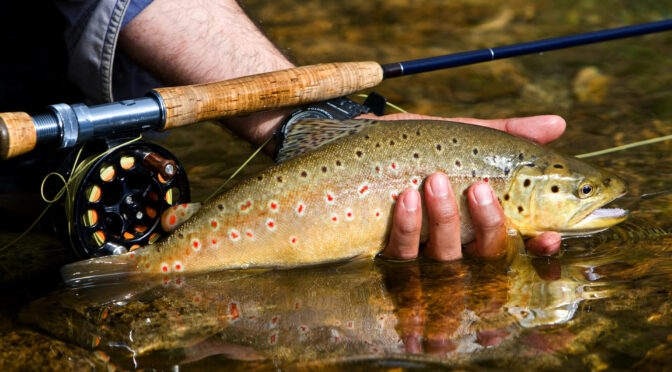
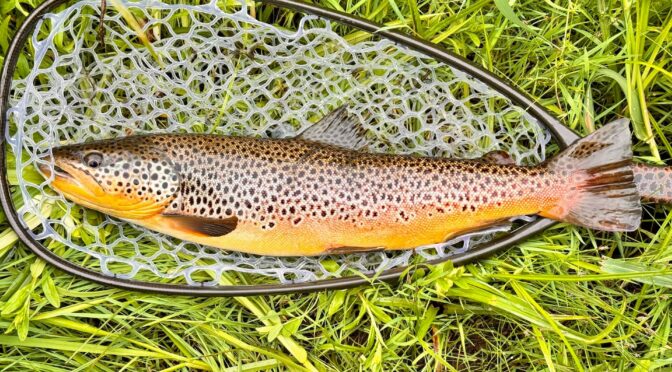
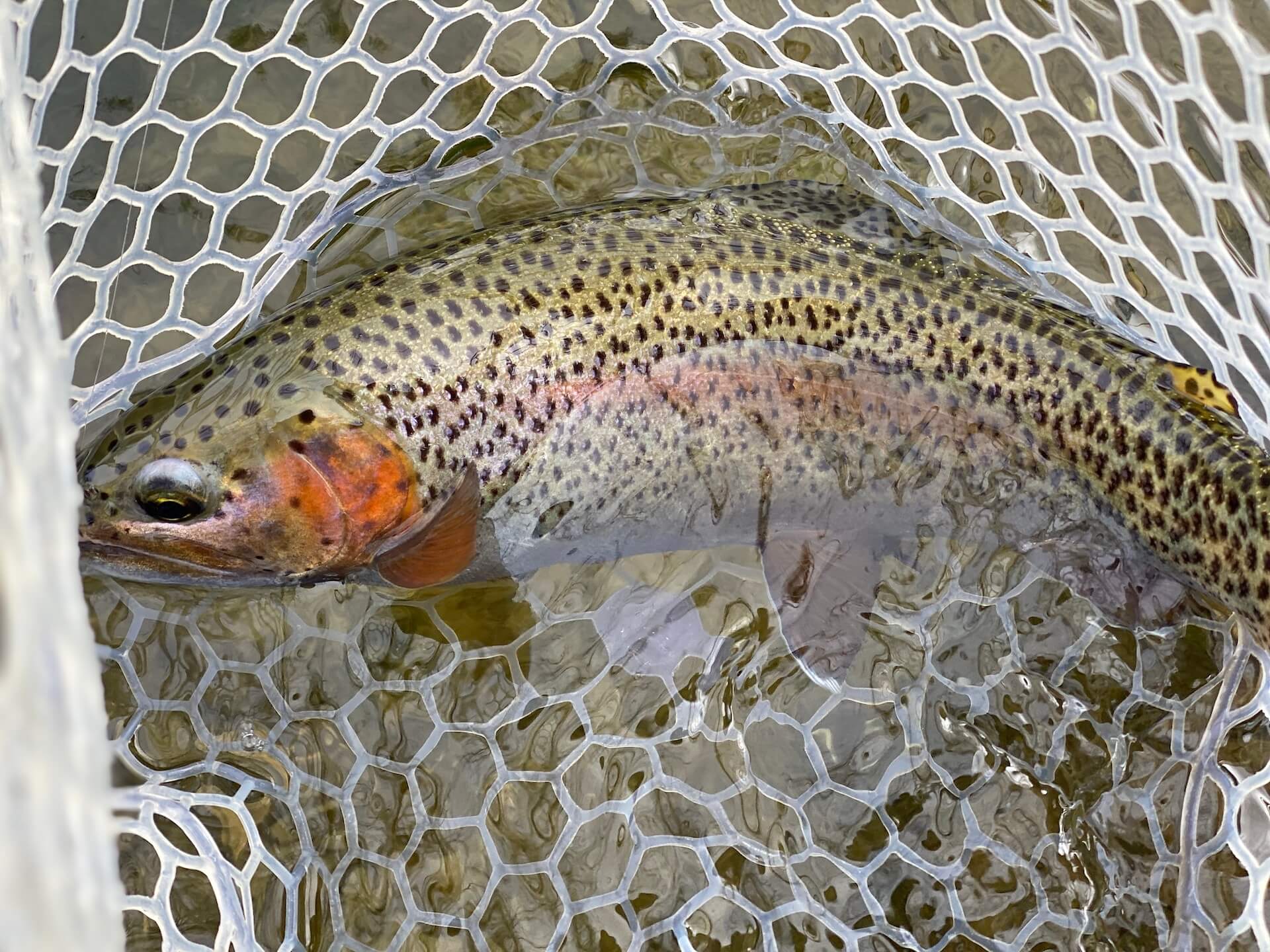
Spotting tells you which is which. Brown trout: golden-brown cast, dark spots, plus red spots with pale halos along the lateral line. The halos around the red spots are the diagnostic. Rainbow trout: olive-to-silver back with the pink-to-red lateral stripe, dark spots scattered across the body with no halos. The brown trout’s spotting is denser on the flanks and sparser on the tail; the rainbow’s spotting is more even, with heavy spotting on the dorsal fin and tail.
How to choose a setup for the fish you’re targeting
A 9-foot 5-weight covers resident rainbow trout, cutthroat, brown trout, and brook trout in most freshwater rivers and lakes. This is the universal trout rod for a reason: it loads dry flies and small nymphs at 30 to 60 feet, throws an indicator rig at moderate range, and handles a small streamer when the dry-fly window closes. A purpose-built trout fly rod at this weight is the right starting point for any of the resident species above. Where the rivers run smaller and the water demands a more delicate presentation, a 3-weight in the best 3-weight fly rods tier handles small-stream rainbows and cutthroats with line control that a 5-weight cannot match.
Steelhead change the answer. A single-hand 8-weight is the lower bound for winter-run fish on coastal systems and Great Lakes tributaries, with the best fly rod for steelhead category centering on 7 to 9 weights in 9- to 11-foot lengths. The longer rod helps with mending, line control through the swing, and the lifting power on a long hookup. For two-handed work where the water is too tight for backcast or the swing demands a long anchored cast, a Spey rod in 6- to 8-weight grain windows runs the full discipline from traditional long-line Spey for summer fish to short heavy Skagit heads for winter sink-tip work.
The reading material that ties these species together: how to catch trout covers the resident-species fishing approach across rainbow, brown, cutthroat, and brook, and a fly fishing hatch chart carries the seasonal hatch timing that drives most resident-trout dry-fly work. For the rod-weight context across all the species above, the fly rod weight chart sets the comparative frame.

Leonard Schoenberger is a fly fishing professional and gear specialist with over 20 years of experience on the water. As the manager of Heidarvatn, a world-class sea trout lodge in Iceland, his product recommendations and tactical advice are tested in some of the most demanding conditions on earth. His expertise has been mentioned in The New York Times, the Financial Times, and at the Outdoor Media Summit.