Last updated on May 29th, 2026.
Dry flies are artificial imitations of adult aquatic insects tied to ride on top of the water rather than sink through it. Their job is to present the right silhouette, color, and size of a natural bug from the trout’s underwater point of view, where the fish reads each surface item against the bright sky as a backlit shadow on the meniscus. Get any of those three variables wrong, especially during a selective hatch, and the fly drifts past unmolested.
A dry fly pattern is not a single recipe. It is a family of construction styles (Catskill, parachute, comparadun, CDC emerger, foam terrestrial) crossed with a target insect order (mayfly, caddisfly, midge, stonefly, or terrestrial). The angler chooses both axes based on what is hatching, how the trout are rising, and how rough the water is. The pages in this hub cover each of those families and the specific hatches that drive them; the section below is the orientation map.
The entomology that drives the patterns
Trout that feed on the surface are almost always keyed on one of four aquatic insect orders, plus the occasional terrestrial that fell in from the bank. Each order has a distinct life cycle, and the dry fly only works at specific windows inside that cycle, when the adult or emerging stage is exposed on the surface film long enough for a fish to read and eat it.
Mayflies (Ephemeroptera) are the order most fly anglers learn first. The aquatic nymph lives on the riverbed for months or years, breathing through abdominal gills, before swimming or crawling to the surface and emerging through the surface film as a dull-winged subimago. Caddisflies (Trichoptera) take a different route: their larvae either build portable cases out of silk and gravel or spin filter-feeding nets in the current, then pupate underwater inside a silken cocoon, cut their way out with specialized mandibles, and swim hard for the surface, where they often skitter and flutter before lifting off. Midges (Chironomidae) are tiny non-biting flies whose larvae tolerate low oxygen and high pollution (the bright-red “bloodworm” is a midge larva using a hemoglobin analog) and whose pupae ascend slowly to the surface to eclose; midges hatch year-round, including in the dead of winter, which is why they matter to trout when nothing else is moving. Stoneflies (Plecoptera) are the outlier: they crawl out of the water onto rocks or vegetation to emerge as adults, never breaking through the surface film, so trout feed on stonefly nymphs along the bottom and edges, and on adults only when females return to the water to lay eggs.
The dry fly works when the insect is on, in, or just under the surface. That is a narrow window. For mayflies it covers the emerging dun, the floating dun riding the surface to dry its wings, and the spent spinner trapped flat in the film after mating. For caddis it covers the adult fluttering at the surface during emergence and the egg-laying female. For midges it covers the pupa stuck in the film and the adult, often clustered in mating balls. For stoneflies it is mostly the returning adult female. Everything outside those windows belongs to nymph and wet-fly patterns, which is a separate set of techniques covered elsewhere in the gear theory hub.
The dun and the spinner
Mayflies are unique in the insect world for moulting one final time as a winged adult, and that quirk produces the two distinct life stages every dry fly angler eventually has to recognize. When the nymph reaches the surface and breaks through the film, it emerges as a sexually immature subimago, called a dun by anglers. The dun’s wings are fringed with tiny hairs (microtrichia) that hold moisture, the body color is dull and chalky, and the fly rides the surface upright on the meniscus while the wings dry. It cannot fly fast or evade much. Trout know this and key on duns hard during a hatch.
Within roughly twenty-four hours, sometimes much less, the dun moults a second time into the sexually mature imago, called a spinner. The spinner has clear, glassy wings, a brighter or more translucent body, and (in males) specialized upward-looking turban eyes used to find females in the mating swarm. Adult mayflies have vestigial mouthparts and cannot feed, so the entire imago stage is reproduction. After mating, females drop eggs onto the water and die, falling to the surface with wings splayed flat to either side. This is the spent spinner, and a fish sipping spent spinners in the slick water just before dark is one of the more technical scenarios in dry fly fishing.
The implication for pattern selection: a dun pattern (upright wings, hackled body, fuller silhouette) and a spinner pattern (flat wings tied perpendicular to the hook, sparse body, no hackle to lift it) are not interchangeable. A trout porpoising during a daytime hatch is most likely on duns. A trout sipping gently in flat water at dusk, leaving almost no rise ring, is on spinners. Tie on the wrong stage and even a perfectly matched size and color will refuse.
Pattern families
The pattern family is the construction style of the fly: how the hackle, wing, and body sit on the water. Different families present the same insect in different ways, and matching the family to the water type and the trout’s rise behavior matters as much as matching the size and color of the bug.
The Catskill dry is the classic upright-wing hackled pattern that defined American dry fly fishing in the early twentieth century. The hook is dressed with a sparse tail, a slim dubbed body, an upright divided wing of flank feather or hair, and a heavy collar of rooster hackle wound at the head. The hackle fibers hold the fly off the water on the tips of dozens of stiff barbs, so only a small part of the fly actually touches the surface film. Catskill dries float well in rough or broken water and give a high, prominent silhouette. Adams, Light Cahill, and Royal Wulff are Catskill-lineage patterns.
The parachute pattern flips the hackle ninety degrees. Instead of winding hackle around the hook shank, the tier ties a visible white or bright post (often calf tail or polypropylene yarn) upright and wraps the hackle horizontally around the base of the post. The result: the fly sits flush in the surface film with hackle fibers radiating flat across the water like an insect’s legs, and the post stands straight up where the angler can see it. The Parachute Adams is the most widely used dry fly in the world for a reason. Parachutes work in flat or slow water where a high-floating Catskill looks artificial, and the post gives the angler a visual reference in low light or against broken water.
The comparadun (and its close cousin the sparkle dun) uses no hackle at all. The wing is a fan of stacked deer or elk hair, splayed roughly 180 degrees across the top of the hook, and the tail is microfibetts split wide. The body sits directly on the surface film, supported by the buoyancy of the hollow hair wing. The silhouette is the most accurate of any dun pattern: a slim body riding low, two wings sweeping back, no fuzz of hackle fibers underneath. Comparaduns are devastating on educated trout in slick water during a focused mayfly hatch, and useless in fast pocket water where they sink on the second drift.
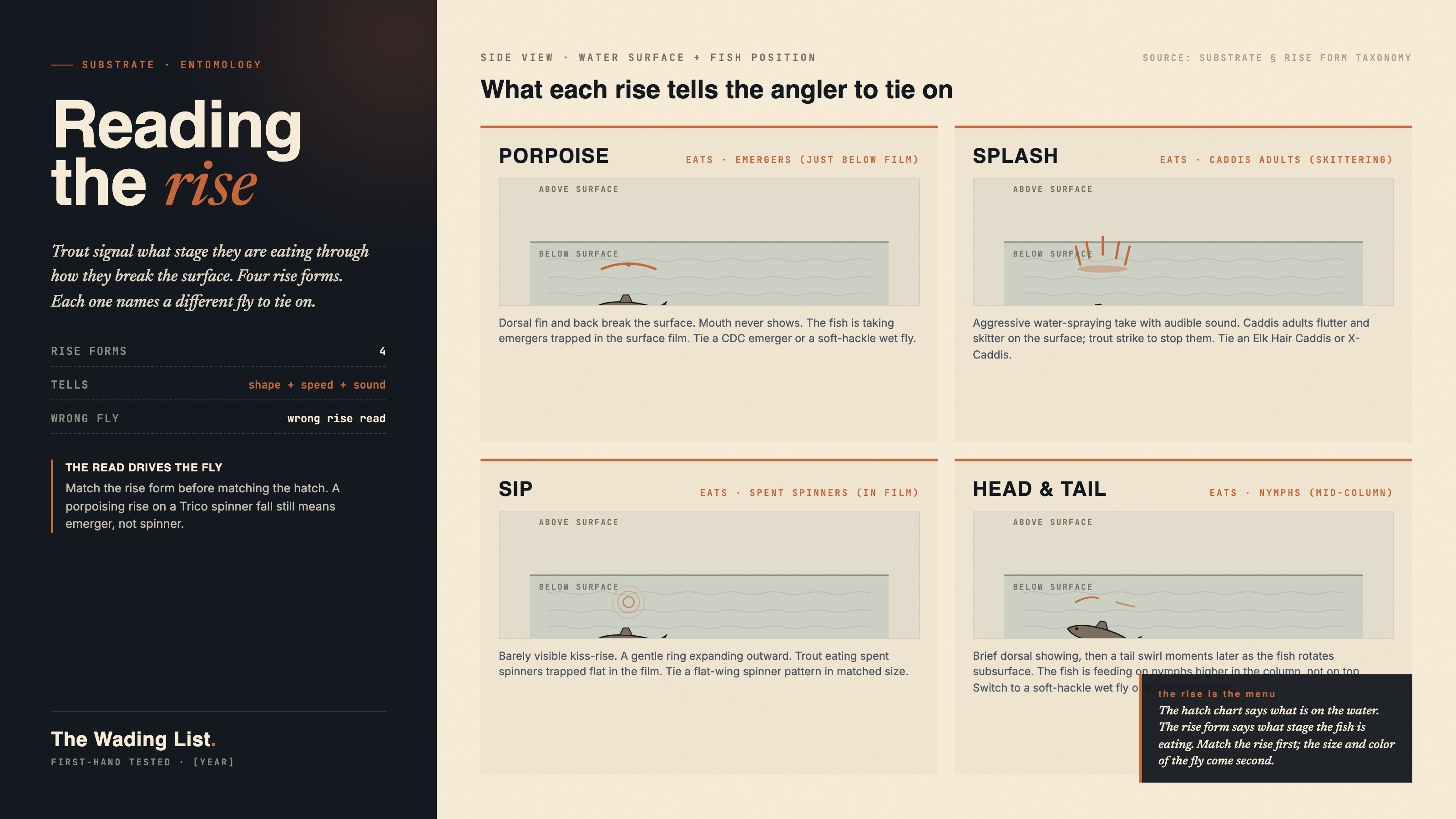
CDC (cul de canard) emergers and CDC duns use a small bundle of soft, water-shedding duck feathers from the preen-gland area as the wing. CDC traps tiny air bubbles, which is why it floats without floatant, and the soft fibers move with the current in a way that stiff hackle does not. Emerger patterns ride half-submerged: the trailing shuck (often a piece of Z-lon or Antron representing the splitting nymphal skin) hangs through the film while the wing rides above. When a trout is porpoising (dorsal fin breaking the surface but the mouth never opening above it), the fish is taking emergers just below the meniscus, and a CDC emerger is the answer.
Foam terrestrials cover the warm-weather staples that fall in from the bank: hoppers, beetles, ants, and crickets. Closed-cell foam holds the fly on the surface indefinitely, so foam patterns survive multiple casts without dressing and ride high enough to suspend a heavy beadhead nymph as the top fly in a dry-dropper rig. Hoppers (Chubby Chernobyl, Morrish Hopper, Fat Albert) get fished from late June through October on rivers with grassy banks. Foam ants and beetles get fished any sunny afternoon from May through September. Terrestrials are not matching a hatch in the entomological sense; they are matching opportunism.
Matching the hatch
“Match the hatch” is the operating principle of selective dry fly fishing. It means identifying which insect, in which life stage, the trout are eating right now, and offering a pattern that mimics that specific combination of size, silhouette, and color. Three inputs feed the decision: what is on the water, what the rise form looks like, and what the calendar plus weather suggests should be hatching.
Specific hatches drive specific patterns at specific times. Pale Morning Duns (PMDs) typically hatch mid-morning through early afternoon in summer, on freestone and tailwater rivers in the western United States; a size 16 to 18 PMD comparadun or sparkle dun in pale yellow-olive is the standard answer. Blue-Winged Olives (BWOs) prefer cool, overcast, drizzly afternoons, which is the opposite of most insect hatches that need warm sun; BWO duns are tiny (size 18 to 22) with slate-grey wings and olive bodies, and a CDC emerger or parachute pattern works through the column. Tricorythodes (Tricos) come off in dense clouds in the cool of mid-morning from July through October; the dun lasts only minutes before molting to spinner, and the spinner fall later in the morning is where the fishing really starts, on size 22 to 26 spent-wing patterns. Hexagenia limbata (Hex) is the giant of the mayfly world, hatching at dusk and into full darkness on slow rivers and lakes in the upper Midwest from late June through July, on size 6 to 10 hooks; a Hex dun or spinner is the rare moment in dry fly fishing when a literal three-quarter-inch fly is in scale.
The rise form is the second input, and trout reveal what stage they are eating through how they break the surface. A porpoising rise (dorsal fin and back show, mouth never breaks above the film) means the fish is taking emergers just below the surface; switch to a CDC emerger or a film-rider. A splashy, aggressive take that throws water means caddis adults, which skitter and flutter on the surface and trigger reactive strikes; an Elk Hair Caddis or X-Caddis works. A gentle, almost invisible sip in flat water (sometimes called a kiss rise) means the fish is eating spent spinners trapped in the film; tie on a flat-wing spinner pattern in the right size. A head-and-tail rise where the dorsal fin shows briefly behind the head means the fish is feeding on nymphs higher in the water column, often well below the surface; this is not a dry fly situation at all, and the right move is to switch to a soft-hackle wet fly or a shallow nymph.
The calendar plus weather is the third input, the one that prevents the angler from arriving on the river with no working theory. A hatch chart for the specific river covers what is on, in what week, at what time of day. Our fly fishing hatch chart covers this in detail, including how stream temperature, recent precipitation, and barometric pressure shift the timing of common hatches. Carry the chart, check the bug at hand, then watch the rise form and refine.
When NOT to fish dry
Dry flies are not always the right answer, and one of the more useful skills in trout fishing is reading when to put them away.
Subsurface feeding signals are the first cue. A head-and-tail rise (described above) puts the fish in the middle of the column on nymphs. A boil or bulge with no actual surface break means the trout is taking emergers or fleeing minnows just beneath the film and a streamer or soft-hackle is the move. If you are watching a riffle for ten minutes and seeing zero surface activity but trout are clearly present (you can spot them on the bottom or you can see flashes as they turn to take subsurface prey), the fish are eating nymphs and a dead-drifted weighted nymph rig is going to outproduce any dry by an order of magnitude.
Water temperature is the second cue. Trout metabolism is governed by water temperature, and dry fly fishing depends on active surface feeding. When water drops below about 50°F (10°C), insect activity collapses and trout slow down; the surface goes quiet for most of the day, and morning warmth becomes the brief window when anything is happening. When water rises above 65°F (18°C), the surface can look active but trout begin to stress, dissolved oxygen drops, and at 68°F+ fishing becomes ethically questionable because catch-and-release mortality climbs steeply. The functional window for surface-active trout is roughly 50°F to 65°F; outside it, expect nymphing to outperform dry fly fishing on most water types.
Light and water conditions are the third cue. Glare on the surface from bright midday sun can make even an actively hatching pod of fish nearly impossible to spot, and an overhead sun also drives trout off the surface into deeper holding lies. Bluebird sky after a cold front often kills surface activity for hours. Conversely, a flat overcast afternoon with a light drizzle, especially in spring or fall, often produces the best dry fly fishing of the year because the low-pressure system extends the hatch window and the fish lose their wariness in the diffused light.
The dry fly is one tool in the box. Knowing when not to use it is half of using it well.
Related gear
Building out a dry fly box is one piece. The rest of the rig matters too.
The rod is the first lever. Dry fly fishing on small to medium trout water is the home territory of the 4-weight, 5-weight, and 6-weight rod with a medium to medium-fast action that protects light tippets and presents small flies softly. The best trout fly rod page covers the broader trout rod selection, while the dedicated 5-weight rod guide focuses on the rod size that defines dry fly fishing for most anglers.
Tying your own dry flies eventually becomes the cheaper and more interesting path. A decent rotary vise opens up the entire pattern world covered above. The best fly tying vise guide walks through the rotary versus stationary distinction, jaw types, and the difference between an entry-level vise and the lifetime tools that come out of Renzetti, HMH, and Regal.
Our hatch chart guide is the calendar-and-water companion to this page: which hatch when, on which river types, at what time of day, with what flies. Read it alongside this hub.
Our emerger flies guide drills into the in-between stage, where most of the trickiest selective dry fly fishing actually happens. Trout feeding on emergers eat more bugs per minute than trout feeding on duns, and a CDC emerger in the right size is often the difference between fish on and fish frustrated.
The fly line carries everything. A weight-forward floating line in the matched weight, with a delicate front taper, is the dry-fly standard. The best fly lines page covers the trade-offs between distance-tapered lines, presentation tapers, and the recent generation of textured coatings.

Leonard Schoenberger is a fly fishing professional and gear specialist with over 20 years of experience on the water. As the manager of Heidarvatn, a world-class sea trout lodge in Iceland, his product recommendations and tactical advice are tested in some of the most demanding conditions on earth. His expertise has been mentioned in The New York Times, the Financial Times, and at the Outdoor Media Summit.