Last updated on May 26th, 2026.
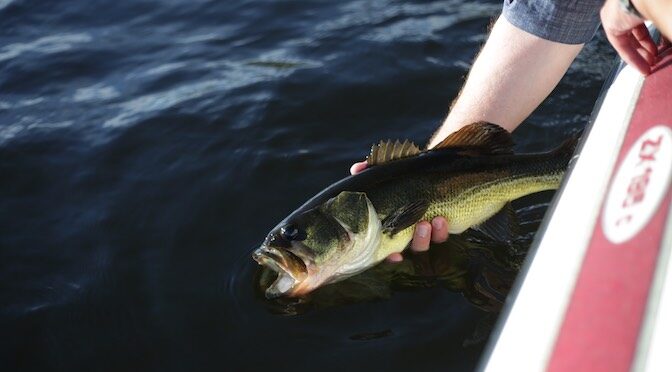
The fast answer to what you have in your hand is the jaw line. A largemouth’s upper jaw extends well past the back of the eye when the mouth is closed. A spotted bass’s jaw stops at the eye or just short of it. A smallmouth’s jaw also stops at the eye, but the body is bronze-brown with vertical bars rather than the spotted bass’s lateral blotch line and tidy rows of belly spots. Those three jaw-and-pattern reads cover almost every black bass an angler will land in the lower 48.
The species question matters past the ID itself because the three black bass live in measurably different water, hunt with different mechanics, and fish very differently on a fly rod. Largemouth (Micropterus salmoides) hold tight to vegetation and wood in warm still water. Smallmouth (M. dolomieu) hold on rock and gravel in cool flowing or clear-deep water. Spotted bass (M. punctulatus) occupy the transition zone between them, in clear reservoir water, river tailouts, and the rocky points where a fishery has both flowing structure and lake-like depth. Reading the species off the fish in your hand tells you where to cast the next one, and it tells you what fly to tie on.
This page covers the visual identification first, the habitat and behavior that flow from species biology second, and the fly-fishing implications for each third. The aim is that after one read you can both ID the fish and know whether you should be throwing a deer-hair popper at a lily pad or drifting a crayfish through a current seam.
How to tell the three apart in the hand
Five physical traits separate the three species reliably. Color is unreliable, listed last only because anglers reach for it first and shouldn’t.
Jaw line against the eye. Hold the fish so its mouth closes naturally and look at the maxilla, the back of the upper jaw. Largemouth: the jaw extends well past the rear edge of the eye. Spotted and smallmouth: the jaw stops at or slightly in front of the eye. This is the single most reliable identifier and the one a tournament observer relies on.
Dorsal fin profile. The largemouth has a deep notch between the spiny front section and the soft rear section of the dorsal fin, deep enough that the two halves look almost separate. The spotted and the smallmouth carry one continuous dorsal fin with a gentle sloping membrane connecting the spiny and soft sections.
Lateral pattern and belly spots. A largemouth carries a single dark horizontal blotch line down the side, with a mostly unmarked belly below it. A spotted bass shows the same lateral line plus tidy rows of small dark spots arranged below it, the trait the name comes from. A smallmouth carries vertical dark bars on a bronze flank, no spot rows, and often a tri-lobed dark mark behind the eye.
Tongue tooth patch. Run a fingertip across the center of the tongue. A spotted bass has a small, distinctly rough sandpaper patch of tiny teeth in the center of the tongue. A largemouth’s tongue is smooth. This is the tiebreaker when the fish is small and the jaw line is ambiguous.
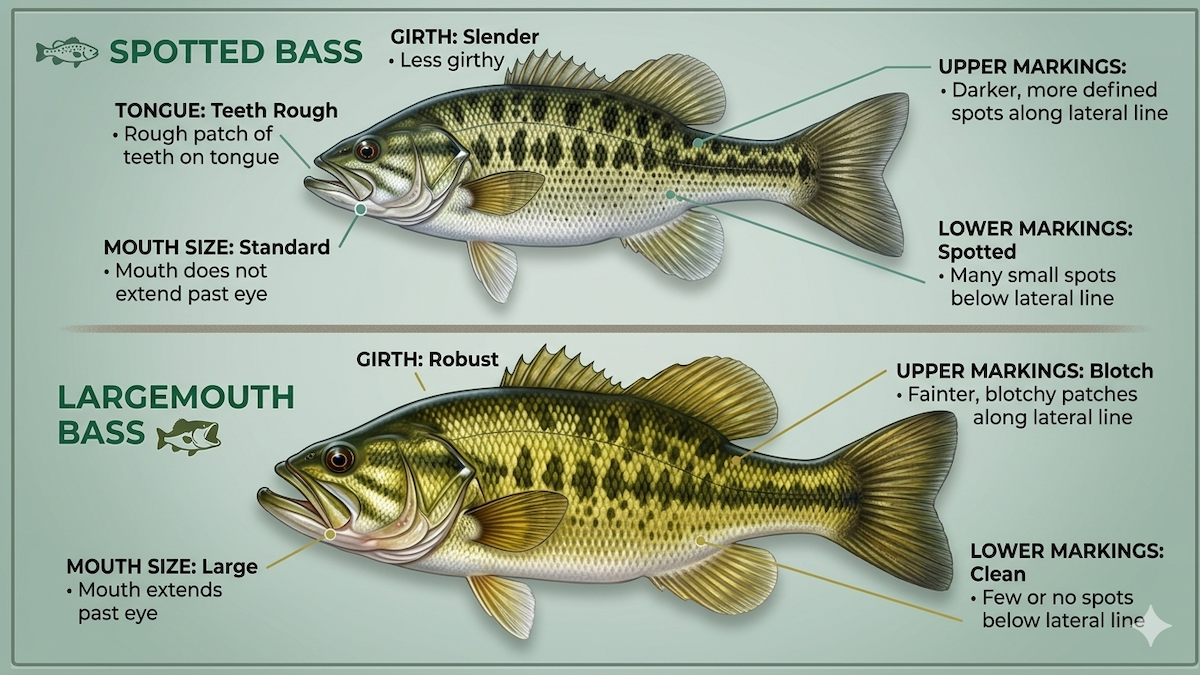
Cheek scale size. The scales on a spotted bass’s cheek are visibly smaller than the scales on the body. On a largemouth they are the same size as the body scales. This matters mostly on close-up photographs after the fact.
Color shifts dramatically with water clarity, diet, and stress. A dark-water largemouth can look almost black; a clear-reservoir spotted bass can look pale olive. Use color as a clue, never as a determination.
Where each species actually lives
Largemouth, spotted, and smallmouth bass occupy three different thermal and structural niches, and the species you find on a piece of water is almost entirely a function of which niche that water provides.
Largemouth are warmwater, structure-oriented ambush predators. Their feeding window centers on 60 to 75 degrees Fahrenheit. Below 50 they drop deep and slow down. Above 80 the dissolved oxygen in shallow water drops below the level that supports active feeding and they push into shade, depth, or moving water. They want vegetation and wood, fallen timber, lily pads, dock pilings, the back ends of coves, weedline edges, anywhere they can hold motionless and wait for prey to swim into ambush range. Largemouth do not chase. They wait.
Smallmouth are coolwater fish that hold in the 55 to 70 degree band and favor flowing rocky water. Clear gravel-and-boulder rivers, the rocky points and shoals of deep lakes, the tailwater sections below dams. They feed on crayfish, sculpins, and baitfish, and they read current the way a trout reads current. A smallmouth in a river will sit behind a boulder where the flow delivers prey, exactly the lie a brown trout would take in the same seam. They tolerate cooler water than largemouth and warmer water than most trout, which gives river smallmouth a productive season that runs through the heat of summer when largemouth have dropped deep.
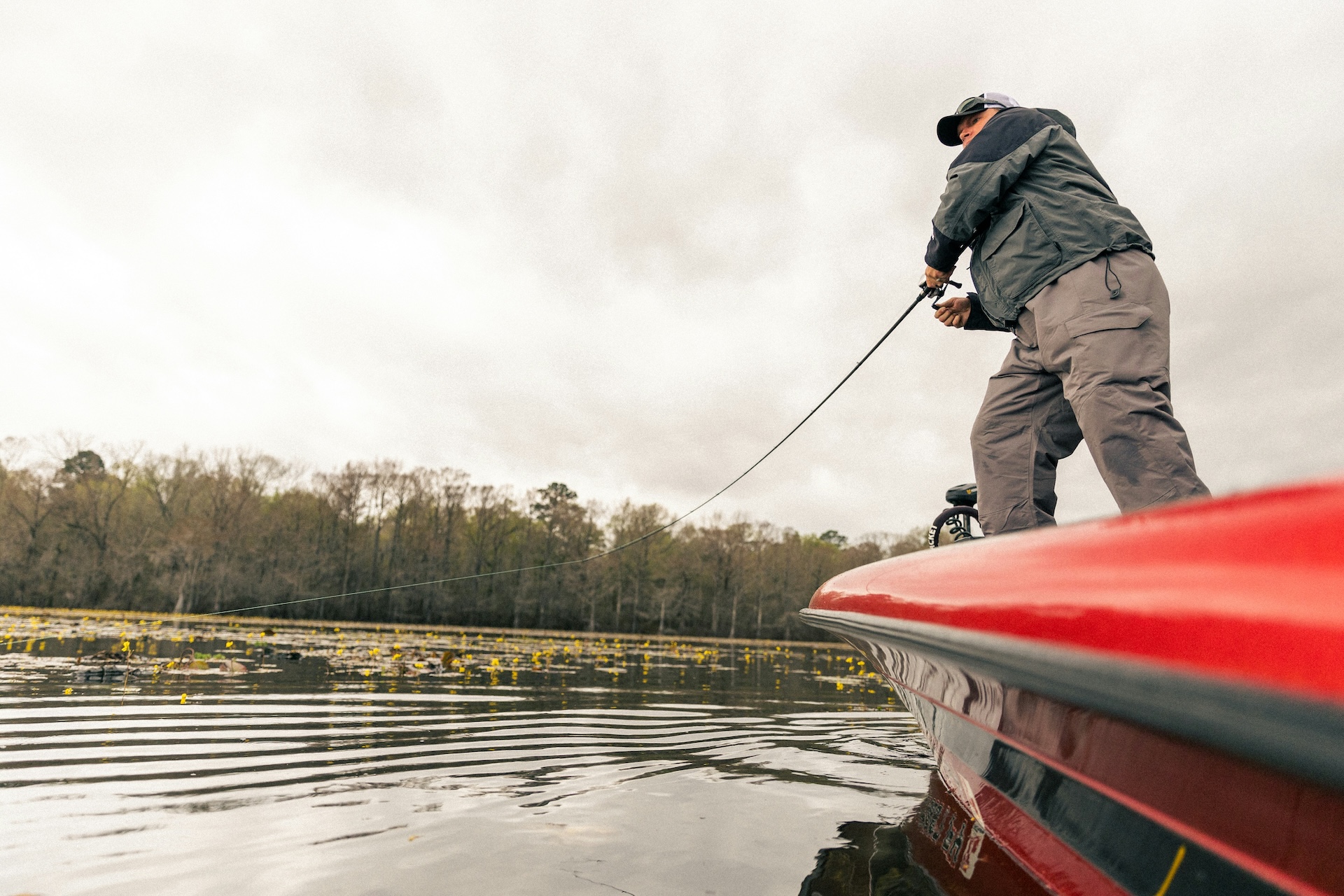
Spotted bass slot between the two. They prefer clearer, deeper, often slightly cooler water than largemouth, but they tolerate flow and rock structure better than largemouth do. The classic spotted bass water is a clear southern reservoir with rocky points, brush piles in 15 to 30 feet, and a thermocline they can follow up and down through the season. They school more readily than the other two species, often suspending in groups over deep structure. They feed actively year-round, including through cold months when largemouth slow down.
The three species overlap. A reservoir can hold all three. The shallow vegetated coves and creek arms will fish largemouth. The rocky main-lake points and humps will fish spotted bass. The tailwater section below the dam will fish smallmouth. Read the water type and the species follows.
Behavior and the take
The species-specific behavior translates directly to how the fish takes a fly and how it fights.
Largemouth are ambush feeders that strike from rest. The take on a surface popper is the iconic violent boil where the fish closes from below and inhales the fly during the pause in the retrieve. They hit hard, often jump on the hookset trying to throw the fly with a head-shaking thrash at the surface, and dig for cover the moment they feel pressure. The fight is short, violent, and aerial. A largemouth in a lily pad bed will be in the pads before the second jump if the angler doesn’t lean on the rod immediately.
Smallmouth chase. They are aggressive open-water predators that will run a streamer down across a current seam, and they fight deep, with long bulldogging runs and multiple jumps. Pound for pound a smallmouth pulls harder than a largemouth of the same size, partly because the fish lives in current and is conditioned to it. Smallmouth in clear water also see well, and a sloppy presentation or a heavy leader spooks them in conditions where a largemouth in stained water would not have noticed.
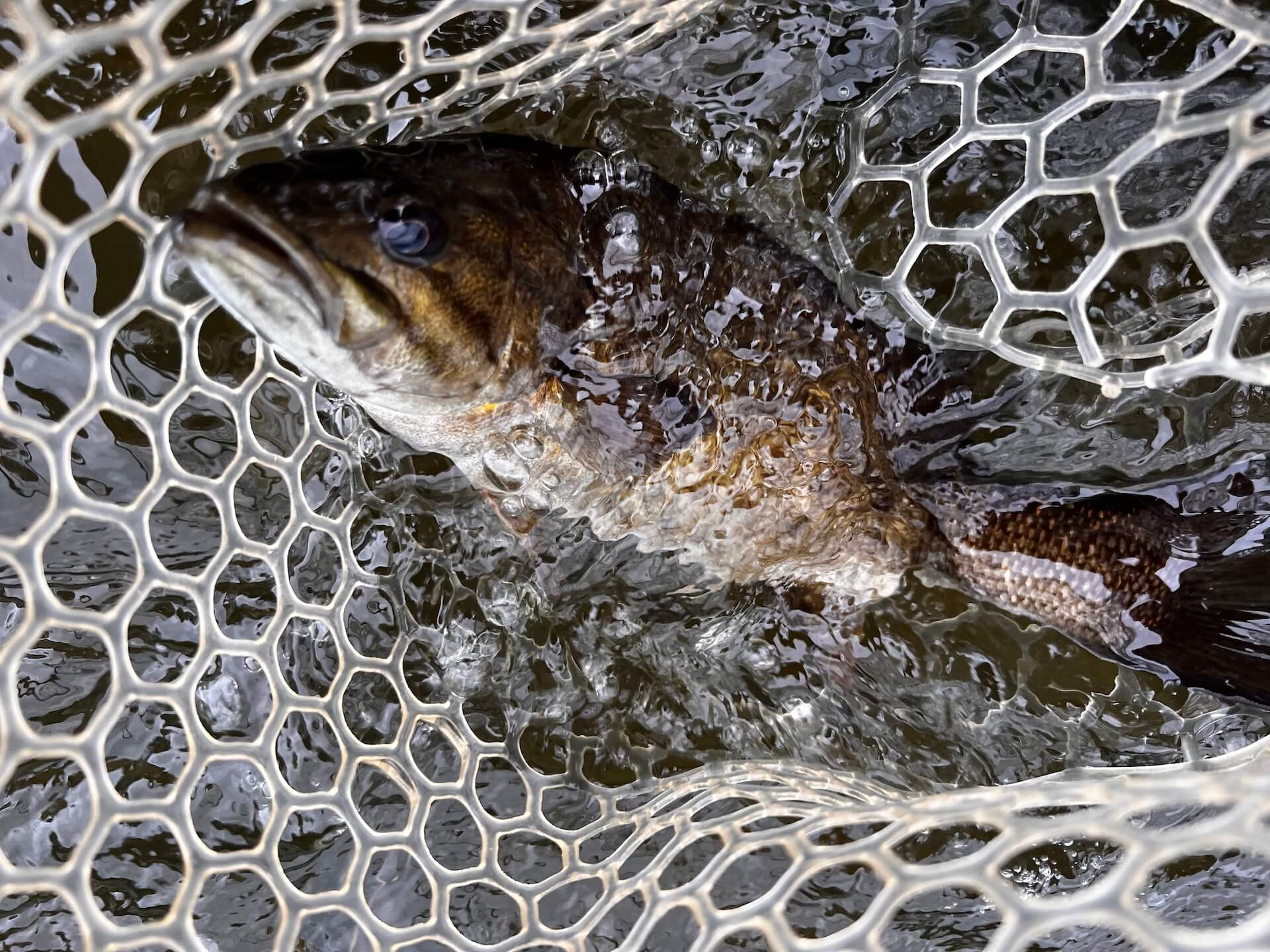
Spotted bass split the difference. They chase like smallmouth but often in schools, which means a hooked spot frequently brings the rest of the school up with it. They fight deep and hard, more pull than acrobatics, and the bulldog-style head-shaking runs of a 3-pound spotted bass on an 8-weight will test the drag on a reel set for trout. They feed actively in cold water more readily than the other two species, which makes them the practical winter target on Southern reservoirs.
Water temperature is the universal governor. Below the species-specific feeding threshold the metabolism drops and the fish slows. Above the species-specific upper bound the oxygen drops and the fish moves to find more. The same logic that determines where a trout holds in summer determines where a bass holds, scaled up for warmer water and broader thermal tolerance.
Range and where each is dominant
Largemouth bass are the most widely distributed and aggressively stocked of the three, native to the eastern and southern US and introduced almost everywhere in the world that has warm fresh water. They dominate the warmwater pond, lake, and slow-river fisheries of the entire continental US.
Smallmouth are native to the Mississippi and Great Lakes basins and have been widely introduced into clear, rocky waters across the country. They dominate the cool clear river fisheries of the Upper Midwest, the Ozarks, the Susquehanna and Potomac drainages, the upper Tennessee, and the rocky lake fisheries of New England, the Great Lakes, and the inland Northwest.
Spotted bass have a more restricted native range centered on the lower Ohio and Mississippi basins, the Gulf states, and the Tennessee drainage. They dominate the deep clear reservoirs of the South: Lewis Smith Lake in Alabama, Lake Lanier in Georgia, Lake Cumberland in Kentucky, and the Coosa River system across Alabama and Georgia. The Alabama spotted bass, a larger subspecies, is the form most fly fishers from outside the region will eventually catch if they target spots on a Southern trip.
Where ranges overlap, the species sort by habitat preference more than by competition. A single reservoir often has all three with the species predictably distributed across the water types within it.
Fly-fishing implications per species
Bass fly fishing as a category sits in the 7-to-9 weight bass fly rod range, which is where the AFFTA grain-weight chart puts heavy streamers and light saltwater work. The flies are bulky and air-resistant in a way that a 5-weight trout rod cannot load against. Within that 7-to-9 range, the species you target shifts the choices.
For largemouth in heavy cover, the default rig is an 8-weight with a floating bass-taper line, a 7.5-foot leader to 1X or 0X (12 to 15 pound test), and a bass fly like a deer-hair popper or a weedless Game Changer or weighted Woolly Bugger. The 8-weight matters because a 2/0 deer-hair popper has bulk and a 5-weight or 6-weight rod cannot turn it over. The short heavy leader matters because the fish bolts into a stump on the hookset and the leader has to hold against a fish dragging it through wood. Cast tight to cover. A fly that lands a foot from a stump produces. A fly that lands six feet from the same stump does not.
For smallmouth in moving rocky water, the rig shifts toward subsurface presentations. A 7-weight or 8-weight, often with an intermediate or sink-tip line, a similar 7.5-foot leader but stepped down to 2X or 3X in clear water (8 to 10 pound test), and a fly box centered on crayfish patterns, sculpins, and baitfish streamers like a Clouser Deep Minnow. Read the river the way you would for trout: current seams, the slow water beside the fast water, behind boulders, the deep slot below a riffle. Smallmouth hold in the ambush positions a brown trout would hold in. The drift-and-swing presentation a steelhead angler uses on a swung fly translates almost directly to smallmouth on a sculpin pattern.
For spotted bass in deep clear reservoirs, the rig moves further toward sinking lines and weighted patterns. An 8-weight with a full-sink or fast sink-tip line, a 9-foot leader straight to 0X or 1X fluorocarbon (because fluoro’s higher refractive index matches deep clear water better than nylon), and Clouser-style baitfish patterns weighted with tungsten eyes. Spots suspend over structure rather than holding tight to it, which means the cast goes to the structure but the fly works the water column on the strip back. Count the fly down, find the depth the fish are holding at, then repeat that count on every cast. Spotted bass schooling on a deep point is one of the most consistent and underused fly fisheries in the southern US.
Across all three species the retrieve cadence is the same principle: bass strike at irregular motion. A continuous strip is less effective than a strip-strip-pause, or a long strip followed by two short ones, or a strip and a hard rod-tip twitch. The fly behaves like wounded prey when the retrieve is uneven, and that is what triggers the strike. The pause is where the strike usually comes. The single most common error new bass fly fishers make is retrieving too steadily; the second is fishing too far from cover. Slowing down, adding pauses, and casting close enough that you occasionally hang up are the three adjustments that change a slow day into a productive one.

Leonard Schoenberger is a fly fishing professional and gear specialist with over 20 years of experience on the water. As the manager of Heidarvatn, a world-class sea trout lodge in Iceland, his product recommendations and tactical advice are tested in some of the most demanding conditions on earth. His expertise has been mentioned in The New York Times, the Financial Times, and at the Outdoor Media Summit.