Last updated on September 30th, 2026.
Bass spawn when shallow water holds a stable temperature in the 60 to 75 degree Fahrenheit band for several consecutive days. That is the master variable. Day length, moon phase, and barometric pressure modulate the timing within a season, but they do not override water temperature. A pond that warms past 60 in the second week of April will produce spawning fish that week; the same pond in a cold spring that drags into May will hold its fish in pre-spawn staging until the water finally settles in the right range.
The other piece worth getting straight up front is that “the spawn” is not a single event. It is a three-stage process. Pre-spawn is the staging and feeding window, when bass move from deep wintering water toward the shallow flats they will spawn on. The spawn itself is bed-building, egg-laying, and bed-guarding behavior on hard-bottom shallows. Post-spawn is the recovery window, when females in particular sulk for one to two weeks before normal feeding resumes. Each phase fishes differently, and the fly box that works in pre-spawn is not the box that works on a bed-guarding male or a post-spawn fish that has dropped to the first piece of deep structure outside the spawning flat.
For a fly fisher, the pre-spawn window is the single most productive fly-rod opportunity of the bass year. The fish are heavy with eggs, feeding aggressively to build the energy reserves the spawn will burn through, and concentrated on predictable staging structure. If you have one weekend a year to fish for bass on the fly, you want it to be the weekend the water in your home pond settles into the high 50s and starts climbing.
What triggers the bass spawn
Sustained water temperature is the trigger, and the word “sustained” carries the weight. A single 75-degree afternoon in early April does not start the spawn. Bass need three to five days of stable water temperature in the right band before they commit to moving onto beds. The mechanism is endocrinological: rising temperature drives the hormonal cascade that pushes females to develop eggs and males to begin nest-building behavior, and that cascade integrates temperature signal over days, not hours.
The species sit in slightly different bands. Largemouth bass (Micropterus salmoides) spawn across the widest range, 55 to 75 degrees, with the most intense bed activity between 60 and 65. Smallmouth (M. dolomieu) lean cooler and earlier in the band, typically 55 to 65, which means in a lake holding both species the smallmouth will often spawn ahead of the largemouth in the same body of water. Spotted bass (M. punctulatus) sit between the two, overlapping with largemouth but tolerating the cooler end better. On a mixed-species lake, the sequence is usually smallmouth first, then spotted, then largemouth, with the runs overlapping by a week or two on either end.
Day length matters as a secondary cue. Bass populations at high latitudes that experience long winters use photoperiod as the trigger that begins egg development, and water temperature then determines the actual bed-building moment. This is why a 65-degree week in January in Florida does not trigger a January spawn the way the same temperature in March would; the photoperiod baseline is not there yet for the fish to commit.
Moon phase produces noticeable waves within a spawning window. Full and new moons coincide with the largest pulses of fish moving onto beds in any given week, which is why guides on the Florida largemouth lakes plan client trips around the moon calendar in March and April. The mechanism is not fully understood but the pattern is consistent enough to fish on.
A useful visual cue for anglers: when pollen from nearby trees starts coating the surface of the water, the temperature has almost certainly settled into spawn range. The tree species that drop pollen heavily in spring (oak, pine, birch depending on region) bloom in response to the same accumulated thermal signal that the bass use. If the water looks yellow-green at the edges, it is time to look for beds.
The three phases of the spawn
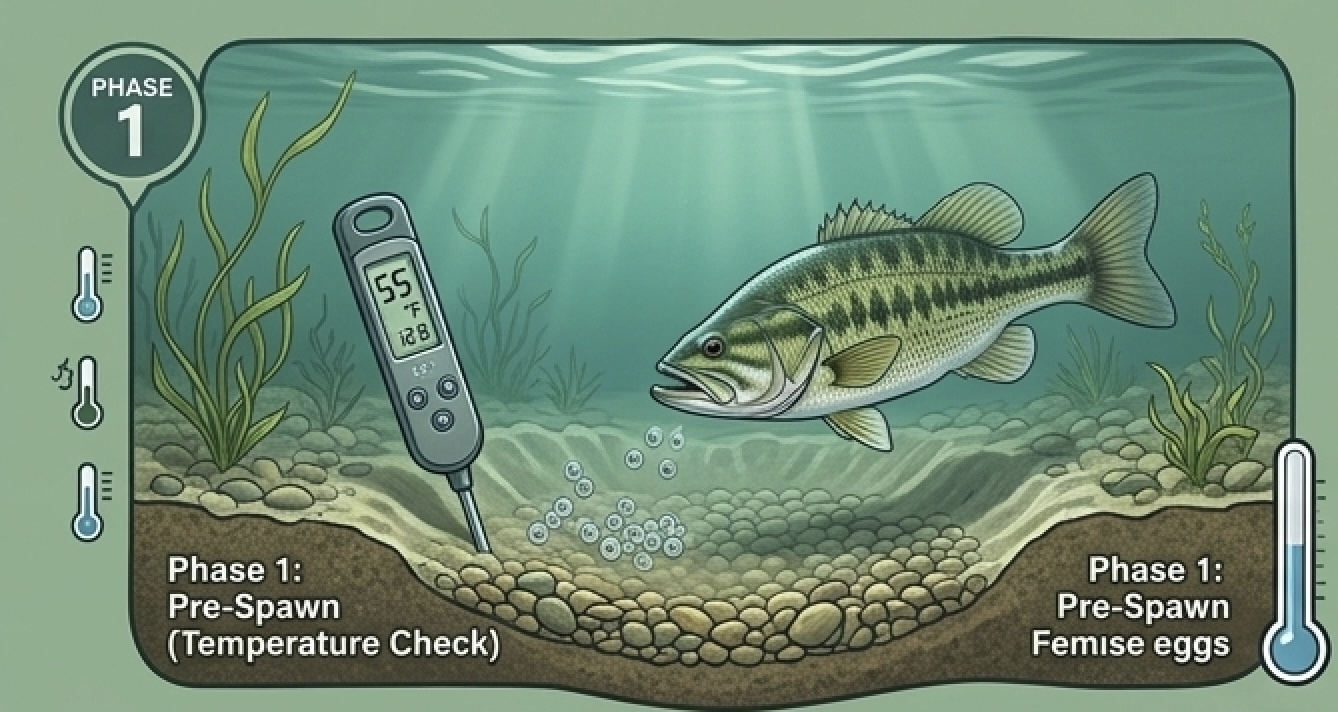
Pre-spawn is the staging phase. Water has warmed past 50 and is climbing through the 50s into the low 60s. Bass have left the deep winter water and are moving toward the shallow flats they will spawn on, but they have not committed to beds yet. They stage on the structure between the two: secondary points on a reservoir, the first drop-off into a spawning cove, creek-channel bends, the deeper edges of the weed line. They feed heavily on this structure. Females are eating to build the egg-development energy reserve; males are eating ahead of the energy-burning bed-guard period that comes next. Pre-spawn fish are some of the heaviest bass of the year and they hit hard. For a fly fisher, this is the window where a weighted streamer fished along a drop-off edge or a popper worked across a warm shallow flat produces the largest fish of the season.
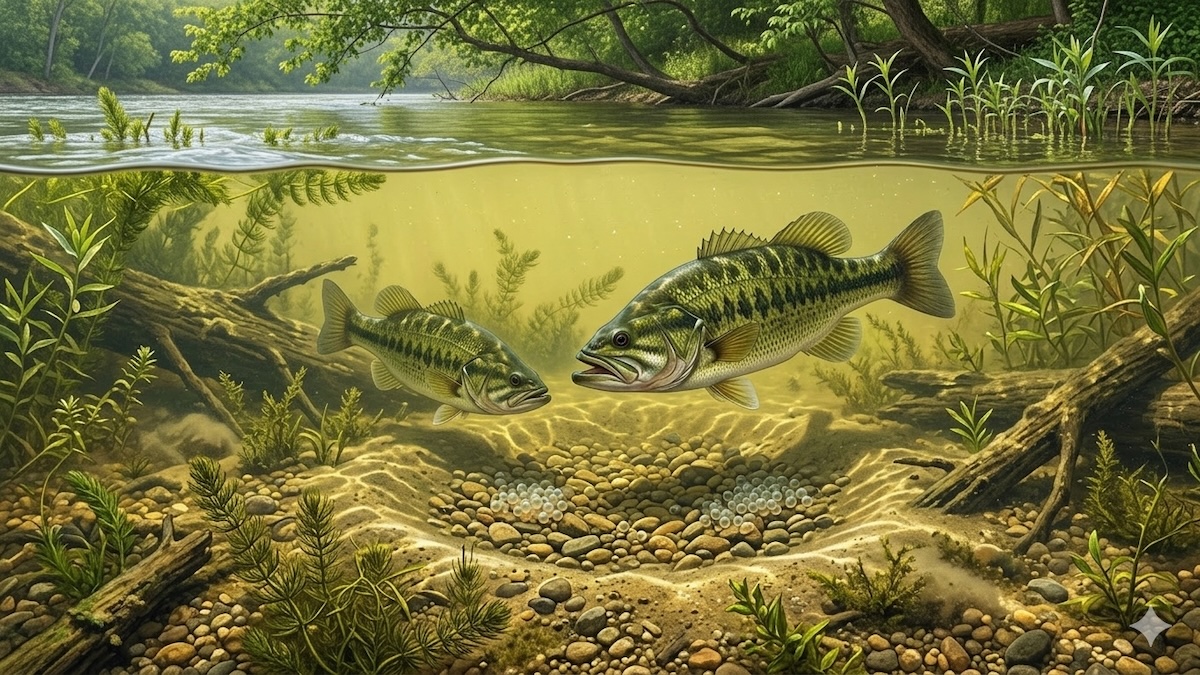
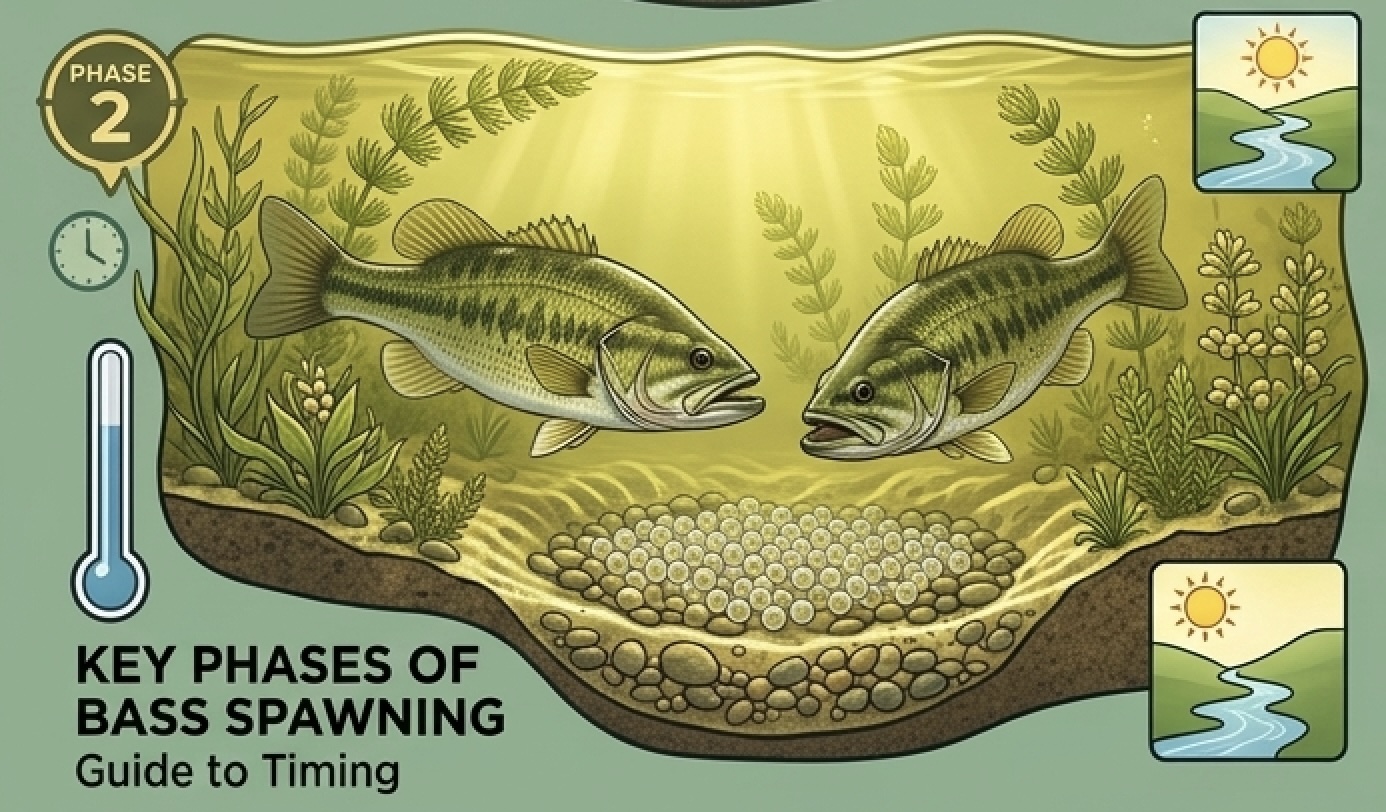
The spawn itself begins when the water settles into the 60 to 65 range for largemouth, slightly cooler for smallmouth. Males arrive on the shallow hard-bottom areas (sand, gravel, the cleaner edges of weed beds) and fan out circular bed depressions with their tails. The beds are visible to the angler as light-colored circles in the bottom, usually two to four feet across, in two to six feet of water. Females cruise in, deposit eggs, and leave; males stay on the bed to guard the eggs and the newly hatched fry. The bed-guarding male is fiercely territorial and will attack anything that enters the immediate strike zone of the nest, which is the basis of bed-fishing as a tactic. A fly that lands on or near the bed and stays in the strike zone draws a defensive strike, not a feeding strike. The fish takes to remove the threat, not to eat.
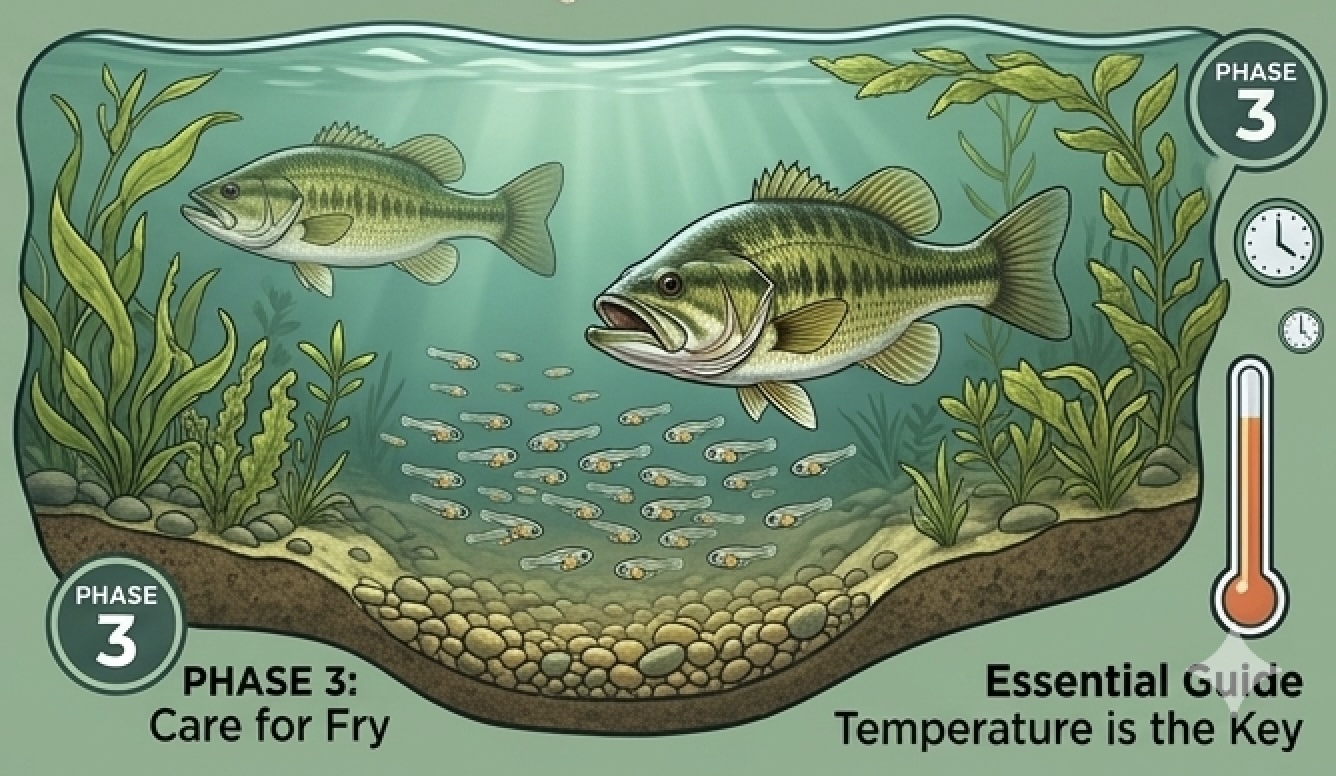
Post-spawn is the recovery window. The female has expelled eggs and burned a significant portion of her body weight; she drops off the spawning flat to the first piece of deep structure outside it (a creek channel ledge, the outside edge of a point) and recovers for one to two weeks. During this window she feeds sparingly. The male stays shallow to guard the fry, but the intensity of the guard drops as the fry disperse, usually within two weeks of hatch. This is the toughest fishing window of the spawn cycle. Fish are present but not feeding, and the angler who slams them in pre-spawn and on beds can have a quiet week between the spawn ending and the post-spawn feeding pattern resuming. Topwater can produce on males still holding shallow; deeper streamers on the first structure outside the flats produce on recovering females. Once recovery is done, usually as the water climbs past 70, bass shift into the summer pattern and feed aggressively on the bluegill and shad fry that hatched a couple of weeks behind them.
Regional timing across North America
The spawn moves north with the sun. In Florida and the Deep South, largemouth bass begin spawning in late January and run through March, with the heaviest activity in February. Lake Okeechobee, the Stick Marsh, and the Rodman Reservoir produce trophy spawning largemouth in February most years. Central Florida is where the genuinely big spawning females (8 to 12 pounds on a fly is achievable, 14-plus has been done) get caught most consistently.
Through the mid-South (Texas, Louisiana, Mississippi, Alabama, Georgia, the Carolinas), the spawn runs roughly March through April, with peak weeks shifting by a few days each year depending on how the late-winter weather plays out. Lake Fork in Texas, Guntersville in Alabama, and Santee Cooper in South Carolina sit in this band.
The mid-Atlantic and the lower Midwest (Virginia, Tennessee, Kentucky, Missouri, southern Illinois) run April into early May. The Ohio River smallmouth fishery peaks in this window, and the lakes that grow large smallmouth (Dale Hollow, Pickwick, the Tennessee River impoundments) produce most of their giants on pre-spawn and spawning fish in April.
The upper Midwest and the Northeast (Wisconsin, Michigan, Minnesota, New York, Vermont, New Hampshire, Maine) run May into June, with smallmouth typically two weeks ahead of largemouth in mixed-species waters. The smallmouth fishery in the upper Mississippi River and the upper St. Lawrence is a May-into-June event. Largemouth on the same waters spawn into the third week of June.
The northernmost bass populations (northern Ontario, Quebec, parts of Maine and the Adirondacks) can spawn as late as the first week of July, particularly in deep, slow-warming lakes. By the time these fish are spawning, the southern populations are already in summer feeding mode and the angler who chases the spawn northward can have spawning bass on the fly from February through July if travel is in the picture.
Largemouth, smallmouth, and spotted bass
Largemouth spawn shallow and on softer bottoms than the other two. They prefer protected shallow flats and the back ends of coves, with bed-building on sand, gravel, or the harder edges of weed-bed substrate. The protection matters: largemouth nests in open water exposed to wind get blown out, and the species selects for sheltered cover. This is why bass-spawn fly fishing for largemouth is largely a pond, cove, and protected-shallow game.
Smallmouth spawn in moving rocky water and on rocky shoals in lakes. They prefer cleaner, harder substrate (coarse gravel, cobble, the edges of boulder fields) and tolerate more current than largemouth. River smallmouth spawn in the slower water alongside the main current, often in pool tails and on the inside of bends where gravel collects. Lake smallmouth use rocky points and gravel shoals. The bed is more loosely defined than a largemouth’s neat circle, and the male’s guard radius is wider. Smallmouth on beds in clear water are some of the most visually exciting fly-rod targets in freshwater; sight-fishing to a holding male on a gravel shoal in three feet of clear water is the warmwater analogue of stalking a brown trout in a tailwater.
Spotted bass spawn more like largemouth than smallmouth, but they tolerate deeper water for bed-building and they often spawn on the same structure largemouth use one to two weeks earlier in the year. On the Tennessee and Coosa River systems where spotted bass dominate, the spawn is largely over by the time the largemouth get serious. The fly-fishing approach overlaps heavily with the smallmouth approach; spotted bass take crayfish and baitfish patterns aggressively and behave more like a smallmouth than a largemouth on the strike.
Fly fishing each phase
Pre-spawn fishes the staging structure with weighted streamers and slow-moving subsurface flies. A Clouser Deep Minnow in white-over-chartreuse or olive-over-white, fished on a floating line with a long leader along the outside edge of the spawning flat, picks off feeding fish that have not yet committed to beds. Larger profile bass flies (Game Changer, articulated streamers, Murdich Minnow) draw the heaviest females. The retrieve is slower than summer streamer work; strip and pause, with the pauses doing the work. Pre-spawn fish are heavy and lazy in cool water, and they will not chase a fast fly the way a 75-degree summer fish will.
The spawn itself fishes bed-targeting flies. The fly needs to land on or immediately adjacent to the bed and stay in the strike zone long enough for the male to commit to defending against it. Weighted nymphs that sink quickly and sit on the bed, small white streamers that show against the bed substrate, and bright attractor patterns that the angler can see while sight-fishing all work. The take is defensive, not feeding, and the strike often happens after several presentations as the male’s irritation builds. Polarized sunglasses are not optional for bed-fishing; the ability to see the bed and the fish on it is the difference between a productive day and casting blind.
Bed-fishing raises an ethics question that is worth naming. A bed-guarding male removed from the bed for the duration of a hooked fight leaves the eggs exposed to bluegill and other predators for that window. In high-pressure waters where many anglers target bedding males, the cumulative effect on the year’s recruitment can be measurable. Catch them, but land them fast, photograph them at the water, and release them directly back over the bed. Do not hold a bed-guarding fish for ten minutes of photos at the boat or carry it fifty feet for measurement. In waters where bass populations are stressed or the local fishery is small, leaving the bedding fish alone and targeting pre-spawn or post-spawn fish is the better call.
Post-spawn fishes the recovery structure with slow, deep presentations on the female-recovery side and topwater on the male-still-shallow side. The post-spawn females are not aggressive, and the patient angler who works a weighted streamer slowly along the first deep structure outside the spawning flat produces fish that are sitting and not moving. Males still on the flats guarding scattered fry will hit a popper or a frog pattern as the bluegill spawn begins and they shift to summer feeding mode. The transition from spawn-guard behavior to summer feeding is usually complete within two to three weeks of the female recovery, and by the time water hits 75, the bass year has flipped fully into 2026‘s summer pattern.

Leonard Schoenberger is a fly fishing professional and gear specialist with over 20 years of experience on the water. As the manager of Heidarvatn, a world-class sea trout lodge in Iceland, his product recommendations and tactical advice are tested in some of the most demanding conditions on earth. His expertise has been mentioned in The New York Times, the Financial Times, and at the Outdoor Media Summit.