Last updated on May 29th, 2026.
Mending is the act of repositioning the belly of the fly line on the water after the cast lands, in order to delay or eliminate the drag that current variation would otherwise impose on the fly. A perfectly cast fly does not drift naturally on its own; the moment it lands, the river starts pulling on different sections of line at different speeds, and within a few seconds the fly is being dragged across the surface in a V-wake that any selective trout reads as unnatural. The mend buys back that natural drift.
The cast delivers the fly to the right place. The mend keeps it fishing there. The two skills are inseparable in moving water, and most of the gap between a competent caster and an angler who actually catches fish on rivers lives in the mend.
The mechanics of drag
When a fly lands on water with current variation between the angler and the fly, three things happen in sequence. The line lies across the current in whatever shape the cast produced. Different sections of the line are now sitting in different speed lanes. The faster section starts pulling line through the slower section, dragging the belly of the line downstream faster than the fly itself is moving in its lane.
Within five to ten seconds of landing, the fly is no longer moving at current speed. It is being pulled by the line, accelerating into a glide across the surface or swimming subsurface at an unnatural angle. From the trout’s perspective, this is wrong. A natural insect drifts with the current of the lane it occupies; an unnatural one moves across lanes or moves faster than the water it sits in. Selective trout reject dragged flies categorically.
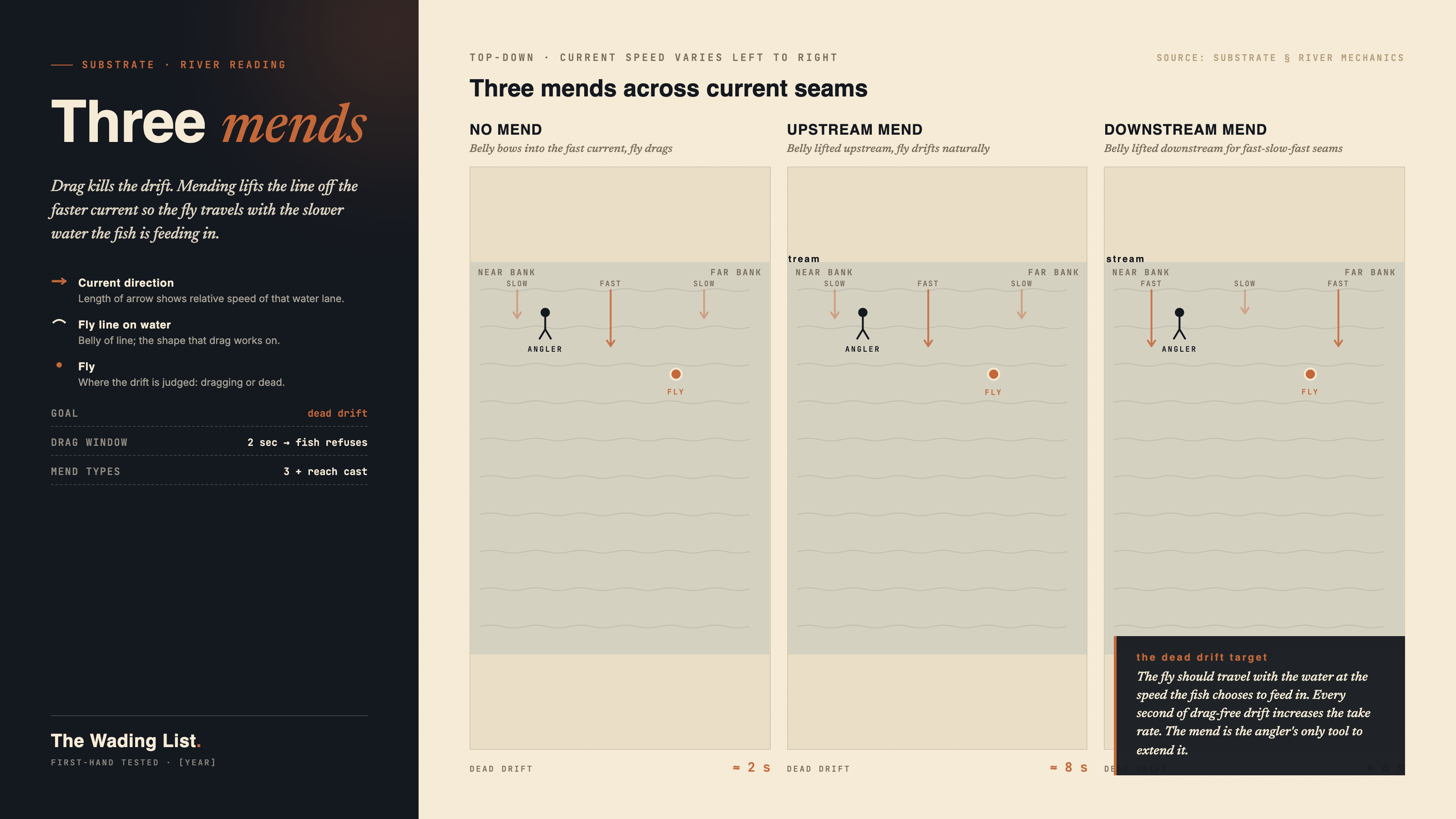
The mend solves this by repositioning the belly of the line so that the current’s pull no longer creates drag. If the line is being pulled downstream too fast, mend the belly upstream to absorb the slack. If a slow inside lane is letting the fly drift faster than the line, mend slack into the fly’s lane. The goal in every case is a dead drift: the fly and the line moving at the same effective pace, with no acceleration of the fly across or through the lane.
This is what river anglers mean by reading water. The current seams (the visible lines where fast water meets slow water) are not just where fish hold; they are also where drag happens fastest. The angler reads the surface for these seams and predicts where the line will be pulled, then positions the cast and the first mend to anticipate that pull.
The basic mend
The classic upstream mend handles the most common drag situation: the angler standing in slower water near the bank, casting across to a current seam farther out, with the fly drifting through faster water in the middle.
Cast the fly to the target. As the line lands and the fly begins to drift, the belly of the line in the faster middle current starts being pulled downstream faster than the fly in the seam.
Before the drag begins to pull on the fly, lift the rod tip and flip the belly of the line upstream. The motion is a smooth lift, a roll of the rod tip in a half-circle upstream, and a stop. The belly of the line moves upstream while the leader and the fly stay roughly in place (because the mend lifts the line off the water briefly, breaking the surface tension’s grip on it).
The mend gives the fly a few more seconds of dead drift before the current catches up and starts dragging again. Mend again as needed; large mends early in the drift, smaller mends as the fly approaches you, with the goal of a complete drift through the holding water.
Variations and refinements
The downstream mend is the inverse: when the angler is in faster water and the fly is drifting through slower water (or vice versa, depending on cast angle), the mend flips the line downstream rather than upstream. The same mechanic, different direction.
The reach cast is a built-in mend executed in the air rather than after the line lands. As the forward cast straightens, the angler sweeps the rod tip horizontally upstream (or downstream) before the line settles. The line lands with the belly already positioned upstream of the fly, buying drift before any post-cast mend is needed. The reach cast is the most useful single technique for tight-line nymphing and indicator dry-fly work because it delivers the cast already mended.
The stack mend (sometimes called the pile mend) drops slack into a specific section of the line, often near the leader, to give the fly extra drift time. Useful when the angler is casting to a near-bank seam from across a fast inside current; the stack absorbs the pull until the slack runs out.
The parachute cast drops slack into the leader itself, by checking the rod tip high and letting the leader collapse in soft S-curves before settling. The slack in the leader buys drift time at the fly. Common in dry-fly fishing to selective trout in flat water.
The slack-line cast (or pile cast) drops slack into the entire forward presentation by checking the rod sharply at the end of the cast, letting the line and leader settle in a wandering pile rather than straightening. Maximum drag protection at the cost of casting accuracy; works on selective fish in moderate current.
The mend-on-the-water versus mend-in-the-air distinction matters. Mending after the line lands is easier to learn but always disturbs the surface to some degree (any mend creates a small ripple). Mending in the air (reach cast, parachute cast) keeps the presentation cleaner because the mend is executed before the line touches water. Most river fishing combines both: a reach cast for the initial mend, then post-landing mends as drift continues.
Reading the water before the cast
The best mends are predictive. Before the cast lands, the angler should already know where the line will be pulled, where the seams are, and what the first mend will be. This is reading water in the most operational sense: turning the visible surface texture into a prediction of how line will behave on it.
Current seams are visible as the lines where fast water meets slow water. The surface texture changes (faster water tends toward more broken or chopping, slower water toward smoother or glassier), and the line between them is where drag happens fastest. Cast across a seam, and the section of line crossing the seam will accelerate while the section in slow water lags.
Boulders, rocks, and submerged structure create slow water immediately upstream of them (the pillow), fast water on either side, and an eddy zone downstream where the water swirls or reverses. Each zone has its own drag profile. A fly drifting through a pillow above a rock needs the mend to delay the pull from the fast water around the sides; a fly drifting through the eddy downstream of the rock needs slack management because the eddy’s currents are circular and unpredictable.
Riffle-to-pool transitions concentrate fish (current delivers food into the pool head) and complicate drift. The fast water of the riffle drops into the slower water of the pool; a fly entering the pool head behind the angler’s line in the faster current will drag immediately unless the cast is mended before it lands.
Wading position matters. Standing in slow water and casting across to fast water inverts the typical drag direction. Standing in fast water and casting across to slow water creates a different drag profile again. The same fly pattern, the same cast distance, with the angler in a different position can require opposite mends.
Common mistakes
The mend that is too late. Once the line has been dragging the fly for several seconds, mending no longer recovers the drift; the fly has already been pulled out of its lane. Mend early, as soon as the line lands and certainly before any visible drag begins. The first mend usually happens within one or two seconds of the cast settling.
The mend that disturbs the leader and the fly. A heavy, splashy mend (the rod tip flipped hard, the line slapped back onto the water) repositions the belly but also pulls the leader and the fly out of position, often dragging the fly across several lanes in the process. Mend the belly only; the rod motion should be a smooth lift and roll, not a chop. The leader should not move during a clean mend.
The mend that pulls the fly. If the line is moving when the mend executes, the leader and fly will move with it. Time the mend to a moment when the current’s pull on the line has paused or slackened (often immediately after the cast lands and before the current has fully engaged). A correctly timed mend repositions line; an incorrectly timed mend repositions the entire rig.
Too many mends. Each mend disturbs the surface and signals the fish. On selective water, three good mends through a 20-foot drift outperform six bad ones. Mend deliberately and only when the drag math demands it.
Mending in the wrong direction. The direction depends on where you are standing, where the fly is, and where the current is pulling fastest. Beginners often mend reflexively upstream when the situation demands a downstream mend. Take a moment after the cast lands to identify the drag direction before flipping the line.
Mending versus other line control techniques
Mending repositions line on the water after the cast. Several adjacent techniques reposition line in different ways and at different points in the drift.
The reach cast (above) is a pre-landing mend executed in the air. Often the highest-leverage technique for situations where the angler knows the drag direction before the line lands.
Line management with the non-casting hand is the running-line skill: pulling slack in, letting slack out, or pinching the line under the rod-hand index finger to maintain feel. This is not mending in the strict sense, but it is the continuous adjustment that complements mending.
High-sticking is the technique of lifting the rod high to keep line off the water entirely. Useful in close-in nymphing where any line on the water would create immediate drag. Euro nymphing is the formalized version of high-sticking, with rods built specifically (10 to 11 feet, 3- or 4-weight) for the technique.
The strike is a line-management event that interrupts the drift. When a fish takes, the angler sets the hook by lifting the rod and tightening the line; this terminates the drift and shifts to fighting mode. The discipline of mending is what gets the fly to the strike in the first place.
Related gear
The rod matters for mending precision. A 9-foot or 10-foot rod gives more reach for mending across current seams than a 7.5- or 8-foot rod; longer rods are easier to mend with at distance. Action profile matters too: medium and medium-fast rods mend more smoothly than fast-action stiff rods, because the deeper flex absorbs the rod-tip motion without jerking the line. The best fly rods page covers the action and length choices for river fishing.
For trout specifically, the best trout fly rods page covers the 3- to 6-weight range where most river mending happens, with the 9-foot and 10-foot lengths that fit the technique.
The line itself affects how mending works. A weight-forward floating line with a moderate front taper mends cleanly; a heavy short-head line (like a Skagit) is much harder to mend because the heavy belly resists repositioning. Our guide to best fly lines covers the line tapers that match river fishing technique.
Reading the water that determines where to cast and where to mend is its own skill, taught more by hours on the water than by any single page. Our guide to fly fishing hatch chart covers the entomology side (which insect is on, what stage matters), and the rise-form table connects the surface signal to the underlying trout behavior. Both are inputs to the mend-driven drift that delivers the fly to the fish.

Leonard Schoenberger is a fly fishing professional and gear specialist with over 20 years of experience on the water. As the manager of Heidarvatn, a world-class sea trout lodge in Iceland, his product recommendations and tactical advice are tested in some of the most demanding conditions on earth. His expertise has been mentioned in The New York Times, the Financial Times, and at the Outdoor Media Summit.