Last updated on May 25th, 2026.
The Panga 28 is what you reach for when the gear inside it is worth more than the bag, and the water it has to survive is not a passing shower but the actual operating environment. Saltwater on a skiff deck. Spray off a heli pontoon. A raft flip on day four of a multi-day float. This review is about whether the Panga 28 earns its place in that specific use case, and how its construction actually keeps water out, not just whether it looks tough on a product page.
If you have read our waterproof backpack master guide, you already know the broad category. The Panga 28 sits at the heavy end of it: the boat-bag archetype, built to live wet for days at a time, not the shower-tested daypack archetype that gets folded in next to a laptop. The substrate criterion is total water-exposure intensity over time, and on that axis the Panga is one of a small handful of bags built to the upper bound.
The Panga 28 vs the Sidekick: which Yeti waterproof does what
This is the question most fly fishers actually have when they land on a Yeti review page, and the SERP does not answer it cleanly. Both bags are waterproof. Both bags share the same DNA of TPU-laminated nylon shell. They are not interchangeable.
The Sidekick Dry 3L (covered in detail in my Sidekick Dry 3L review) is a hip-attachable pouch. Three liters. It holds a phone, a wallet, car keys, one or two fly boxes, a spare spool, maybe a packed lunch and a can of soda if you push it. The closure is magnetic, the shape is slim, and the whole point is that it sits on your wading belt and you forget it is there until the rain turns sideways. It is a valuables-protection device for the day you are already on. Price sits in the $40 to $70 range depending on size.
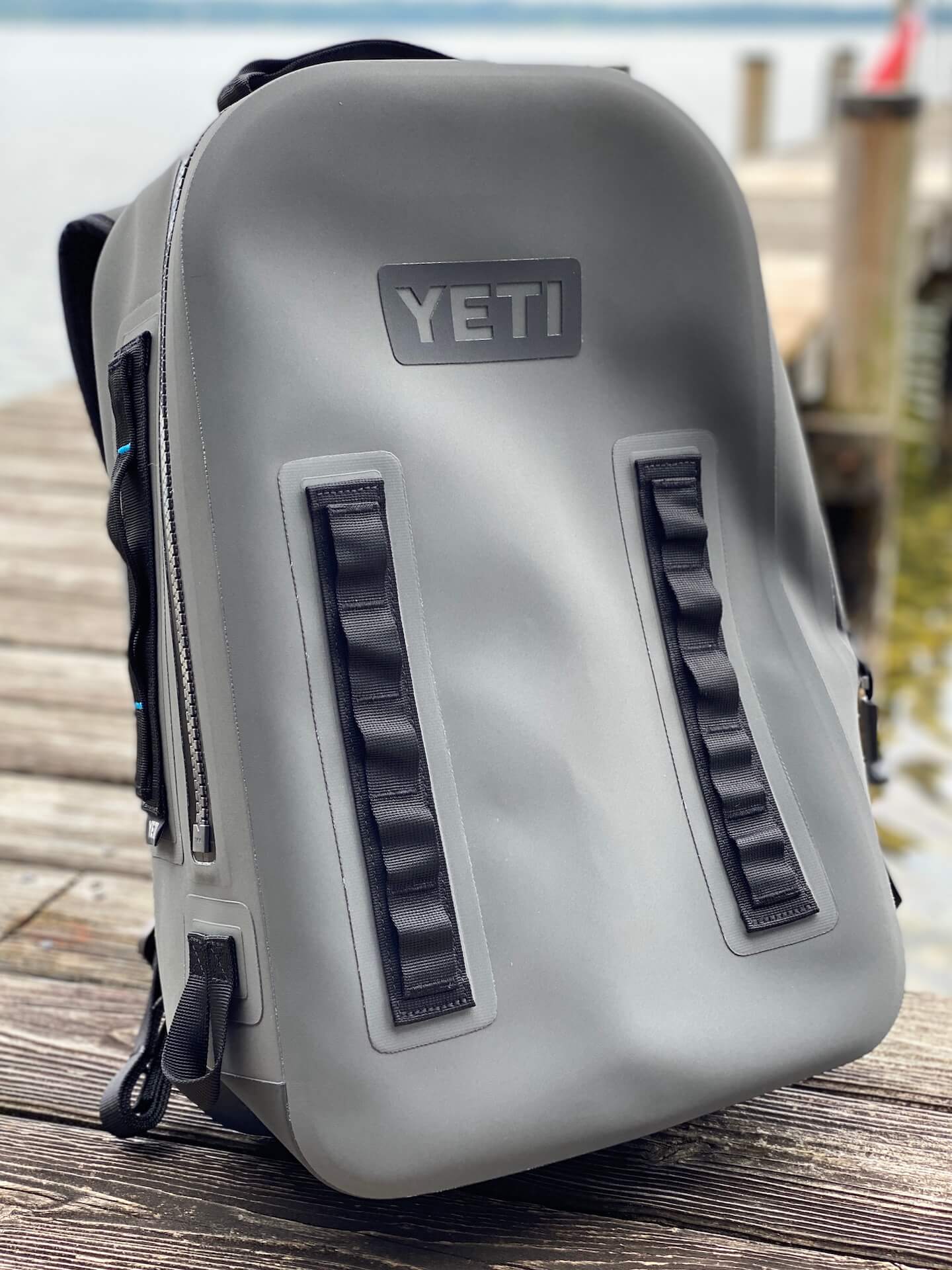
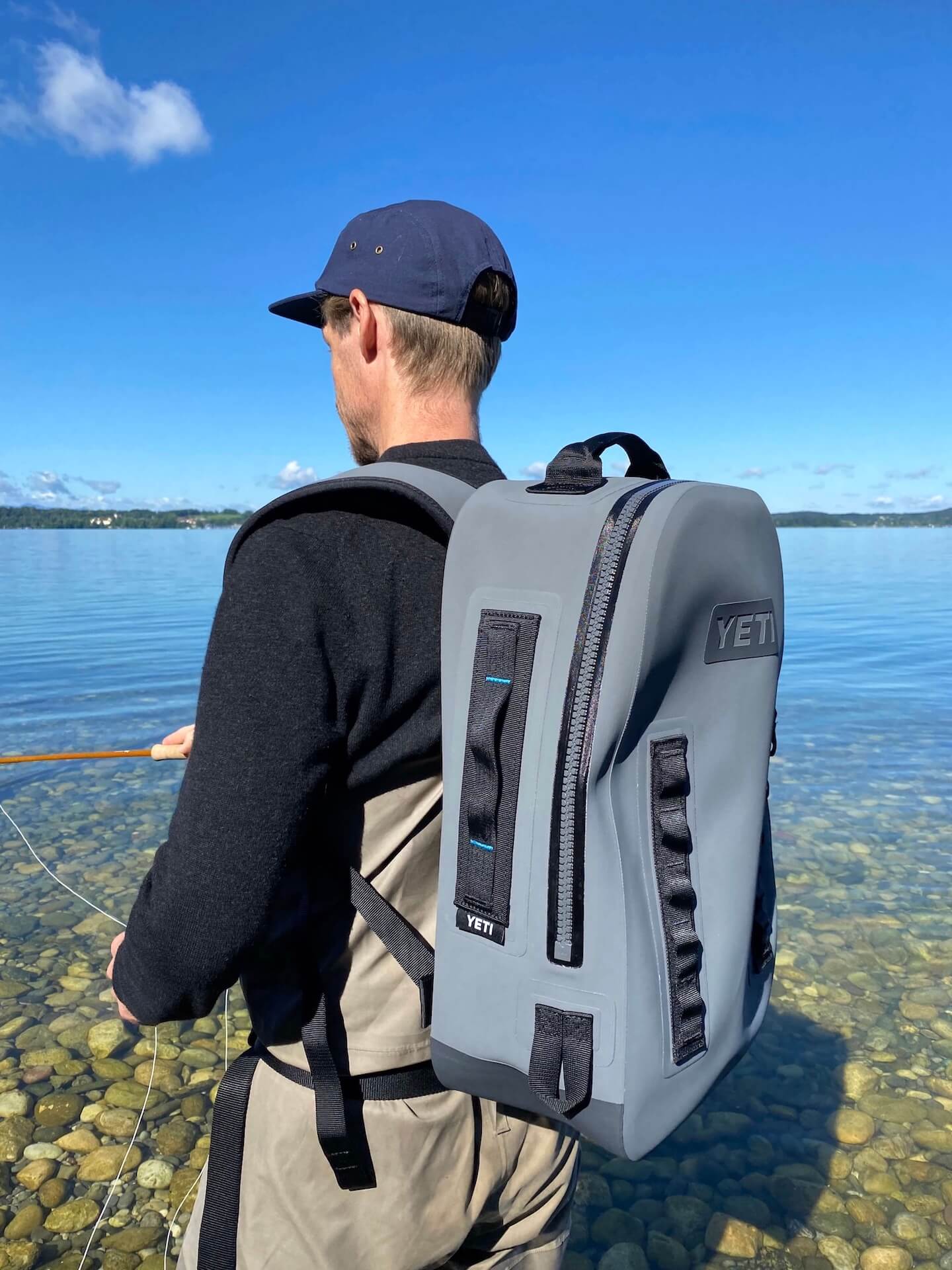
The Panga 28 is a 28-liter expedition backpack. It is the bag you fly with, drive with, load into a skiff with, strap to a raft with. It carries a full day’s worth of layers, a saltwater reel in a soft case, leader wallets, a packable shell, water bottles, lunch for two, a camera body and a lens, and still has room for whatever the trip throws at it. Price is in the $300 to $325 range. The strap system uses what Yeti calls DryHaul shoulder straps with a removable chest strap and waist belt, which matters once the bag is loaded past about ten kilos and you are walking a quarter mile across a tidal flat to the boat.
The clean way to think about it: the Sidekick is for the gear that lives on your person while you fish, and the Panga 28 is for the gear that lives in your transit envelope between the truck and the water. On a saltwater day you might carry both. The Panga 28 holds the day’s spare reels, a backup rod tube, dry layers, and whatever your guide does not want loose on his deck; the Sidekick rides on your wading belt with your phone and the fly boxes you actually need that hour.
The substrate criterion that separates them is volume crossed with water-exposure intensity. The Sidekick covers low-volume, high-intensity (your phone has to stay dry if you slip). The Panga 28 covers high-volume, high-intensity (a whole bag of gear has to stay dry on a multi-hour boat ride through spray).
How the Panga waterproofing actually works
Waterproof bags fail for one of three reasons: the shell material wets through, the seams leak at the stitch holes, or the closure leaks where the bag opens. The Panga 28’s construction addresses each one with a specific mechanism, and understanding the mechanism is the difference between trusting the bag and hoping it works.
The shell is a high-density nylon substrate, but the waterproofing does not come from the nylon. It comes from the TPU (thermoplastic polyurethane) lamination bonded to the nylon. TPU is a continuous, non-porous film. Unlike a DWR (durable water repellent) coating that beads water on the surface and wears off, a TPU laminate is a structural layer of the fabric. Water cannot wick through it because there is no pore structure to wick into. Yeti calls this layered construction the ThickSkin shell, which is a brand name for what is, mechanically, an abrasion-resistant nylon face fabric bonded to a continuous TPU film. The same construction logic shows up across the serious end of the dry-bag market: Watershed and Ortlieb use closely related TPU-laminate systems.
The seams are where most “waterproof” backpacks quietly fail. A stitched seam is not waterproof, because every needle hole is a potential leak path. You can tape over a stitched seam, but the tape relies on adhesive bond strength that degrades over years of flex and UV exposure. The Panga sidesteps this entirely by using radio-frequency welding (RF welding) on the panel joins. RF welding uses high-frequency electromagnetic energy to vibrate the TPU molecules at the seam interface until they fuse into a single continuous polymer layer across the join. There are no needle holes. There is no adhesive. The seam is the same material as the panel, which means it has the same water-blocking properties as the panel and ages on the same curve. This is the mechanism that lets Yeti’s product page claim “submersible” rather than just “waterproof.”
The closure is the third failure point, and on the Panga 28 it is a TIZIP-style TPU-laminated zipper, sometimes called a “drytop zipper” or marketed as TruZip in adjacent product lines. It is not a coated YKK; it is a fundamentally different mechanism. A standard zipper closes two rows of teeth, which interlock but do not seal. A TIZIP closure has a continuous gasket profile molded onto each side of the zipper tape. When you pull the slider closed, the two gasket profiles compress against each other under mechanical pressure, the same way the door seal on a dishwasher works. The result is a closure that holds against immersion pressure, not just splash. The tradeoff is friction: a TIZIP closure does not glide like a YKK. You have to pull it closed deliberately, and you have to keep the gasket lubricated (Yeti ships and recommends a silicone-based lubricant for this exact reason). Skip the maintenance for a couple of seasons and the gasket gets sticky and starts splitting at the corners. Maintain it and the closure outlasts the rest of the bag.
The shorthand most reviewers use is “IP rating,” borrowed from the electronics industry. The Panga is not formally IP-rated in the way a phone is, because IP testing standards are written for sealed enclosures and not for bags that you open and close all day. The fishing-gear question is not “what IP rating does it have” but “does the closure system actually hold under the conditions I will see.” For the Panga 28, the conditions it is built for are sustained spray, accidental brief submersion, and the kind of rain that destroys lesser bags inside half an hour.
Build quality and what the spec sheet does not tell you
The Panga 28 is heavier than a standard 28-liter daypack of the same volume. That is the TPU film and the welded seams and the burly hardware paying their weight tax. Yeti lists the bag at roughly 4.3 pounds empty. A comparable non-waterproof 28L pack runs in the 1.5 to 2 pound range. If you are weight-counting for a backpacking trip, the Panga is the wrong bag. If you are loading it into a boat or a vehicle and walking short distances with it, the weight is the cost of admission for a shell that will not let go.
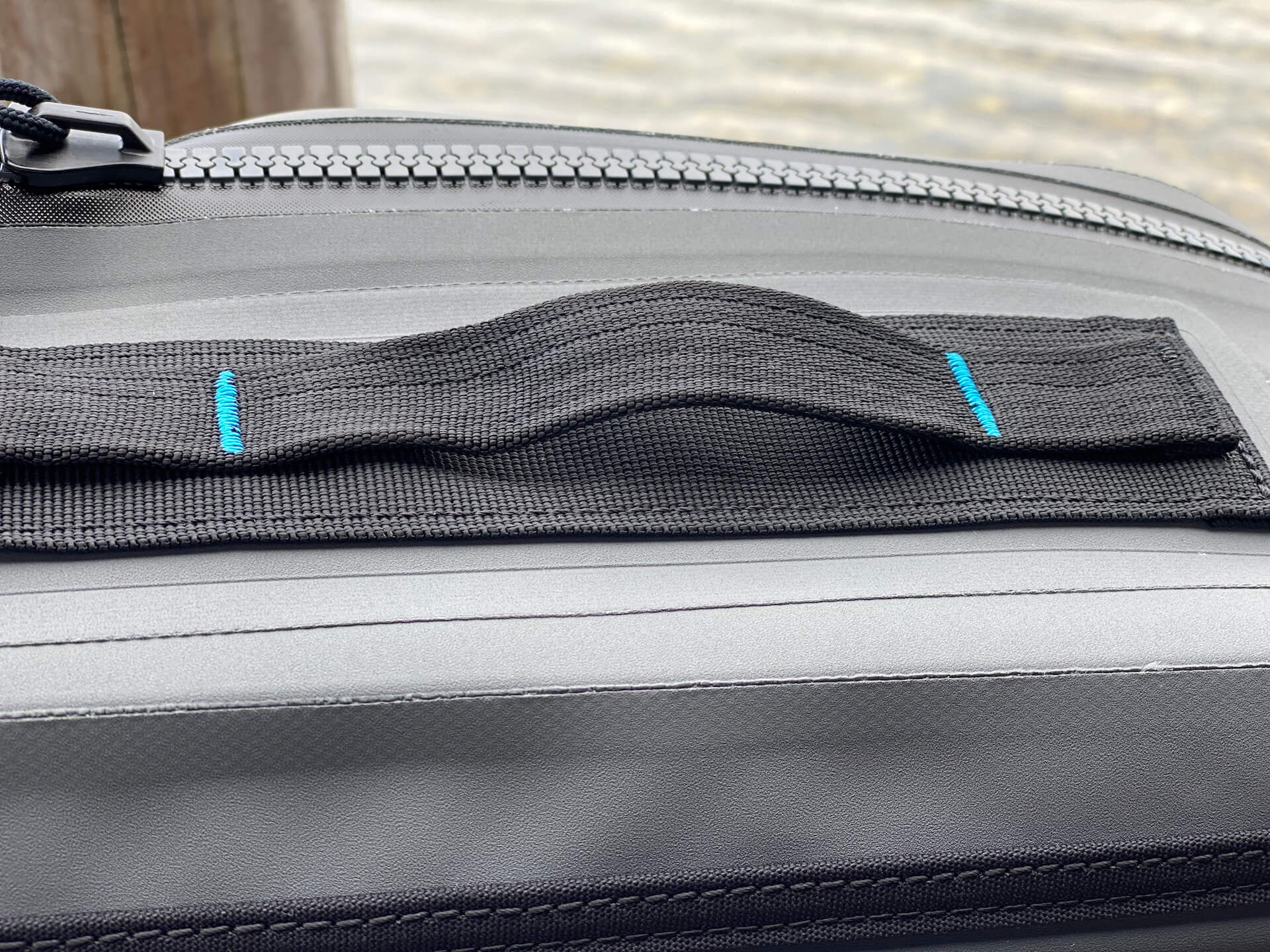
The hardware Yeti calls MetalLock is the lash points and attachment buckles. They are oversized cast metal rather than the plastic snap clips you find on most packs. The reason matters: plastic hardware fails after enough UV and salt cycles, and “after enough” can mean a single season of hard tropical use. Metal hardware survives the same cycles indefinitely. The QuickGrab lash points are paired around the bag’s exterior so you can clip a wet jacket, a coffee thermos, or a rod tube to the outside without opening the main compartment.
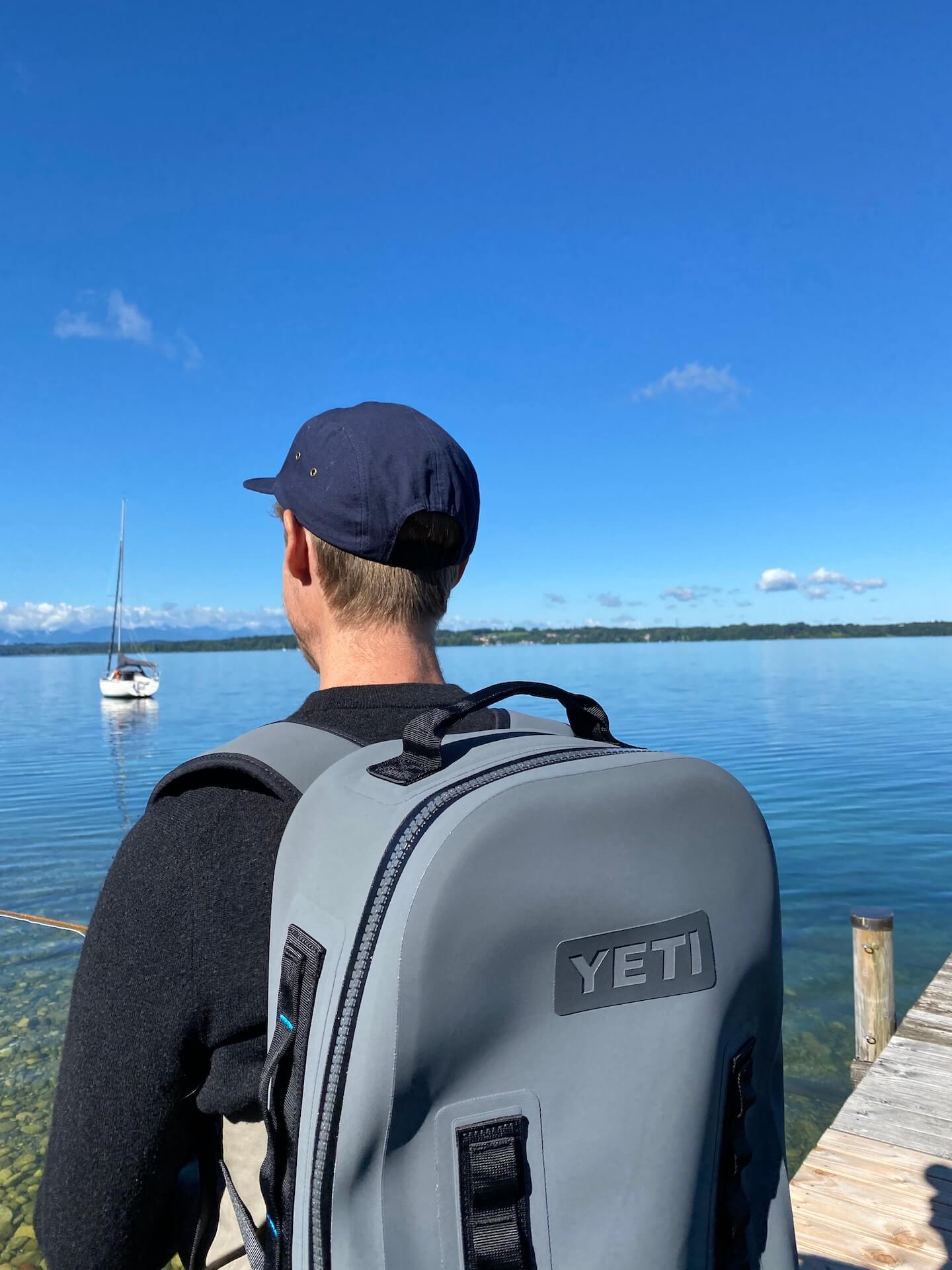
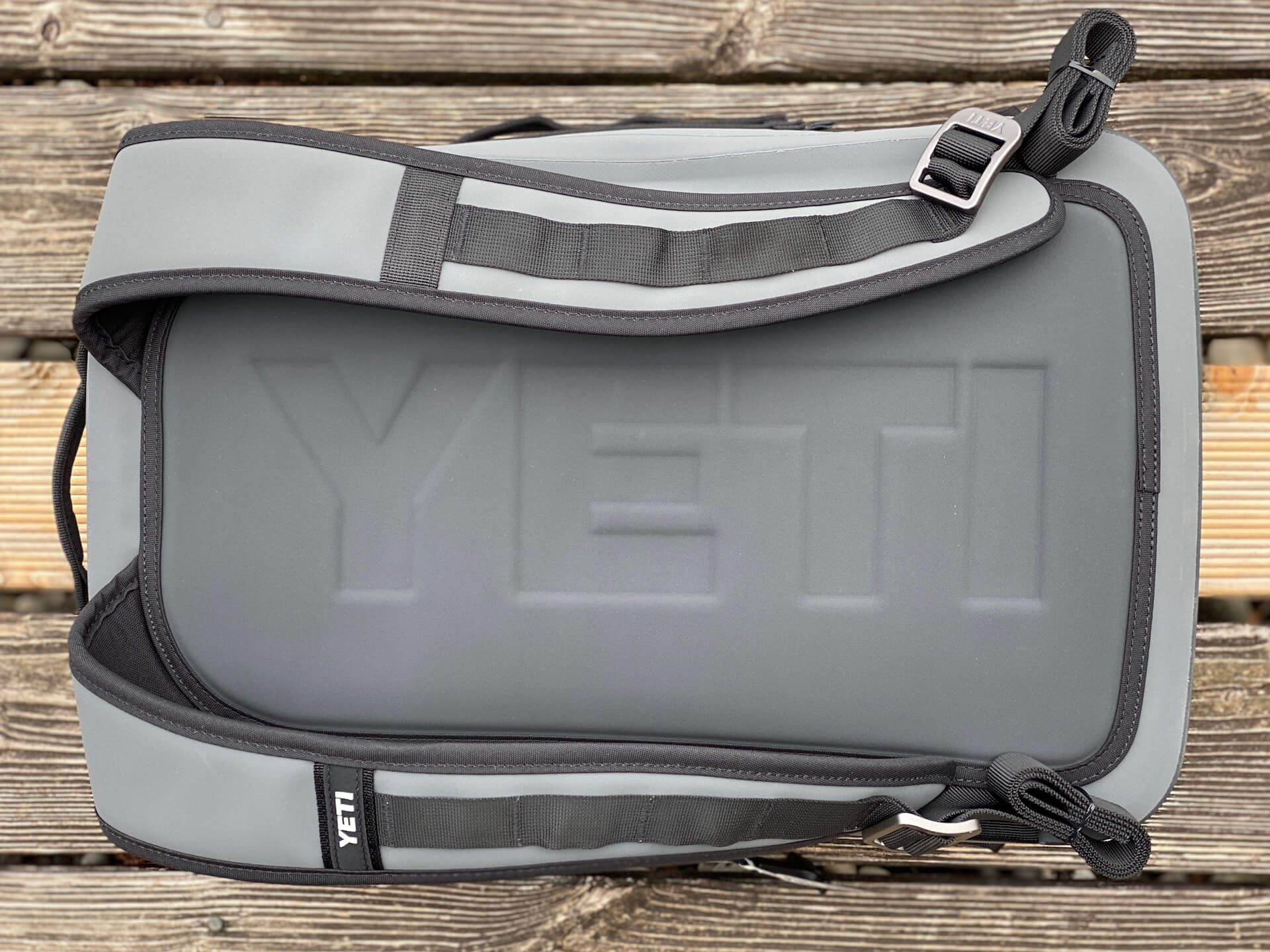
The strap system carries the load through dense-foam DryHaul shoulder straps with breathable mesh facings. Beyond about twelve pounds of contents you will want the removable waist belt and chest strap engaged; they are designed to be removable because for short-haul boat-to-truck carries they are unnecessary, and for full-load airline transit they are essential.
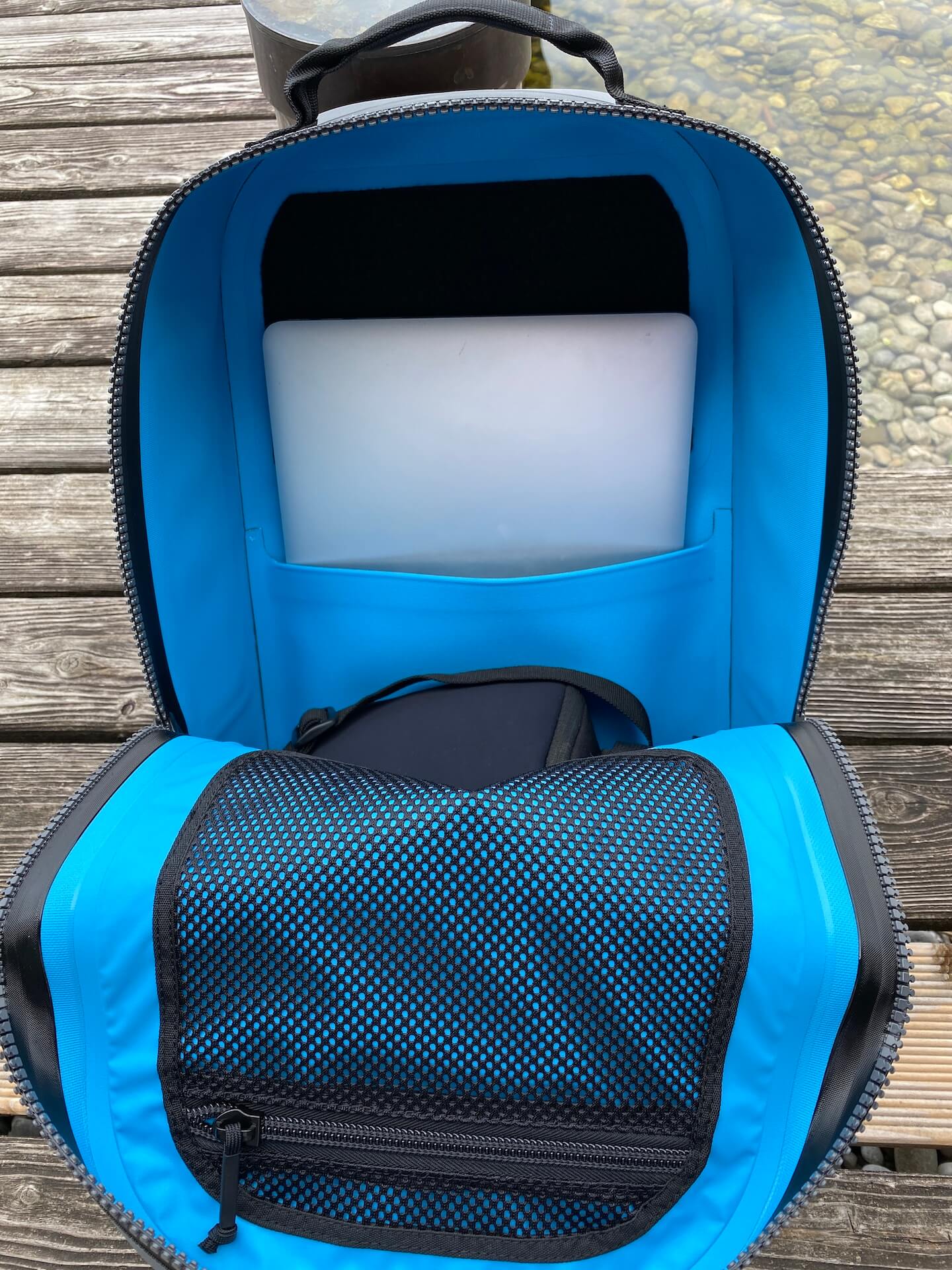
The interior is a single main compartment with a small mesh organizer pocket against the back panel. There is no dedicated laptop sleeve, no water-bottle side pocket, no easy-access top compartment. The design follows the dry-bag logic: one sealed envelope, opened intentionally, kept closed otherwise. If you want compartmentalization, the Panga is not it. If you want a single sealed envelope you can dump your day’s gear into and stop worrying about, this is exactly the shape.
Where the Panga 28 fits
Four use cases earn the Panga 28 its $300+ price tag. Outside these, you are paying for capability you will not exercise.
The first is saltwater drift-boat or skiff fishing. Spray over the bow, salt mist on a windy day, and the constant low-grade wetness of a boat deck destroy gear inside a non-waterproof bag inside one trip. A Panga 28 sits on the deck or under a casting platform, gets soaked externally, and the contents stay dry. For flats fishing where you are running between a half-dozen spots in a day, this is the bag that lives in the boat alongside the cooler.
The second is heli-fishing transit. Helicopter pontoons get wet, gear gets strapped to exposed external mounts, and the unloading conditions at a remote stream are whatever the weather decides that day. The Panga’s submersion-rated closure and welded shell mean that even a brief drop into a tarn during unloading does not write off your gear.
The third is multi-day raft trips. Rafts flip. Coolers fall over. Gear pinned on the frame gets dunked. The Panga 28 is not a substitute for a proper dry bag on a multi-day, but it is the carry-on portion of a raft kit, the bag that holds the day’s electronics, camera, and dry layers and rides on the frame within arm’s reach.
The fourth is airline luggage on fishing-destination trips. Checked luggage gets handled wet, sits on a wet tarmac, and on small bush flights gets strapped to the outside of the plane or the float of a Beaver. A Panga 28 inside checked luggage, or as a carry-on, means that whatever happens between Heathrow and the lodge dock, the contents arrive dry. For destination saltwater trips () this is the bag’s strongest case.
What it is not for: daily commute, school, gym, hiking with a hydration bladder, anything weight-sensitive, or anything that needs compartmentalization. Buying the Panga 28 for a use case it does not solve is the most common reason it gets returned.
Pairing with the rest of the gear kit
The Panga 28 does not replace anything in the on-the-water carry stack; it sits behind it. For the gear you actually have on you while fishing, the calculus splits by water type.
On a saltwater flat or skiff, the Panga 28 lives on the boat and a waterproof sling pack rides on your back when you step off to wade. The sling holds the leaders, tippet, flies, and tools you need for the next two hours. The Panga holds the spares, the spare reel for the saltwater fly rod you are not currently casting, lunch, water, a dry shirt for the boat ride back.
On a freshwater wading day, the Panga is overkill if you are walking from the truck to a single run and back. Use a sling pack or the Sidekick on your wading belt. The Panga earns its place on a freshwater day only if you are doing a long approach hike, a multi-spot day with full gear changes, or a multi-day stretch.
The internal-pocket layout in the Panga assumes you will use it as the envelope, not the organizer. If you want individual gear sorted, use packing cubes or dry pouches inside it. The bag itself is a single waterproof envelope and resists the temptation to over-engineer the interior, which is the right call for the use cases it is built for.
Long-term durability and what wears out
After multiple seasons, the wear points on a Panga 28 are predictable. The shell itself is exceptionally durable; the high-density nylon face fabric resists abrasion against rough surfaces (skiff decks, raft frames, baggage handler gauntlets) far better than uncoated fabric of equivalent weight. UV exposure is not a meaningful threat to the TPU laminate; it is engineered for sustained sun.
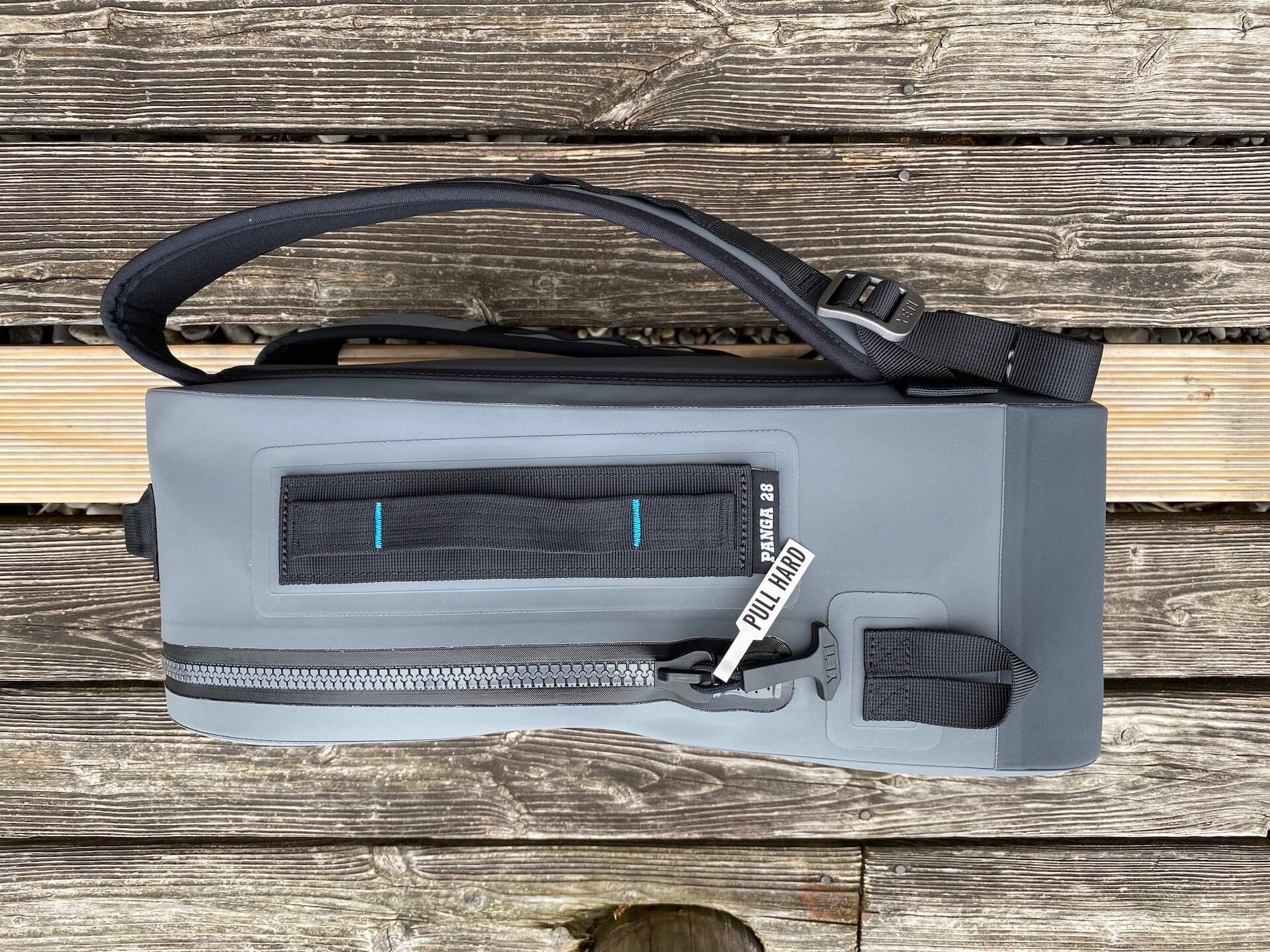
The wear point is the TIZIP gasket. The gasket needs periodic cleaning with fresh water (to remove salt crystals and grit that score the sealing surfaces) and periodic re-lubrication with the silicone lubricant Yeti recommends. Neglect it and the closure becomes harder to operate, the gasket starts to crack at the corners where the radius is tightest, and eventually you will start to see seepage on submersion tests. Maintain it on the cadence of “after every trip with salt exposure, before storage” and the gasket outlasts the rest of the bag.
The hardware does not wear out in any practical timeframe. The strap webbing eventually fades and softens but holds load strength well beyond the point where it looks worn. The mesh on the back panel and shoulder strap facings is the second-most-likely wear point after the gasket; it can be picked apart by Velcro and by repeated abrasion against rough surfaces, but it is cosmetic rather than structural.
How the Panga 28 compares to the alternatives
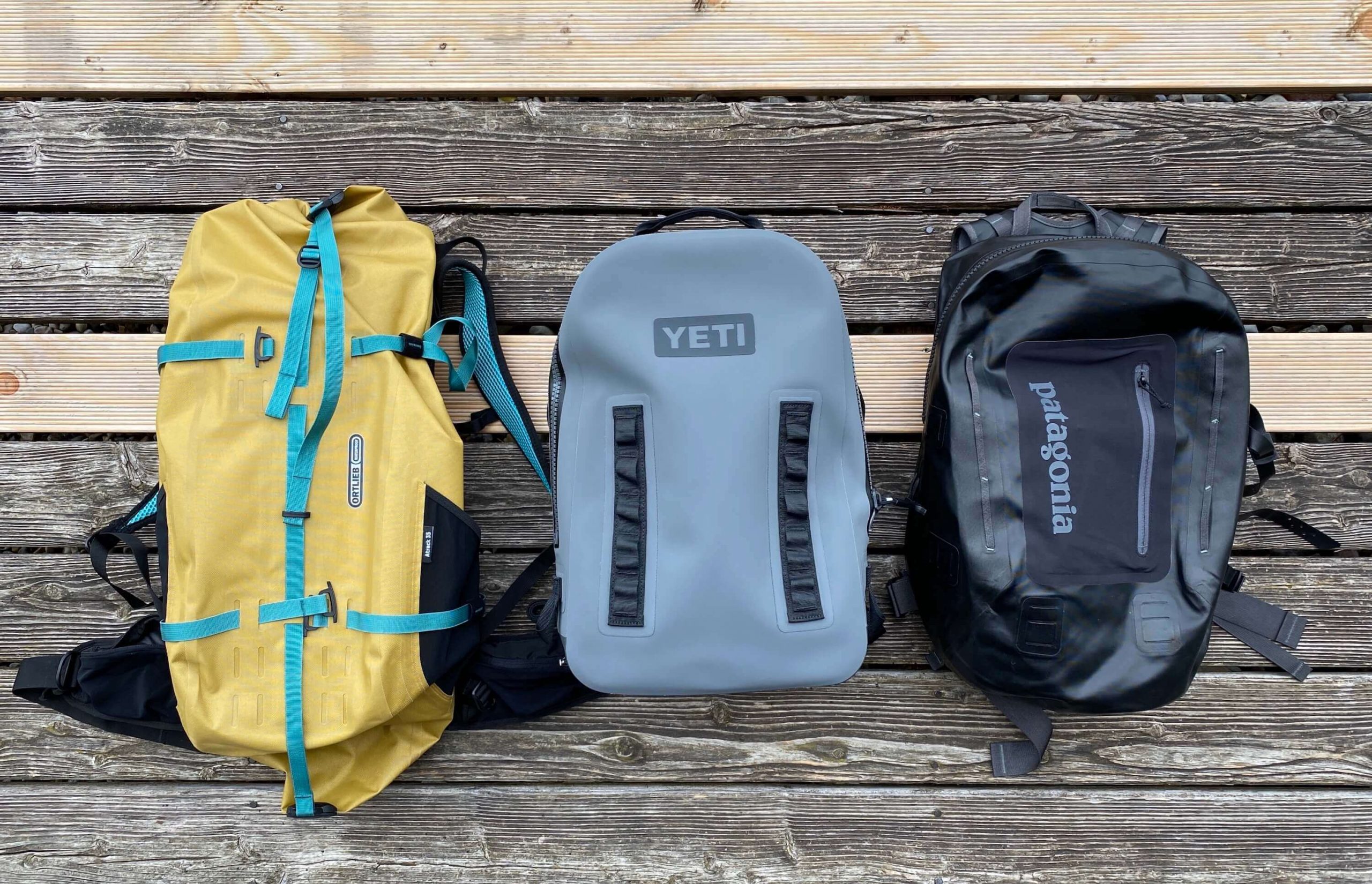
The structural competitors at the same price-and-capability point are the Watershed Animas (and the larger Watershed Westwater for a step up in volume), the Ortlieb Velocity series for the urban-leaning side of the category, and the Sea to Summit Hydraulic Pro Dry Pack for the rafting-specific side. The Panga 28 differentiates on three axes: the welded-seam construction quality (best-in-class, on par with Watershed and ahead of cheaper TPU offerings), the closure mechanism (TIZIP is shared with Watershed; both are submersion-rated), and the carry comfort under load (Yeti’s strap system is materially better than the more minimalist Watershed harnesses for sustained wear).
The dollar cost of all four bags is in the same envelope; the Panga is not the cheap option, but it is not the most expensive either. For a fly fisher specifically, the Panga’s strap system and the hardware ergonomics make it the easiest of the four to live with day-to-day. Watershed has the edge if your use is purely raft-and-river and you want the absolute lightest weight per liter; Yeti has the edge if your bag has to function equally well in an airline overhead, on a skiff deck, and on your back across a flat.
Verdict
The Panga 28 is one of the few pieces of gear in the broader outdoor market where the marketing claim and the engineering reality line up cleanly. It is waterproof because every joint is welded, every panel is TPU-laminated, and the closure is a gasketed compression seal rather than an interlocking zipper. The price reflects the construction; the construction reflects the price.
If your fishing involves saltwater, helis, rafts, or destination travel with checked luggage that has to stay dry, the Panga 28 is the bag. If your fishing is bank access at your local stream with a single change of layers, you are paying for capability you will not use, and a much cheaper non-waterproof pack with a rain cover gets you the same outcome at a fifth of the price.
For the gear you keep on your person while fishing, pair the Panga with the Sidekick Dry 3L on your wading belt; the two share the same construction logic and complement each other across the day. For the master view of the category and the rest of the alternatives, the waterproof backpack guide carries the full lineup.
Where to buy
Frequently asked questions
Is the Panga 28 actually submersible or just splash-proof?
Submersible, within the limits of the closure mechanism. The TPU-laminated shell and RF-welded seams hold against immersion pressure, and the TIZIP closure is gasket-sealed rather than tooth-interlocked. The practical limit is not the bag’s construction but the closure: the TIZIP needs to be fully closed and the gasket needs to be in good condition. A brief drop in fresh water with a properly closed gasket will keep the contents dry. The bag is not a submarine, but for the fly-fishing use cases (raft flip recovery, accidental skiff overboard) it does what is asked of it.
How does the Panga 28 compare to the Yeti Sidekick Dry?
Different categories of bag. The Sidekick Dry is a 1L, 3L, or 6L hip-attached valuables pouch with a magnetic closure, designed to ride on your wading belt and hold your phone, wallet, and a couple of fly boxes. The Panga 28 is a 28L expedition backpack with a TIZIP zipper, designed to hold a full day’s gear in heavy water-exposure conditions. They share the TPU-laminated shell DNA but serve different functions; many fly fishers carry both on a saltwater day.
What is the warranty on the Panga 28?
Yeti’s standard warranty covers manufacturing defects for the lifetime of the bag (limited to original purchaser, registered through Yeti’s website). The TIZIP gasket is treated as a wear item rather than a warranty item; Yeti sells the silicone lubricant and the DryHide Repair Kit separately for maintenance.
Is the Panga 28 worth $300?
The substrate criterion is whether your use case justifies a fully waterproof, RF-welded, TIZIP-closure bag with submersion-rated construction. For saltwater fishing, multi-day rafting, heli-access trips, and destination travel where checked luggage has to stay dry, the answer is yes. For day-hiking with a rain cover backup, no. The cheap alternative is not a cheaper waterproof bag; it is the right pack for your actual use case.
Can the Panga 28 be used as a carry-on?
Yes. At 28 liters, it falls within standard carry-on dimensional limits for most international and US domestic carriers. The single-compartment design is not optimal for organized travel (no laptop sleeve, no quick-access electronics pocket), but the waterproofing is exactly what you want for destination fishing trips where the bag may be exposed to weather on the tarmac or in transit between flights.

Leonard Schoenberger is a fly fishing professional and gear specialist with over 20 years of experience on the water. As the manager of Heidarvatn, a world-class sea trout lodge in Iceland, his product recommendations and tactical advice are tested in some of the most demanding conditions on earth. His expertise has been mentioned in The New York Times, the Financial Times, and at the Outdoor Media Summit.