Last updated on October 2nd, 2026.
At its peak in 1978, a record 70,105 spawning Yellowstone cutthroat trout were counted migrating up Clear Creek.
The creek is a major tributary of Yellowstone Lake and home to their traditional spawning grounds. In 1979, biologists estimated 3.5 to 4 million cutthroat trout inhabited Yellowstone Lake at that time.
In 2007 the number of spawning Yellowstone cutthroats in Clear Creek had collapsed to around 500. The population of cutthroat had dropped in the Yellowstone Lake system, down to what was estimated to 200,000 to 400,000—a 90 to 95% decline.
What happened to this genetically pure strain of cutthroat trout and keystone species that many mammals and birds in the Yellowstone Park ecosystem had come to depend on during their important spring breeding and nesting season?
Clear Creek is a key sentinel site for monitoring the health of the Yellowstone Lake ecosystem. While it is one of 50-plus tributaries that host Yellowstone cutthroat annual spawning runs, it had featured the only weir which served the east shore of Yellowstone Lake and acted as a critical monitoring station for Yellowstone cutthroat trout spawning migrations. Due to the introduction of invasive lake trout into Yellowstone Lake, the populations of spawning Yellowstone cutthroat had plummeted, with Clear Creek counts dropping to roughly 500 by 2008, when the weir was removed following flood damage.
Yellowstone cutthroat typically enter tributaries like Clear Creek to spawn when water temperatures approach 41°F, with peak migration usually in late spring to early summer. The weir was used by the National Park Service to trap and count upstream-migrating cutthroat trout and served as a long-term data source starting in 1945 to monitor the health of the Yellowstone Lake cutthroat population.
The first sign that something was amiss occurred in 1994 when a fisherman caught the first documented non-native lake trout in Yellowstone Lake. The angler caught the fish while on a guide boat and brought it to park rangers, which revealed an illegal introduction of a non-native fish which would severely impact the native Yellowstone cutthroat trout population within a matter of years.
This article documents the near-catastrophe to the native Yellowstone cutthroat population and its impact on the 40-plus species of birds and mammals that depended upon this keystone species as a food source during their spring nesting and breeding season. It includes the dramatic actions taken by the Yellowstone Park fishery biologists and various conservation organizations over the past 20 years to save this species and the park’s entire ecosystem from non-native lake trout. It also chronicles the current work by state biologists to protect Yellowstone cutthroat outside of Yellowstone Lake in their native multi-state range from invasive brook and rainbow trout.
It concludes with my personal journey via an eight-hour, 26-mile horseback ride into Wyoming’s Teton Wilderness and Thorofare area—the most remote area in the lower 48 states—to bear witness to the successful restoration of the Yellowstone cutthroat during its annual spring spawning run.
Yellowstone Park’s Pristine Aquatic Ecosystem
Yellowstone National Park is home to one of the most pristine aquatic ecosystems on Earth. About five percent of the park is covered by water, including more than 220 lakes and 2,650 miles of streams. These waters support 12 species or subspecies of native fish, including Arctic grayling, mountain whitefish, Westslope cutthroat trout, and Yellowstone cutthroat trout.
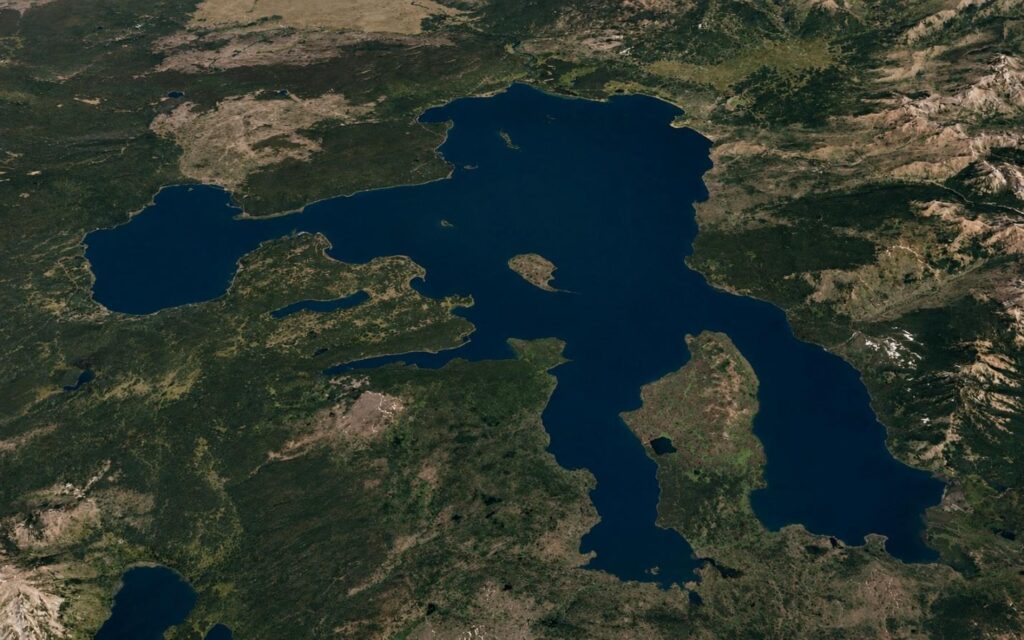
Streams within the park join to become three of America’s most important waterways: the Yellowstone, the Missouri and the Snake rivers. At the heart of the park lies Yellowstone Lake. At an altitude of 7,730 feet with a surface area of 136 square miles and a depth up to 400 feet, the lake is the largest alpine body of water in North America.
Prior to establishment of Yellowstone National Park in 1872, about 40% of park waters were barren of fish because natural waterfalls and watershed divides blocked access following glacial recession. Between 1889 and the mid-1950s, more than 300 million fish were stocked in park waters by fishery managers, including waters that supported native fish, leading to extensive establishment of non-native populations. The extent of adverse effects of non-natives were not initially recognized by park biologists. However, in the decades following these introductions, non-native brook, brown, and rainbow trout had significant detrimental effects on native fish through hybridization, predation, and displacement.
The park’s native fish, particularly the Yellowstone cutthroat trout, are critical to the overall health of the Yellowstone ecosystem. The Yellowstone cutthroat trout are a keystone species which many dozens of park animals rely on as a vital food source, including grizzly and black bears; ospreys and eagles; otters; and more.
After non-native predatory lake trout were first detected in Yellowstone Lake in 1994, the Yellowstone cutthroat trout population began a dramatic decline.
Lake trout were an extremely voracious predator. They simply were eating the young and subadult cutthroat trout.
Since that time, park biologists undertook a monumental effort to remove lake trout from Yellowstone Lake and bring back Yellowstone cutthroat trout from the brink of extirpation.
Outside of Yellowstone National Park, wild Yellowstone cutthroat trout have also been under pressure by invasive rainbow and brook trout introduced in the late 1800s to enhance recreational fishing opportunities. These stockings significantly altered the native fish populations in the Yellowstone River watershed, including Yellowstone cutthroats.
Today the Yellowstone cutthroat trout has experienced a significant reduction in its historical range. Current estimates indicate that only about 43% of their historic range is occupied, which reflects a substantial decline due to factors such as overfishing, habitat destruction, and competition with non-native trout species.
Yellowstone Cutthroat Trout—A Pure Strain Species Under Attack
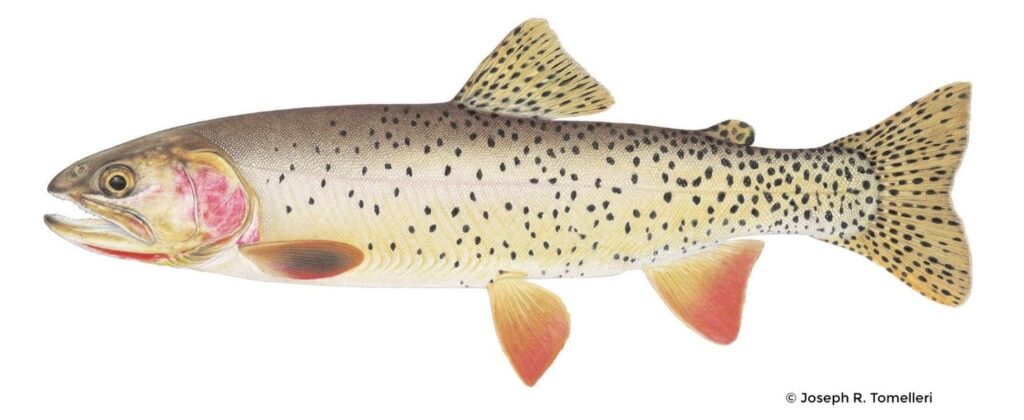
The Yellowstone cutthroat trout (Oncorhynchus clarkii bouvieri) is one of 10 surviving subspecies of cutthroats (Oncorhynchus clarkii) native to the American West. Wyoming hosts four genetically pure strains of native cutthroat trout: Yellowstone, Snake River, Bear Creek and Colorado River species. Yellowstone cutthroats are characterized by a golden brown color with a large spot pattern toward their tail along with the namesake orange-red slash beneath the jaw. Yellowstone cutthroat trout are both adfluvial (lake dwelling) and fluvial (rivers and streams).
Yellowstone cutthroats have been inhabiting Yellowstone Lake since the ice age and without any predators within its natural environment. That is, until lake trout were somehow introduced to Yellowstone Lake, with the first one confirmed in 1994 by an angler who brought the unusual trout to the attention of a park biologist. The original theory that anglers introduced lake trout from Lewis Lake or Jackson Lake has now been replaced by the discovery of lake trout DNA in Pacific Creek, which suggests lake trout may have migrated out of Lewis Lake into Pacific Creek during a high-water period and crossed the continental divide into Atlantic Creek and the upper Yellowstone River watershed which led them into Yellowstone Lake.
Fluvial Yellowstone cutthroat trout were also native to the Yellowstone River watershed which included mountain streams that extended across Wyoming, Montana, Idaho and Utah. With the introduction of rainbow and brook trout in the late 1800s as a result of popular stocking programs, these pure strain Yellowstone cutthroat populations became pressured by both predation and competition for food sources.
To arrest the decline in Yellowstone cutthroat adfluvial and fluvial populations across Yellowstone Lake and Wyoming’s native historical range, two strategic native fish conservation initiatives were launched: the 2010 Yellowstone National Park Native Fish Conservation Program and the 2006 Western Native Trout Initiative which is a public-private habitat partnership involving 12 western states. This initiative aims to conserve and enhance 21 native trout and char species across these regions.
Native Fish Conservation Program Introduced
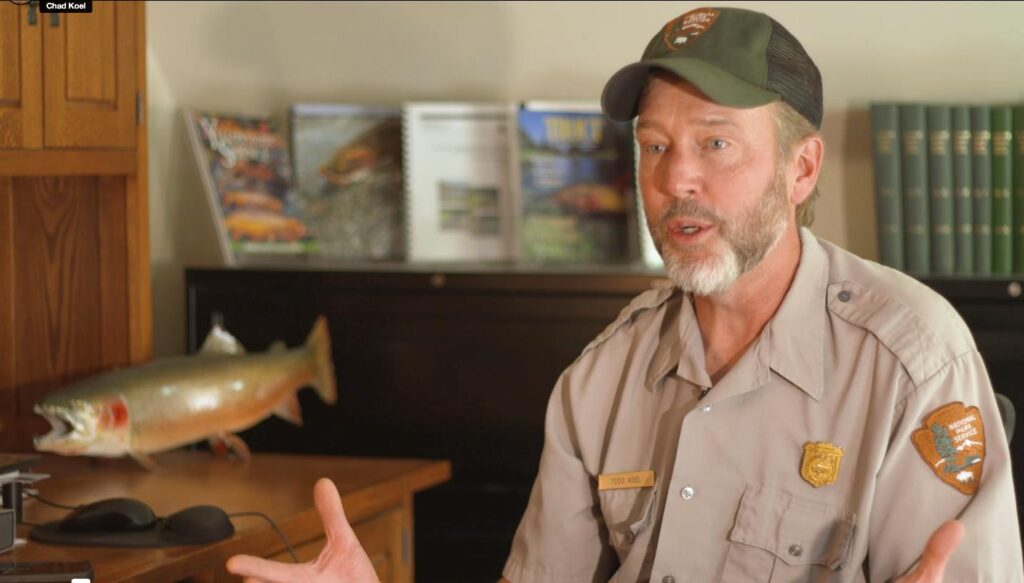
“Since Yellowstone National Park is a pristine ecosystem, we were able to document the impact of one species such as the Yellowstone cutthroat across a large ecosystem,” said Dr. Todd Koel, Yellowstone National Park Native Fish Conservation Program Leader.
Yellowstone’s Native Fish Conservation Program was established in 2010 and features three primary interconnected goals: 1) reverse population declines and restore the ecological role of native fish species like the Yellowstone cutthroat trout; 2) Reduce long-term extinction risks from non-native species and disease; and 3) maintain sustainable angling opportunities for visitors.
Park biologists found that the severe decline in the Yellowstone cutthroat population resulted in grizzly bears switching to elk calves as a springtime food source, eating a couple of them per week. Eagles switched from Yellowstone cutthroats to eating young cormorants and pelicans out of their nests and dive bombing swan cygnets on Yellowstone Lake. The lack of their usual food source caused a decline in nesting activity by ospreys along Yellowstone Lake.
Most predators can’t catch lake trout as a substitute for the cutthroat because lake trout live in deep water and are quite large—ranging from five to 40 pounds. Because of their size, lake trout have no natural predators in the park’s ecosystem, and can potentially live to their 30s and 40s in Yellowstone Lake if they are not removed by netting. By comparison, the life span of cutthroat is typically 10-12 years.
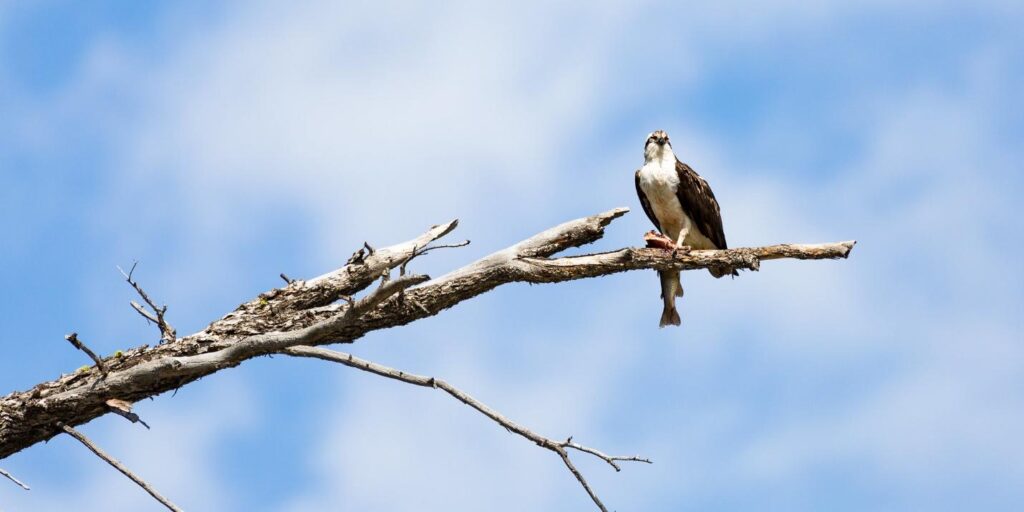
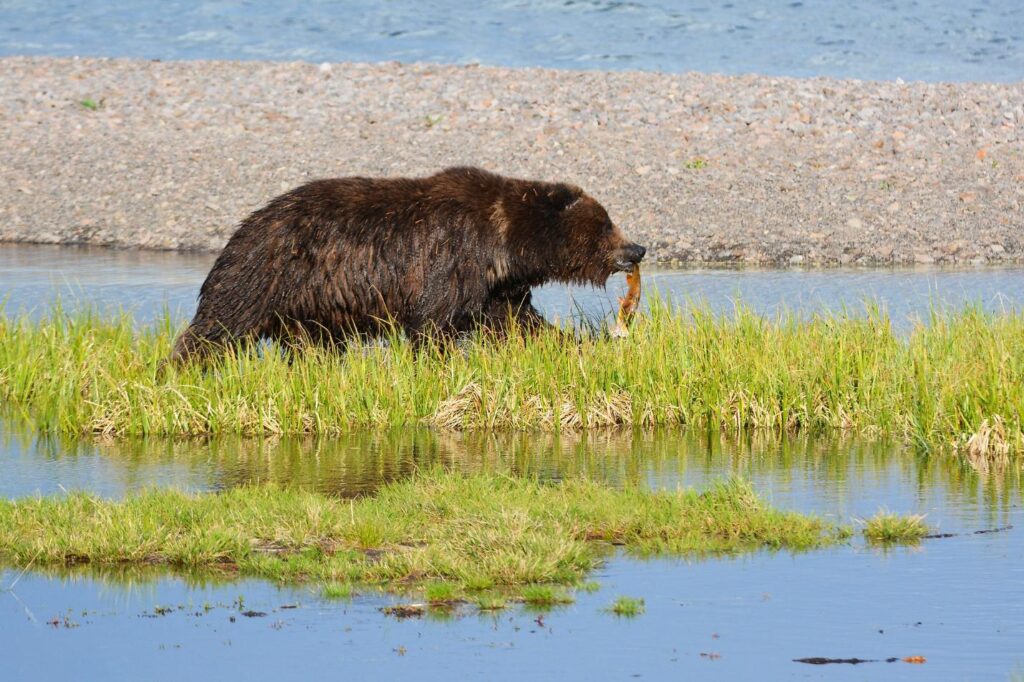
Through utilizing the best available science and a multi-faceted approach, Yellowstone’s Native Fish Conservation Program was established to face this ecological crisis head on in an effort to restore balance to the park’s complex and dynamic ecosystem. According to Koel, “Our goal is as bold as it is difficult: restore the ecological role of Yellowstone’s native fish species.”
An expert panel suggested gillnetting would be the most effective method to remove lake trout to protect native Yellowstone cutthroat trout, although it would require a long-term, possibly perpetual commitment. The National Park Service agreed, and the lake trout control program was started.
Combatting Invasive Lake Trout
The primary activity of Yellowstone’s Native Fish Program is removal of the invasive lake trout from Yellowstone Lake. It’s astounding what harm a single invasive species can have on the Yellowstone ecosystem. Lake trout are predatory, and one mature lake trout can eat approximately 41 native cutthroat trout per year!
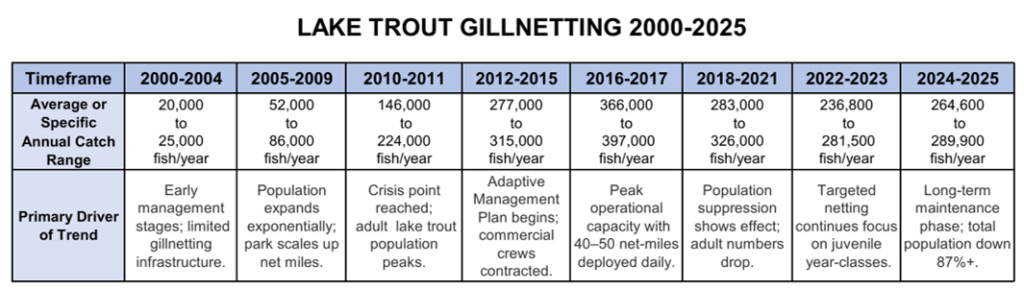
The lake trout suppression program on Yellowstone Lake is one of the largest and longest-running non-native fish suppression programs in existence with 289,900 lake trout removed by gillnetting crews in 2025. Over the past 29 years more than 5.1 million lake trout have been gillnetted. Predatory lake trout (age 6 and older) have been reduced by an estimated 92%, from about 53,300 fish in 2012 to 4,000 in 2022.
The Yellowstone Lake gillnetting season typically runs from mid-May—as soon as the winter ice melts—through October.
Six gillnetting vessels are used to target invasive lake trout. Three boats are operated by an out-of-state Great Lakes commercial fishing contracted crew and three boats are managed by National Park Service biologists and technicians, requiring a total of 20 to 30 crew members. Crews process roughly 40 miles of net in the water every day, setting and lifting thousands of miles of netting across the lake each season. The gillnetting boats operate six days per week on Yellowstone Lake.
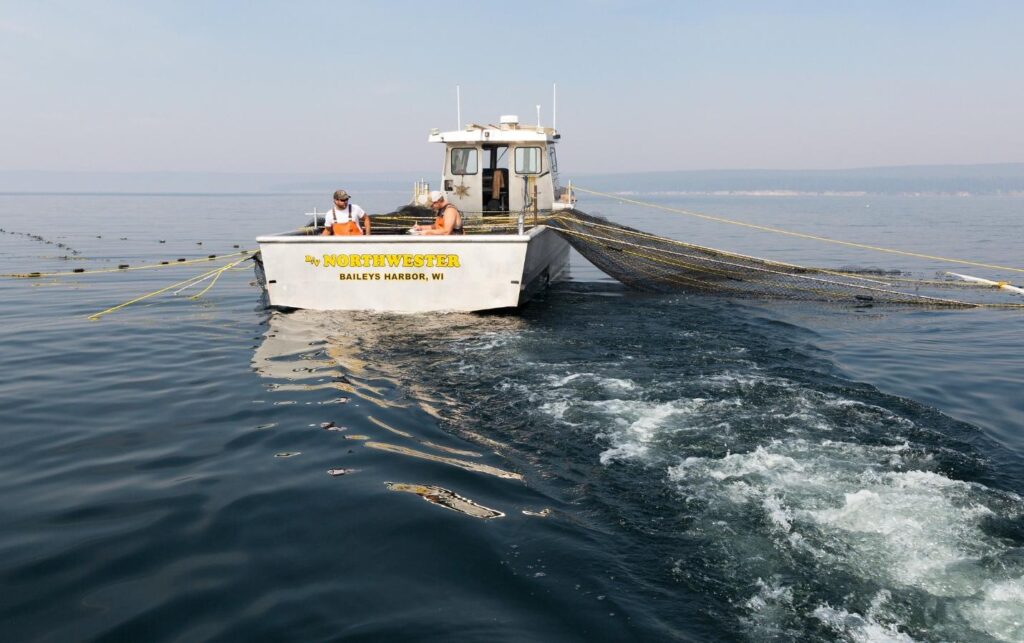
Gill nets are the main tool used for catching and killing lake trout. Panels of net extend upward from the bottom of the lake about six to eight feet high and for many miles. In tandem with gillnetting, park biologists use other effective monitoring and removal methods including telemetry and embryo suppression.
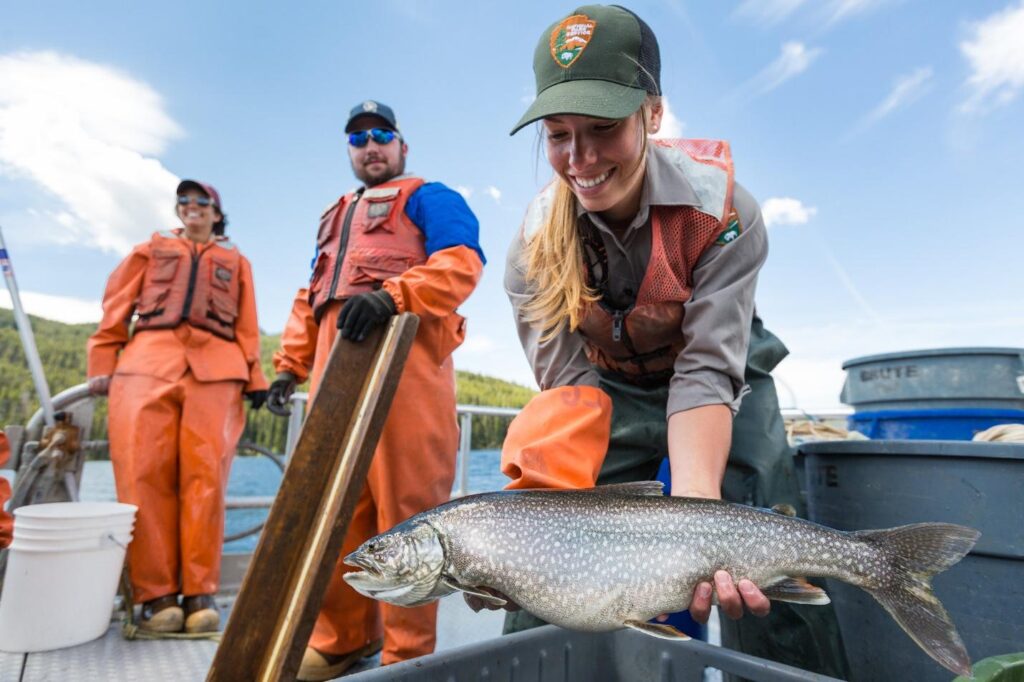
National Park biologists were able to identify lake trout spawning areas among rocky underwater reefs in Yellowstone Lake through telemetry. Acoustic transmitters were implanted in adult lake trout which allowed researchers to track the movements of the fish over time. By analyzing the data collected from the telemetry, biologists were able to pinpoint specific areas where lake trout congregated during spawning seasons.
Armed with this information, biologists began testing various means to suppress invasive lake trout eggs through induced hypoxia (smothering by removing oxygen). Because native Yellowstone cutthroat trout spawn in tributary streams rather than the open lake, these methods selectively eliminate lake trout embryos without harming the native cutthroat population.
Researchers initially used decomposing lake trout carcasses as a means to suppress lake trout embryos. The idea was that depositing decomposing carcasses in lake trout spawning areas would lead to decreased oxygen levels in the water, thereby increasing embryo mortality. Recent advancements have introduced the use of organic analog pellets, which mimic the decomposition process of actual fish. These pellets are designed to suppress lake trout embryos more effectively without the logistical challenges of using real fish carcasses.
The most successful and scalable method involves dropping specially formulated soy and wheat gluten pellets onto spawning beds using helicopters or boats. The pellets dissolve into a sticky, dense film that covers the rocky substrate. As the plant matter rapidly decomposes over two weeks, it strips the surrounding water of dissolved oxygen with dissolved oxygen levels dropping to zero within days, achieving a 100% mortality rate for the embedded lake trout embryos.
The Successful Return of Yellowstone Cutthroat
During 2012-2025, a period of intensive lake trout suppression and population decline, cutthroat trout catch-per-unit-effort substantially improved to pre-lake trout levels, often meeting the primary conservation benchmarks for the lakewide population as described in the 2010 Native Fish Conservation Plan.
During spring (May–July), cutthroat trout spawn in up to 68 tributaries around Yellowstone Lake, move downstream to spawn in the Yellowstone River below Fishing Bridge, or make long-distance spawning migrations upstream into the remote Thorofare headwaters of the upper Yellowstone River.
Spawning Yellowstone cutthroat trout in the Yellowstone River watershed use clean, loose gravel in shallow, well-oxygenated stream riffles and pool crests with water depths from four to 10 inches. Although some cutthroat trout fry may remain in their natal stream for one to two years, most move into Yellowstone Lake within several months of hatching.
While there are some resident Yellowstone cutthroats in these waters, their smaller adult size—10-12 inches—does not permit them to naturally spawn like the much larger 18-24-inch adults that inhabit Yellowstone Lake.
“Today Yellowstone cutthroat trout are much larger in length and weights than they were prior to the lake trout invasion,” said Koel. “The large adult cutthroat trout now can have weights twice as much as prior to the expansion of the lake trout population. However, the remaining adult lake trout are compensating for our removals by producing greater numbers of offspring. Because lake trout cannot be completely eradicated, population suppression by gillnetting or other methods will always be required.”
Adult spawning Yellowstone cutthroat average 18-24 inches and two to six pounds, with males exhibiting their red spawning coloration while females retain their natural golden brown color.
Females reach adulthood and spawning age at four to five years old, while males mature at three to four years. While adults are capable of spawning multiple times, individuals commonly skip a year or more between spawning runs to recover their energy. On average, about 15% of adult trout die strictly from the physical exhaustion and energetic demands of the migration.
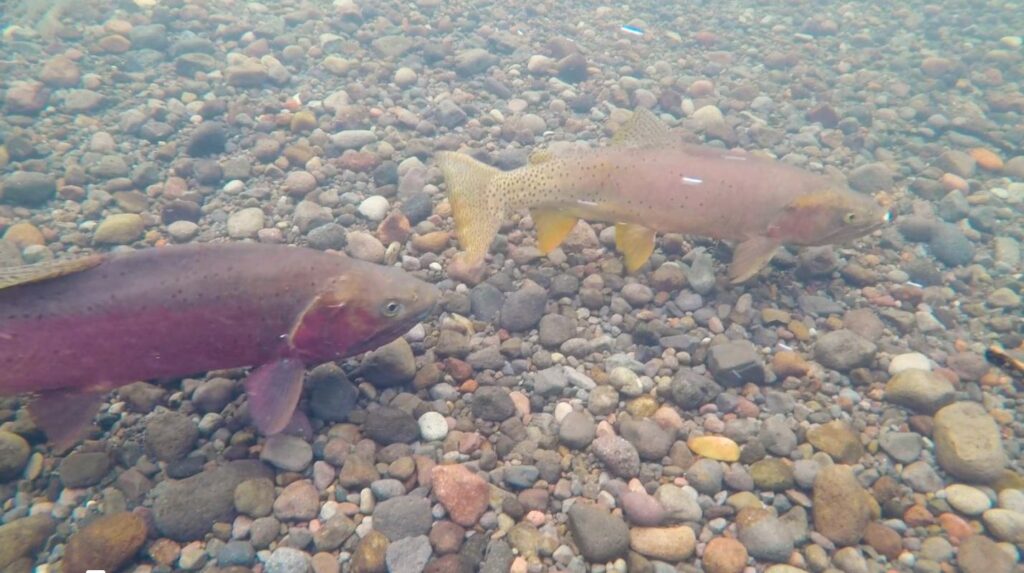
Today, grizzly and black bears have responded to increases in spawning cutthroat trout by returning to some lake tributaries during spring to feed upon them. However, ospreys around Yellowstone Lake have not significantly increased their nesting activity despite some hopes for a rebound in cutthroat trout populations.
As the supervisory fish biologist for Yellowstone National Park, Koel was honored for his 25 years of groundbreaking work protecting and restoring native fish populations, particularly the Yellowstone cutthroat trout by being named the 2025 Simms/Fly Fisherman Magazine Conservationist of the Year.
Dave Sweet—Yellowstone Cutthroat Conservation Volunteer Champion
Dave Sweet is a renowned Trout Unlimited volunteer and conservationist known for his work in the Greater Yellowstone Ecosystem.
“My first trip to Yellowstone was in the mid-1970s and it was kind of a fly fishing Mecca,” said Sweet. “At that time, we caught Yellowstone cutthroat trout by the dozens. I mean, it was unbelievable, the number of fish. If someone had said that fish one day was going to be on the brink of being an endangered species, I wouldn’t have believed it. In the beginning, there was a small handful of us who decided that we were going to try and do something about it, and we had to actually go out and recruit others.”
“We established the Save the Yellowstone Cutthroat Committee. Originally, it was just a group of Trout Unlimited folks, but it grew to include lots of other individuals, lots of other organizations who believed in trying to save this fish. And we tried to bring those folks together with a common mission to bring back this population of native fish.”
In 2007, Sweet’s daughter Diana Miller—a Wyoming Game and Fish fisheries biologist—introduced him to Dr. Todd Koel who was leading the National Park Service lake trout suppression efforts. Sweet volunteered to help support the gillnetting effort by formally leading the “Save the Yellowstone Cutthroat” project which is responsible for fundraising a million dollars a year to support ongoing gillnetting operations in conjunction with Yellowstone Forever (formerly the Yellowstone Park Foundation). He continues to work alongside park officials while serving as the Yellowstone Lake Special Project Manager for Trout Unlimited; a role he has supported for nearly two decades.
“My original role through Trout Unlimited was to raise funds—just over $1 million—for the telemetry study that started the important project to learn where and when lake trout move in Yellowstone Lake,” said Sweet. “That was over 10 years ago. Since then, I have been involved in raising funds to help with the rebuilding of the Clear Creek weir which will hopefully be completed in 2027 so we can restart ongoing monitoring of the annual spring spawning run.”
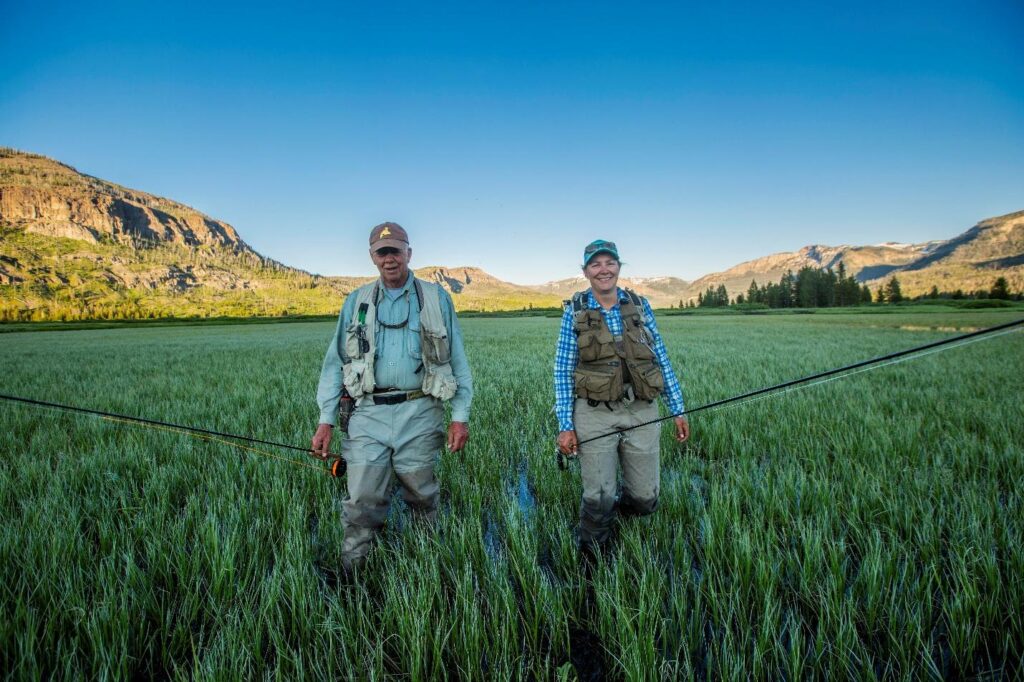
Sweet made a trip with his daughter to the Thorofare in 2017 to see if the Yellowstone cutthroats had returned in substantial numbers. Sweet’s exploratory journey and conservation work, particularly his efforts to protect spawning grounds in the Thorofare region, was featured in the 2018 film “The Return.” (The 13-minute short film can be viewed on Hulu and Vimeo).
Sweet has been a member of Trout Unlimited for nearly 40 years and received the prestigious Trout Unlimited Distinguished Service Award in 2011 and the Aldo Starker Leopold Wild Trout Award in 2017 for his efforts in native Yellowstone cutthroat trout restoration.
The Return of the Yellowstone Cutthroat
The latest data from the National Park Service and its philanthropic partner, Yellowstone Forever, confirms that Yellowstone cutthroat trout populations have rebounded to pre-lake trout invasion numbers, marking one of the most successful large-scale aquatic recovery efforts in U.S. history.
The key recovery metrics and ecological indicators reveal a dramatic shift in the lake’s ecosystem.
Invasive Predator Population Collapse: The population of predatory lake trout age six years and older—the primary consumers of native cutthroat—has been slashed by roughly 90% to 92% from its peak in 2011.
Over Five Million Lake Trout Removed: Gillnetting crews removed 264,650 lake trout in 2025, bringing the historical total of invasive fish cleared from Yellowstone Lake to over 5.1 million.
Yellowstone Cutthroat Spawning Activity Returns: Cutthroat trout are aggressively running up the park’s tributary streams to spawn every spring, a behavior that had completely vanished at the height of the lake trout crisis.
Watershed Success Stories: In the Yellowstone watershed, genetically pure Yellowstone cutthroat populations have made a steady comeback, restoring streams like Soda Butte Creek to historical baselines after targeted removal of competing non-native brook trout.
Trophic Cascade and Wildlife Rebound: Because cutthroat trout spawn in shallow streams (unlike deep-water lake trout), their recovery has triggered a massive nutritional boom for predators during their breeding and nesting seasons. Grizzly and black bears have returned in high numbers to Yellowstone Lake tributaries to hunt spawning cutthroat during the spring. However, while avian predators like bald eagles have successfully returned to nest and hunt around Yellowstone Lake due to the abundance of surface-swimming cutthroat trout, osprey nesting has not returned to historical activity.
Protecting Yellowstone Cutthroat Throughout Their Historic Range
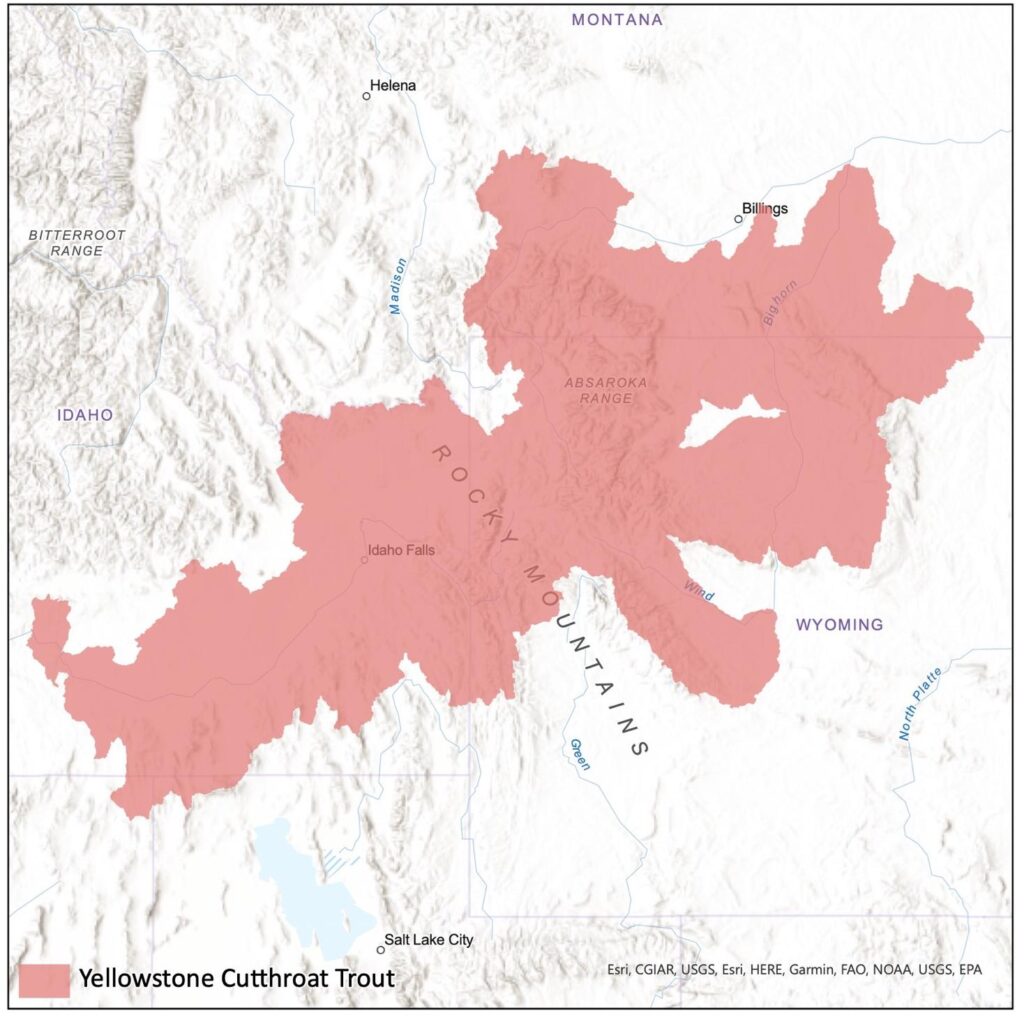
The Native Fish Conservation Program includes the protection of Yellowstone cutthroat throughout their historic range which includes the upper Yellowstone watershed in addition to Yellowstone Lake cutthroats. Yellowstone cutthroats occupy waters in Wyoming, Idaho, Montana, Utah and Nevada and are native to Yellowstone and Snake River watersheds which cross the Continental Divide.
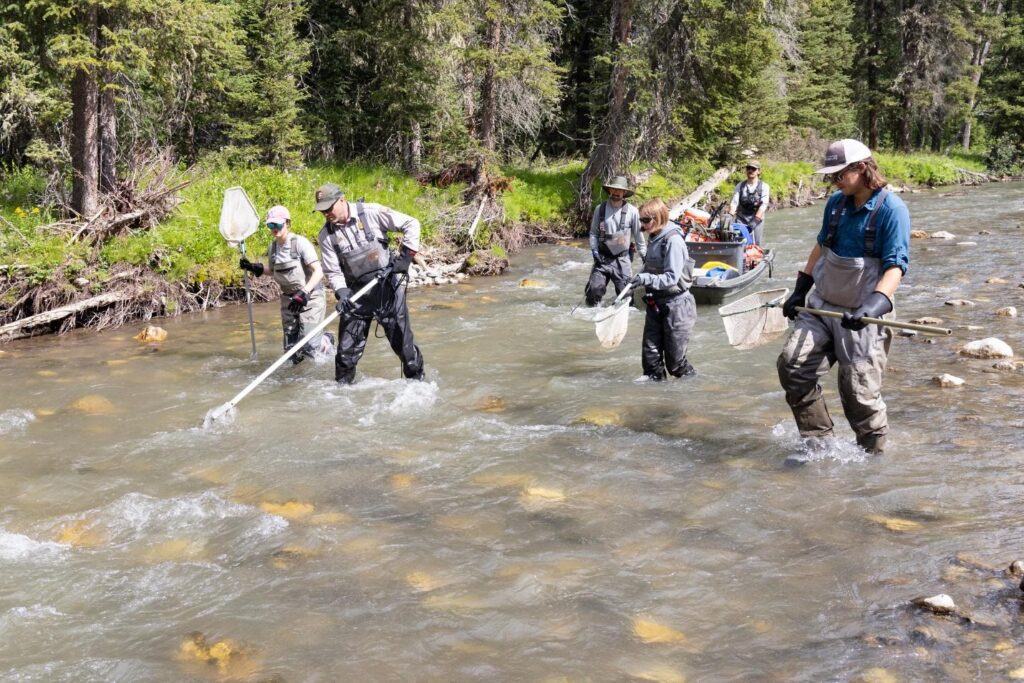
Outside of Yellowstone Park, Jason Burckhardt is responsible for managing the watersheds on the western side of the Bighorn River Basin and Yellowstone River Basin. He has spent 24 years as a Wyoming Game and Fish fisheries biologist.
“My primary focus is to restore native fish communities, specifically the Yellowstone cutthroat trout, by eliminating threats to their genetic integrity, habitat, and populations,” said Burckhardt. “This aligns with the National Park Service’s mission to preserve native species and the natural processes that sustain them.”
“Removing brook trout and rainbow trout from the Yellowstone River basin involves a combination of methods, including the construction of fish barriers to prevent migration; roténone treatment (a naturally derived chemical) to eliminate non-native fish from entire drainages; selective electrofishing to stun and remove fish; and angler-based harvest through “must-kill” regulations. These efforts focus on protecting the genetically pure Yellowstone cutthroat trout from hybridization and predation by non-native species.”
Funding the Yellowstone Cutthroat Restoration Is Ongoing
Yellowstone National Park funds its two-to-three million-dollar annual invasive lake trout gillnetting expense through a combination of federal National Park Service appropriations, park fee revenues, and matched private donations from its philanthropic partner—Yellowstone Forever—which raises the vast majority of the non-governmental funding for the lake trout suppression initiative. Its mission is to protect, preserve, and enhance the park through philanthropy and education. Yellowstone Forever raises funds for critical park projects, including wildlife research (like wolf and bison monitoring), cutthroat trout restoration, trail maintenance, and visitor safety. Donations can be made specifically to support the Yellowstone cutthroat restoration program.
“The recovery of Yellowstone cutthroat trout is extraordinarily important, not only for the future of this iconic native fish, but for the health of the entire Yellowstone ecosystem,” says Lisa Diekmann, President and CEO of Yellowstone Forever.
“Restoring a healthy cutthroat population helps restore an ecological relationship that developed over thousands of years. For that reason, the Native Fish Conservation Program remains an important, long-term conservation priority for Yellowstone National Park and Yellowstone Forever.”
Yellowstone Forever’s financial support of the Native Fish Conservation Program has averaged over one million dollars over the past 10 years.
Visit the Yellowstone Forever website to learn more about donation opportunities.
The Thorofare—Historical Spawning Ground for Yellowstone Cutthroats
To locate spawning Yellowstone cutthroats, a person has a choice of hiking or horseback to reach the Thorofare—the most remote wilderness area in the lower 48 states and located near the southeastern boundary of Yellowstone National Park. It was named by 19th-century fur trappers for its historic role as a well-known travel route. The name reflects its function as a main “thoroughfare,” or passage, for trappers moving through the area to get to the Two Ocean Plateau, a lush meadow area abundant with game.
The Thorofare region in northwestern Wyoming is a broad mountain valley formed by the Absaroka Mountains—a sub-range of the Rocky Mountains—with an elevation of over 12,000 feet. Located in the Teton Wilderness, it sits at the headwaters of the Yellowstone River. Yellowstone cutthroats will travel approximately 30 miles every spring to spawn in the upper Yellowstone River and two key tributaries: Atlantic Creek and Thorofare Creek—both of which eventually flow into their namesake oceans.
Unlike the granite Tetons to the west, the southern Absarokas are formed of ancient volcanic breccia and basalt, creating steep, sculpted ridges and loose, rugged terrain.
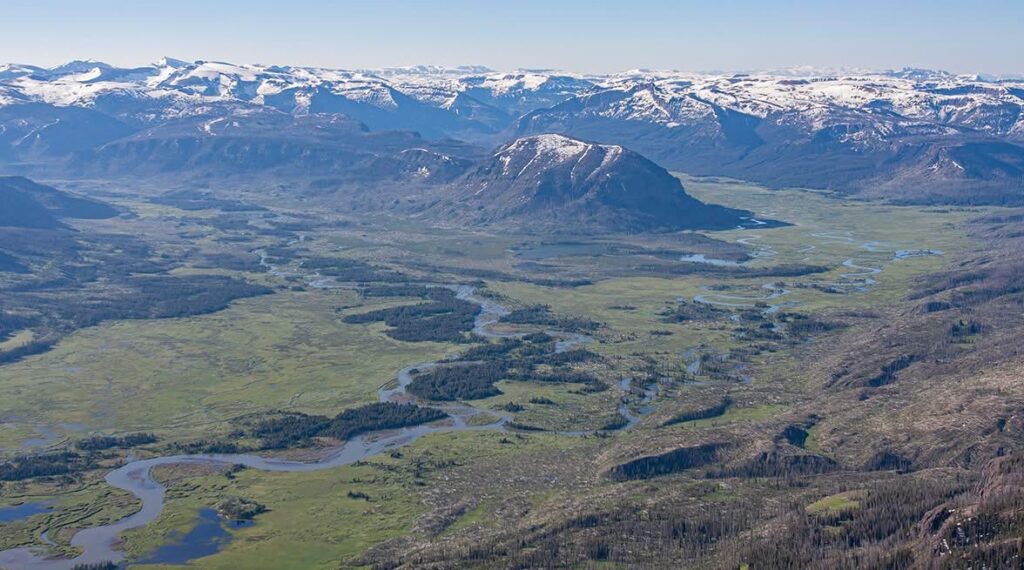
Hawk’s Rest—with an elevation of 9,700 feet—is a famous landmark in the remote Thorofare region, primarily because it marks the geographic epicenter for what is famously considered the most isolated, roadless wilderness in the lower 48 states. Its name is inspired by the historical presence of birds of prey soaring and resting over the upper Yellowstone River valley. Hawks and other raptors such as bald and golden eagles use the high rock formations, trees, and cliffs as natural perches and resting spots as part of an elevated wildlife ecosystem.
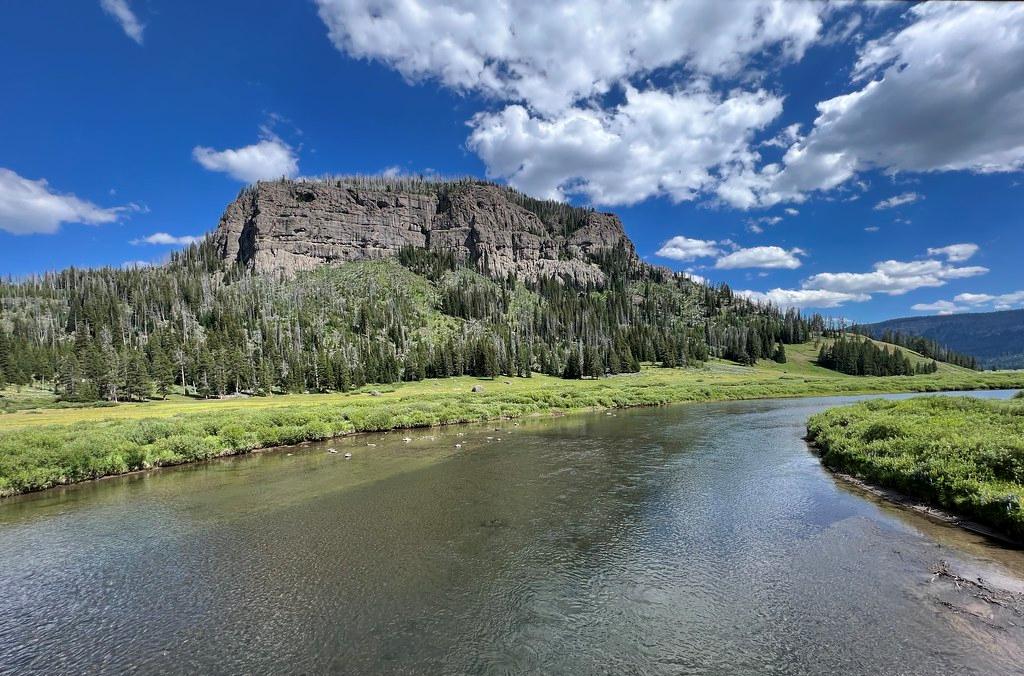
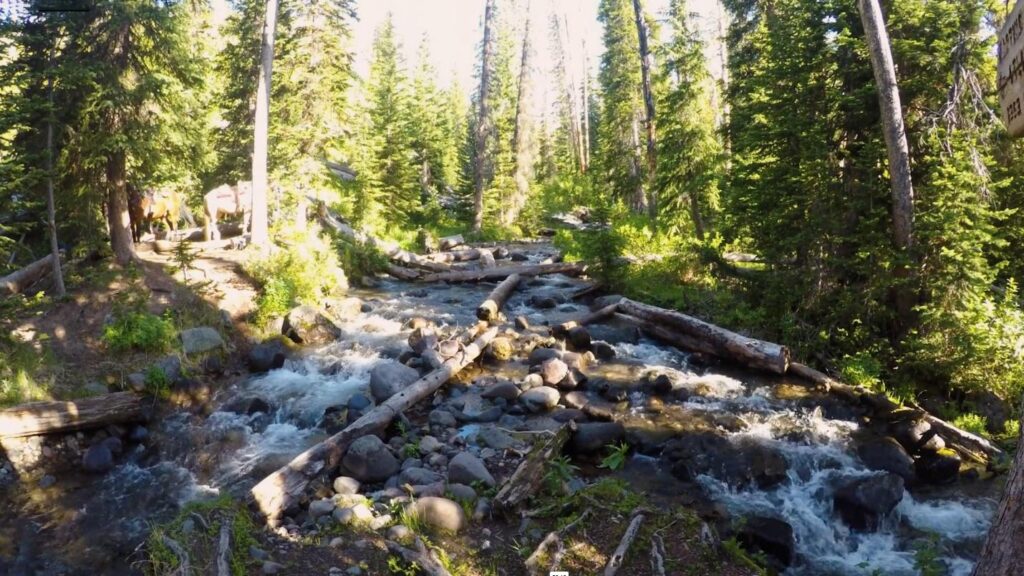
A unique geographic and geological feature of the Thorofare area is Two Oceans Pass—a high mountain meadow atop the Continental Divide—where Two Ocean Creek marks the headwaters of Atlantic Creek and Pacific Creek which eventually flow into their namesake oceans.
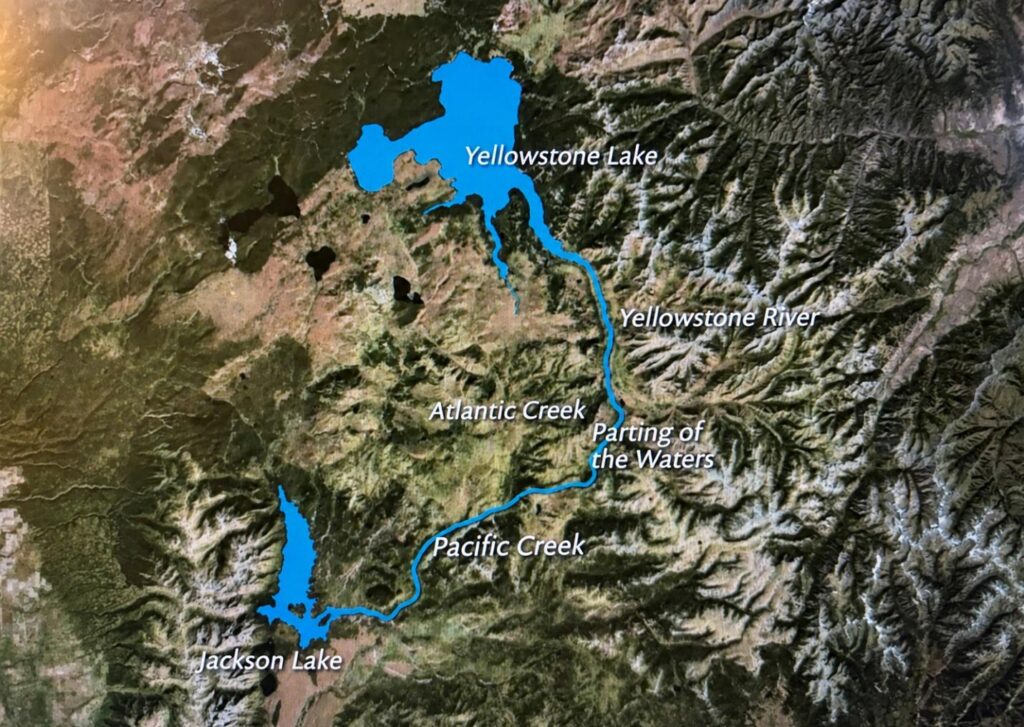
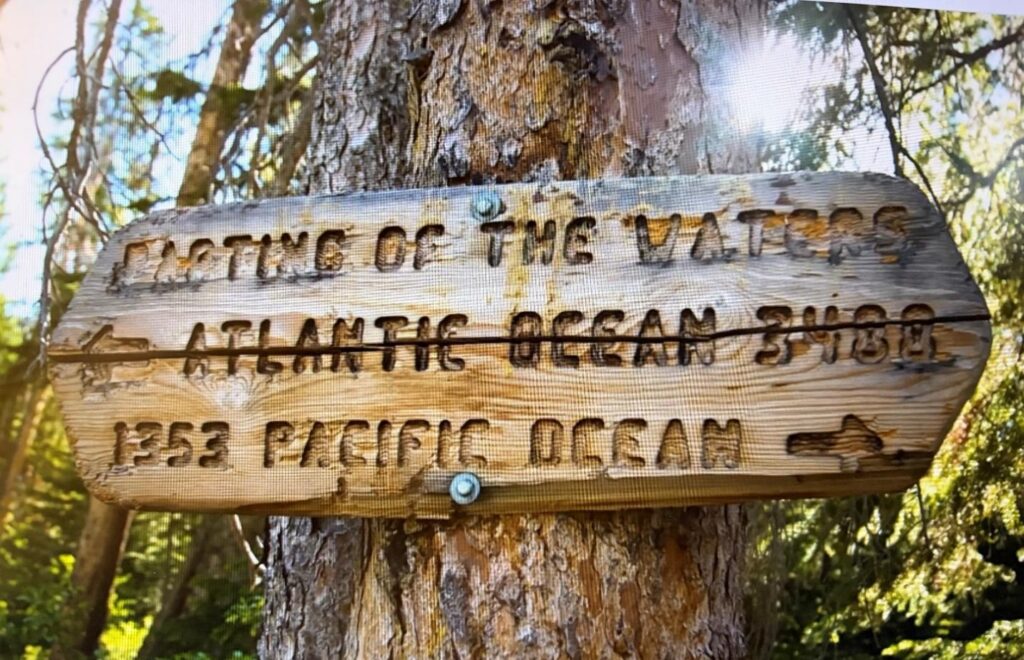
A sign attached to a tree proclaims the location “the parting of the waters” with Atlantic Creek flowing eastward into the Yellowstone River which empties into the Missouri River then Mississippi River before reaching the Gulf of America—a distance of 3,488 miles..
Pacific Creek eventually reaches the Pacific Ocean via the Columbia River after 1,353 miles.
Bearing Witness to a Special Place
I learned about fishing the Thorofare during a Chicago local Trout Unlimited chapter meeting presentation on “Yellowstone’s Hidden Gems” by Michigan fly fishing guide Jay Allen. Allen had spent 20 summers guiding fishing trips out of the Turpin Meadow Ranch in Wyoming’s Bridger-Teton National Forest.
I had fished with Allen on a four-day Teton Wilderness backcountry trip in 2022 to the Buffalo Fork of the Snake River to pursue Snake River fine spotted cutthroats. Getting to our campsite required a three-hour trip on horseback which turned out to be an incredible experience thanks to the wrangler couple who made our horseback experience a comfortable one. (Wrangler Duo Key to Wyoming Wilderness Adventure)
The Thorofare adventure would be different in three ways. The horseback journey would be longer—eight hours in the saddle. Our quarry would be migrating Yellowstone cutthroats during their annual spring 30-mile spawning run out of Yellowstone Lake. And we would be intruding on prime grizzly bear territory within the Yellowstone Park ecosystem.
We departed from the Yellowstone Outfitters trailhead in June and were blessed with excellent weather that day and during our five-day trip with temperatures ranging from highs in the 70s during the day and upper 30s at night. At an elevation of 8,200 feet, the sun’s daytime rays were more intense in the Absoraka Mountains.
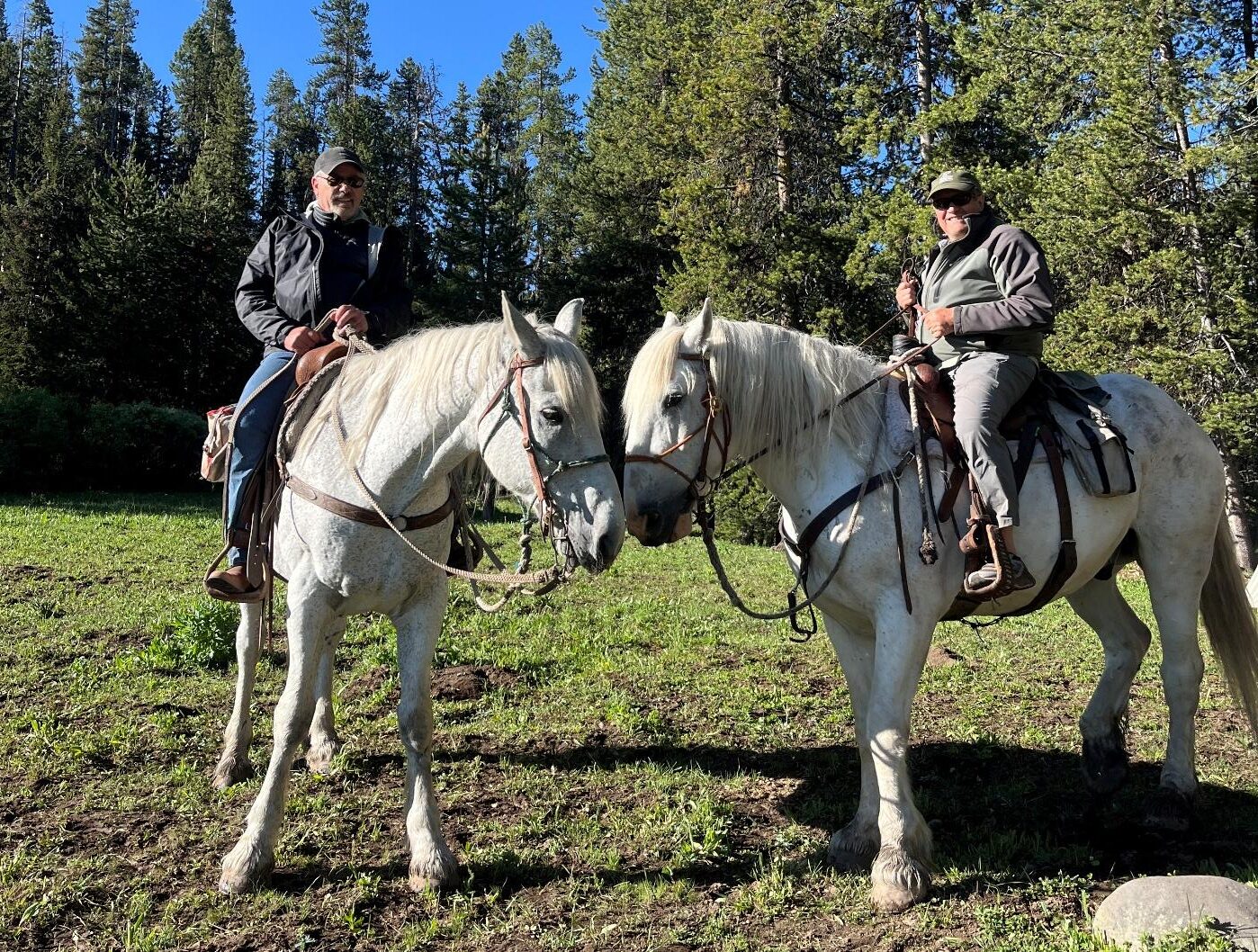
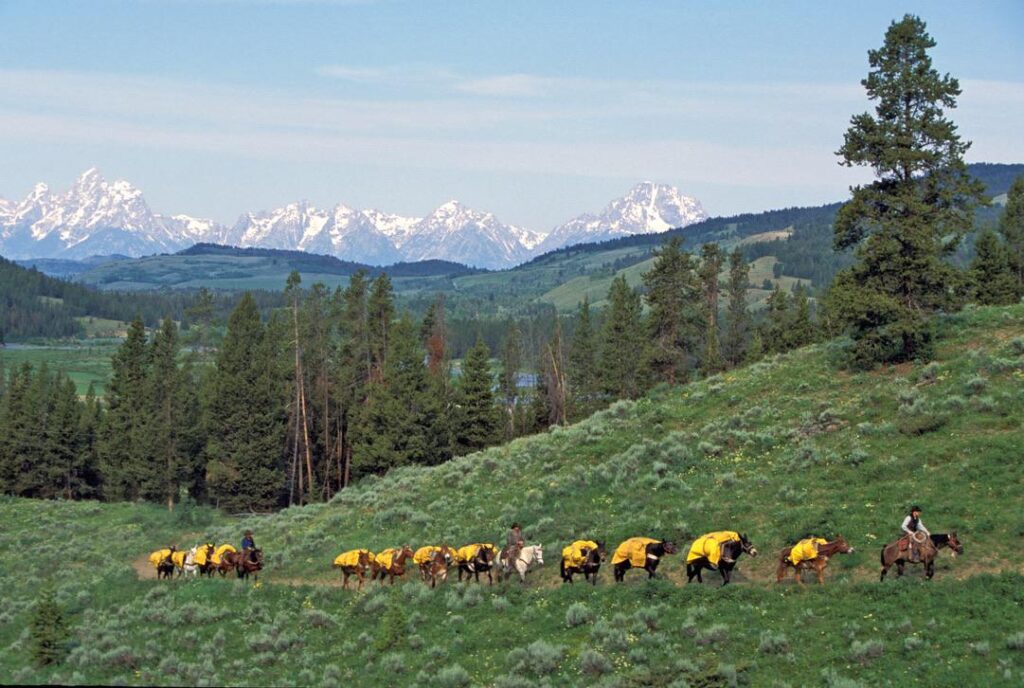
My horse was a large draft horse and smaller cousin of the famous Clydesdales. Trail horses are amazing animals—four-legged ATVs—that can traverse steep inclines; narrow switchbacks; rocky, sandy or muddy trails; and freestone streams and creeks.
My previous three-hour horseback trip was not an uncomfortable experience based on riding a properly sized horse with a correct stirrup adjustment for my height and weight. For the eight-hour Thorofare journey, the trip featured breaks after every two hours—which included lunch—to dismount and stretch.
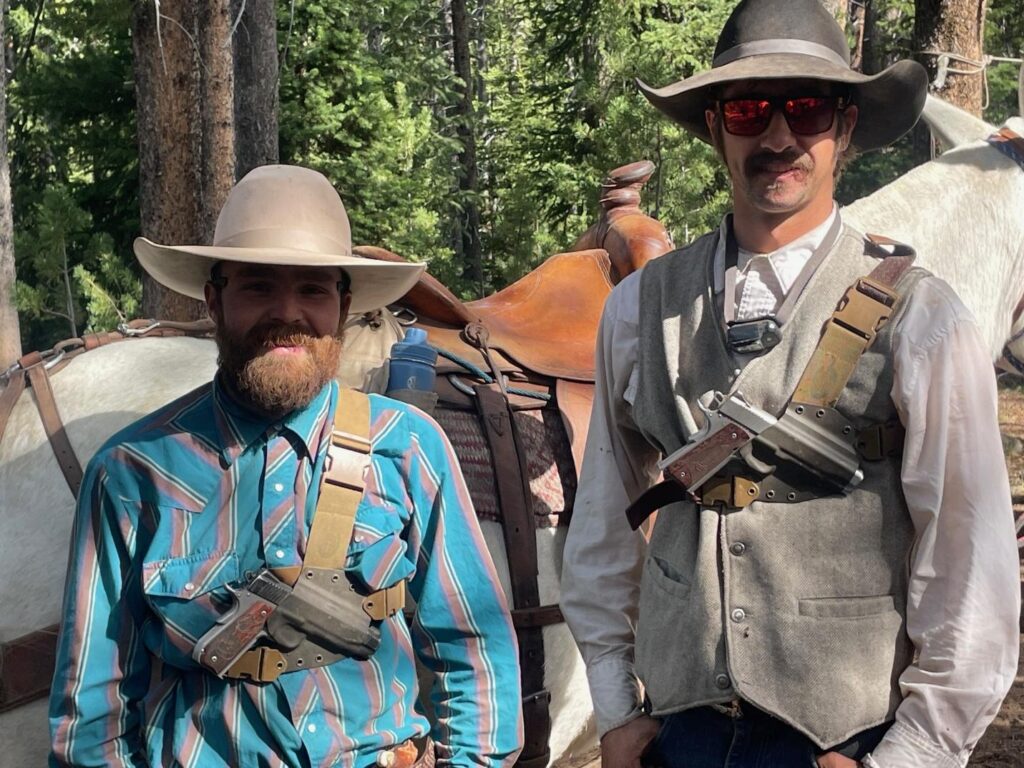
Our group consisted of two wranglers who would also serve as fishing guides and a cook who was married to one of the wranglers. The anglers—besides myself—were longtime fishing buddy Lou Perlaky and a married couple—Scott and Terra Butler from Cody, Wyoming. When I saw our two wranglers packing 10mm revolvers from sun up to sun down, I decided not to bother carrying the recommended bear spray around the campsite or while fishing.
Our 26-mile, eight-hour horseback ride began at the Yellowstone Outfitters Turpin Meadow trailhead where we connected with the North Buffalo Fork Trail. This trail followed the river for over three hours deep into the Teton wilderness and was familiar as it was the same trail we took on a previous backcountry camping trip to fish for Snake River fine-spotted cutthroat in the Buffalo Fork. We then connected with the Soda Fork Trail deep in the Teton Wilderness, which passed through a large wetland ecosystem with lots of creek and stream crossings.
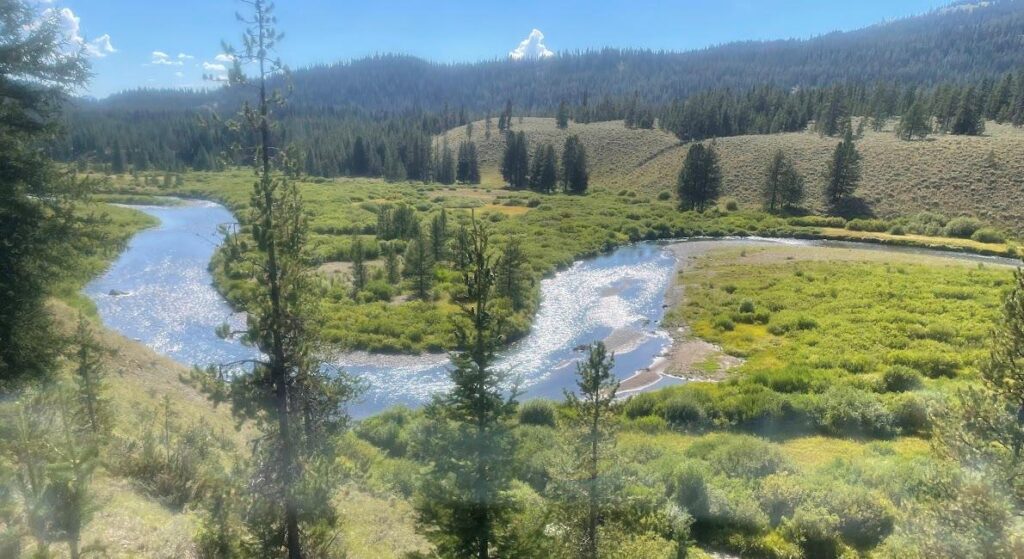
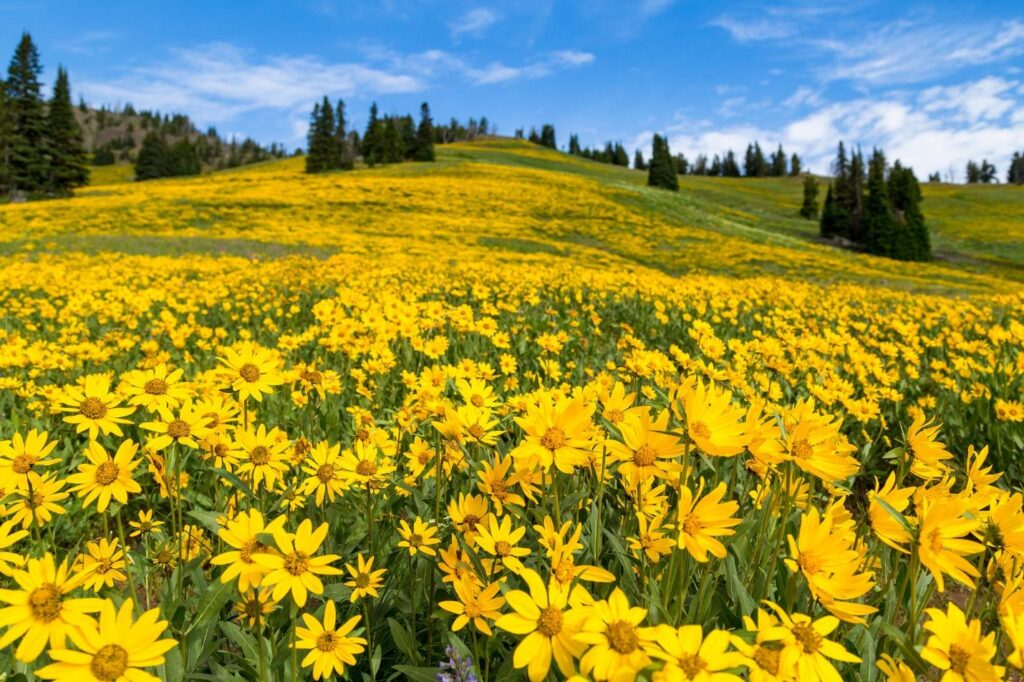
A late May warming trend had accelerated the Absoraka Mountains snowmelt which resulted in a plethora of spring flowers in yellows, pinks, blues and reds which added to the scenic beauty of our day-long trek.
Besides blankets of flowers, the mountainsides and meadows were lush with green trees and grasses as a result of the spring snowmelt. As the sun rose, we discarded our jackets as the morning temperature warmed from the upper 40s to the 70s by our noon lunch break.
After our lunch break, we literally crossed paths with the only grizzly encountered during our trip as it scampered across the trail ahead of our lead wrangler and pack horses.
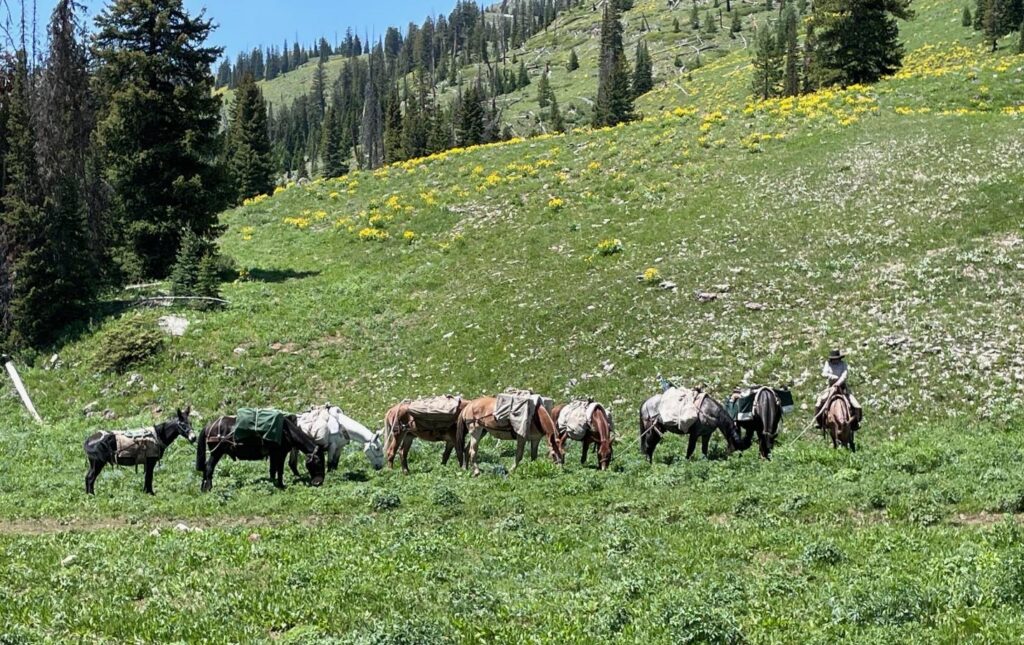
Our horses relished chances to drink from creeks we crossed and munch on grasses and flowers when we took our breaks to dismount and stretch.
The North Buffalo Fork Trail winds through the deep, remote valleys of the Teton Wilderness, offering stunning views of wide river meadows, mountain ranges, and dense pine forests.
It eventually intersects the Atlantic Creek Trail which climbs past Two Ocean Pass into the Thorofare region and Yellowstone Meadows.
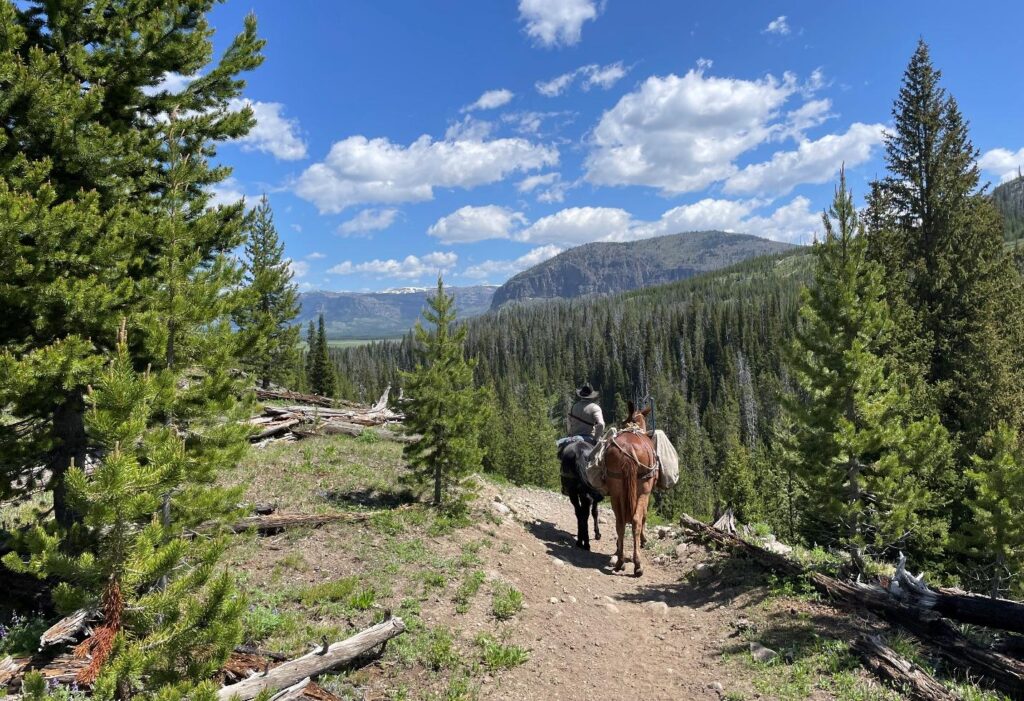
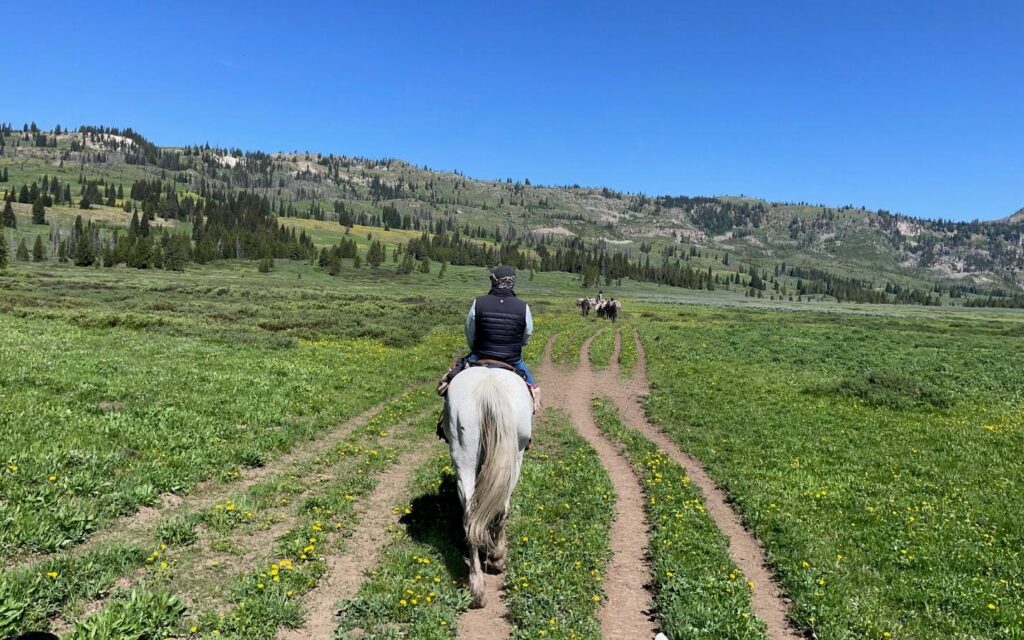
After tight-walking narrow trails on a steep ridge overlooking the North Buffalo Fork and through heavily forested mountain sides, the trail opened up into an expansive miles-wide Thorofare meadow. The trail transitioned into a five-lane “super highway” giving horses and mules multiple parallel routes as we headed towards Atlantic Creek and the landmark Hawk’s Rest promontory.
We arrived at our campsite—which had already been set up—on Atlantic Creek after our all-day horseback ride ready for a cold beer and dinner around a campfire after unpacking our gear and personal duffel bags.
Sleep came easy, although we wished our sleeping bags were resting on a cot instead of a two-inch foam pad on the ground. However, with morning came chilly temperatures in the upper 30s which required a coat for breakfast around the campfire until the sun rose above the mountains and warmed things up. Within a couple of hours, temps were in the 50s as we saddled up for our first day of fishing.
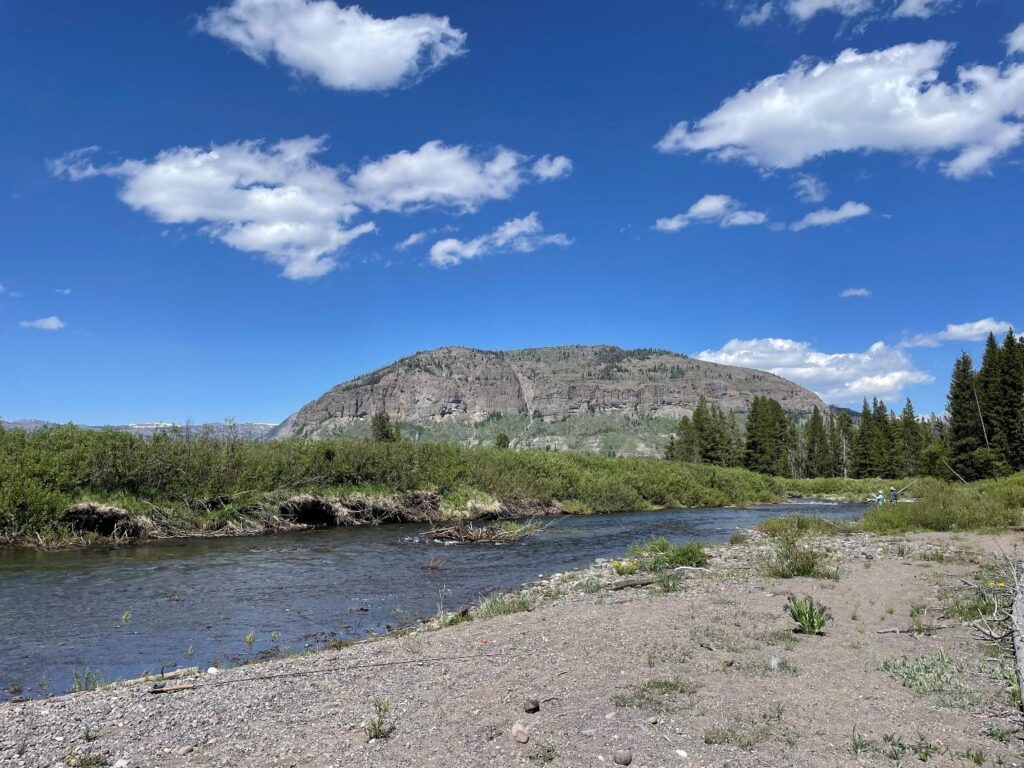
I have caught plenty of Westslope cutthroats over the years in Idaho, Montana and Wyoming along with Snake River fine spotted cutthroats on the Buffalo Fork of the Snake River in this same Teton Wilderness area. However, on this trip I was pursuing my first genetically pure strain of Yellowstone cutthroat and personal proof they were successfully returning to their historical spawning gravel.
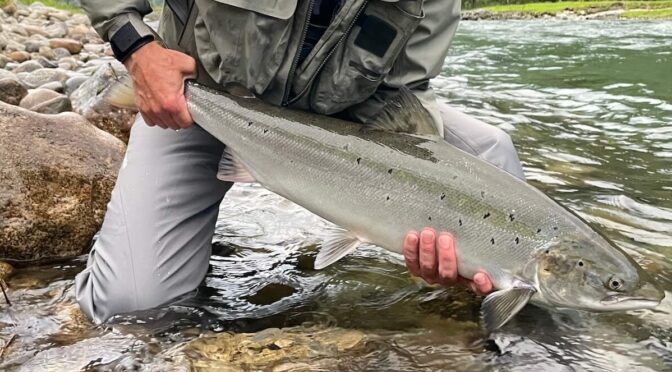
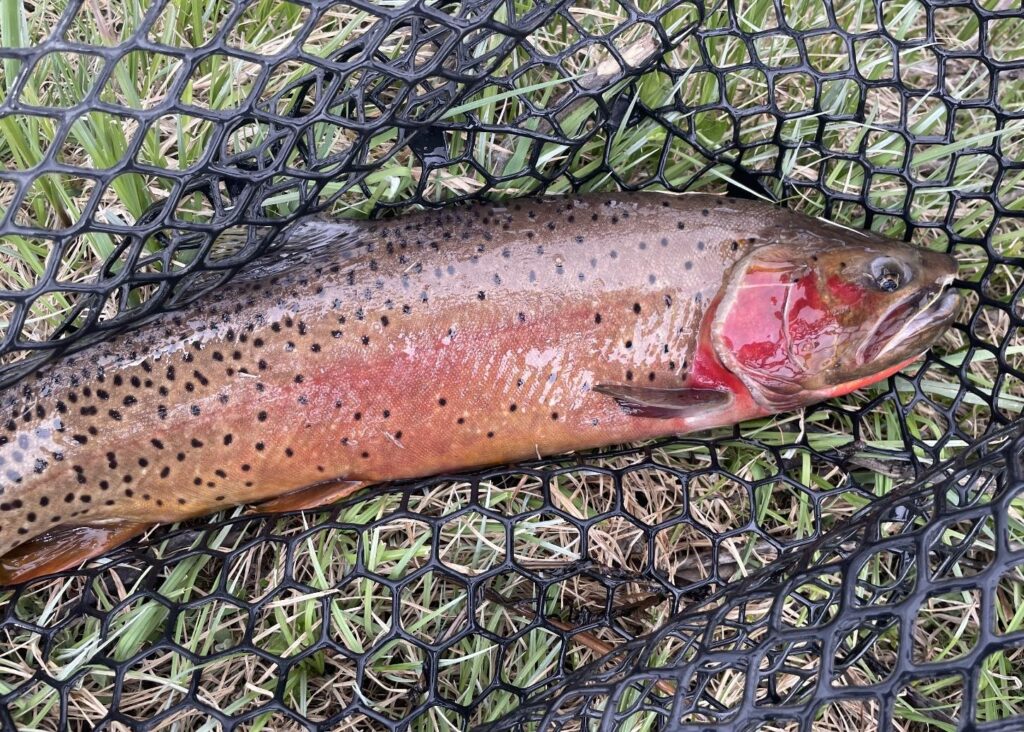
On the morning of our first of three days of fishing, we mounted our horses for a 30-minute ride to fish a small creek which intersected with Atlantic Creek. We found two groups of Yellowstone cutthroats finning in crystal clear water after a hike through dense willows. I successfully landed my first Yellowstone cutthroat—a large 22-inch male displaying crimson spawning colors—using an egg pattern on my 5wt fly fishing outfit.
However, after my hook-up, the pods scattered. After lunch we began scouting for spawning cutts in a different creek in what could best be described as a dense willow marsh which made hiking in waders exhausting on a warm, sunny day. We wasted the afternoon looking for this feeder creek and never came across another fish.
For the next two days, we fished Atlantic Creek which was running somewhat high in some sections. And while we found Yellowstone cutthroats, they were often frustratingly out of reach because of either high-water banks that did not permit safe wading or dense willows.
Where we did find accessible stream beds and spawning trout, we were able to land some fish. However, in one stretch with a dozen trout, we couldn’t get a hook-up despite trying egg flies, nymphs and streamers. They seemed focused entirely on something else.
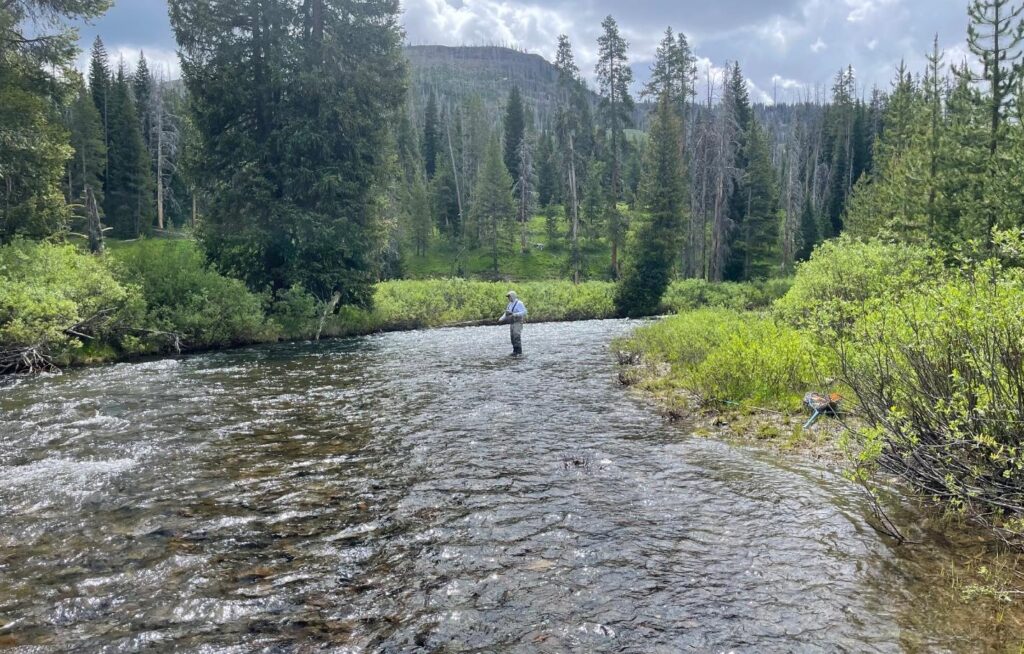
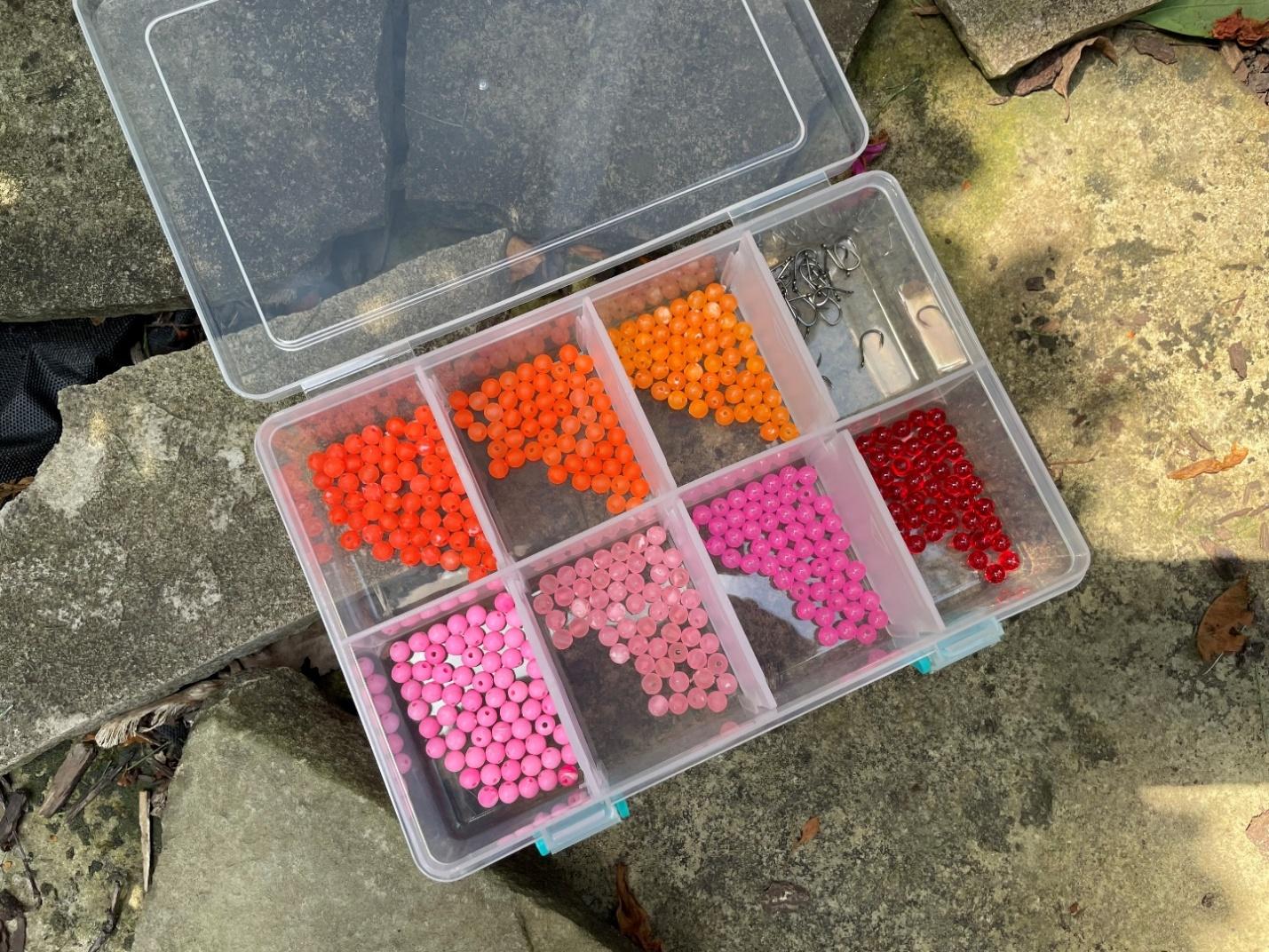
Terra, on the other hand, had better luck, fishing with the other wrangler at different spots from ours. She won honors for most fish, landing 12 Yellowstone cutthroats over the three days using plastic trout egg “beads.”
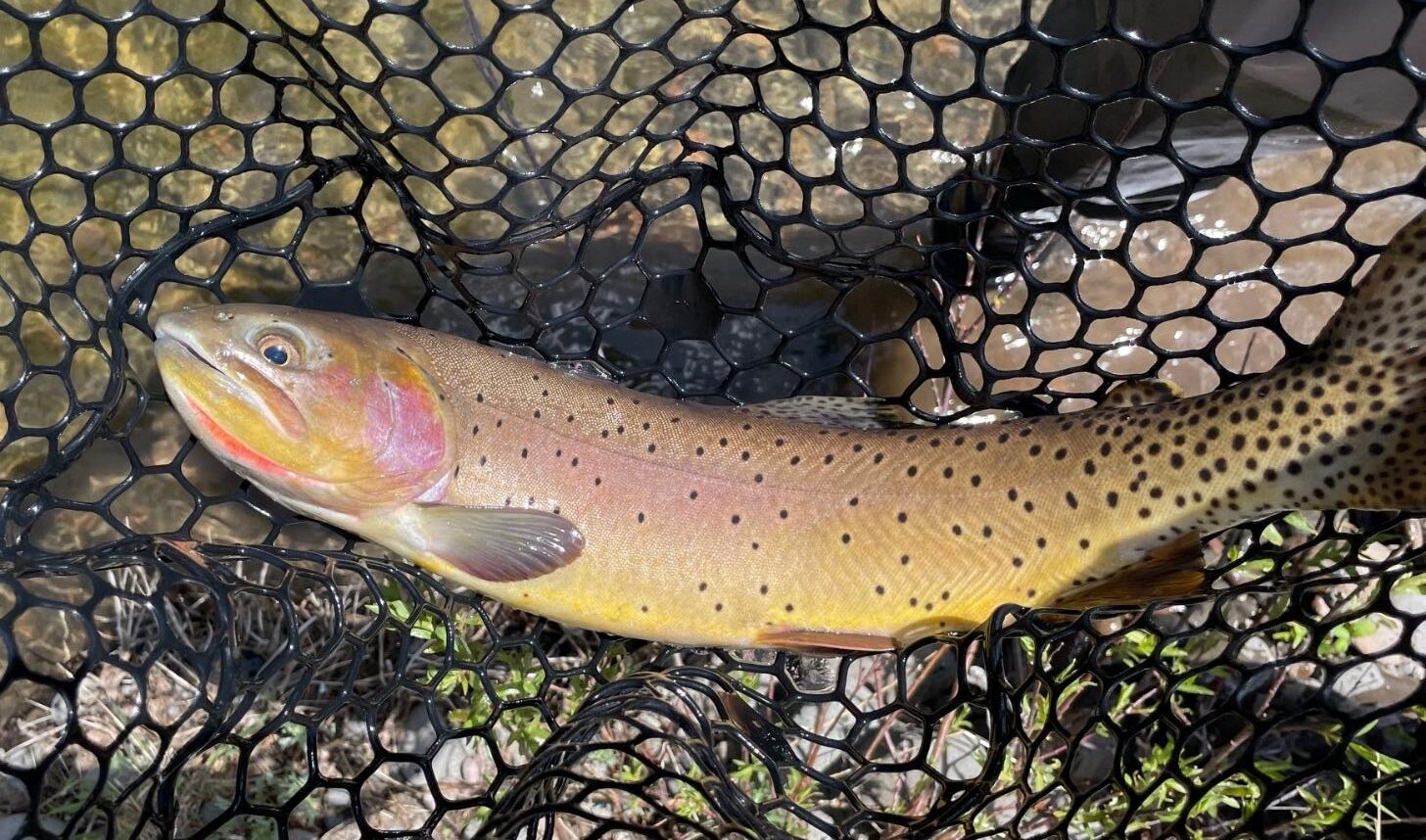
During the spring and early summer spawning season, Yellowstone cutthroats experience hormonal shifts that alter their appearance. Females usually develop richer, more vivid golden or copper tones along their bodies. Their bellies may take on brighter orange and red hues. Males, on the other hand, undergo much more dramatic color shifts, developing fiery, deep red and orange bellies, brilliant gill plates, and highly pronounced color intensity to attract mates. Both genders retain their similar large spot pattern toward their tail and namesake orange-red slash beneath the jaw.
Overall, this was a fantastic once-in-a-lifetime experience, checking off my four “S” criteria for an ideal fly fishing and outdoors adventure: great scenery, wilderness solitude, a new species, and memorable stories based on a unique experience and location history. No matter whether I was traversing steep mountain trails or entering a vast Thorofare grassland meadow, wherever I looked I saw endless country without another human being.
According to Wyoming Game and Fish fisheries biologist Jason Burckhardt, “catching a genetically pure native fish in its native habitat is a pretty cool thing.”
After my Thorofare Yellowstone cutthroat experience, I would certainly agree.
For More Information
Cutthroat: The Race to Save Yellowstone (2024) is a documentary film that chronicles the heroic battle to save the native Yellowstone cutthroat trout from invasive lake trout, an effort critical to preserving the ecological balance of Yellowstone National Park. The one hour and 22-minute film features Yellowstone National Park biologists like Dr. Todd Koel. You can currently watch the documentary for free on Tubi or with a subscription on Amazon Prime Video. If you prefer owning a physical copy, it is also available for purchase as a DVD.
Two outfitters who annually run Thorofare May and June backcountry trips for spawning Yellowstone cutthroat trout are Yellowstone Outfitters and Turpin Meadow Ranch.
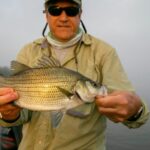
Jim Schmiedeskamp
Retired corporate marketing executive Jim Schmiedeskamp is a member of Chicago’s Oak Brook Trout Unlimited chapter where he was a board director and the Communications and Publicity Chair for 2014-2020. He writes about coldwater conservation initiatives and fly-fishing adventures.